
Credit spreads reflect a favorable outlook, with stable corporate fundamentals, reasonable debt levels and optimistic earnings prospects. I don’t see companies accumulating unnecessary leverage. Most investment grade issuers try to maintain their credit rating.
The returns obtained in the past do not guarantee future returns.
Source: Capital Group, Bloomberg, JPMorgan. Information as of November 30, 2025. Global total: Bloomberg Global Aggregate index. US Investment Grade Corporate Debt: Bloomberg Corporate Investment Grade Index. US High Yield Corporate Debt: Bloomberg US Corporate High Yield 2% Issuer Capped Index; commercial mortgage-backed securities: Bloomberg CMBS Index: Erisa Eligible; asset-backed securities: Bloomberg ABS index; emerging market debt: JP Morgan GBI-EM Global Diversified Index.
Regarding the high yield segment, credit quality has improved, which could keep the default rate below its historical average of 3%. McCann favors higher quality assets, but does not avoid CCC-rated issuers. Some companies face uncertainty over the next three to five years, but their short-term debt levels are affordable. In other cases, some securities are secured by solid assets, so even in the event of a restructuring, investors are protected.
When it comes to emerging market debt, McCann identifies interesting opportunities in Latin American countries such as Mexico, Colombia and Panama, which may offer some protection against the volatility generated by tariffs.
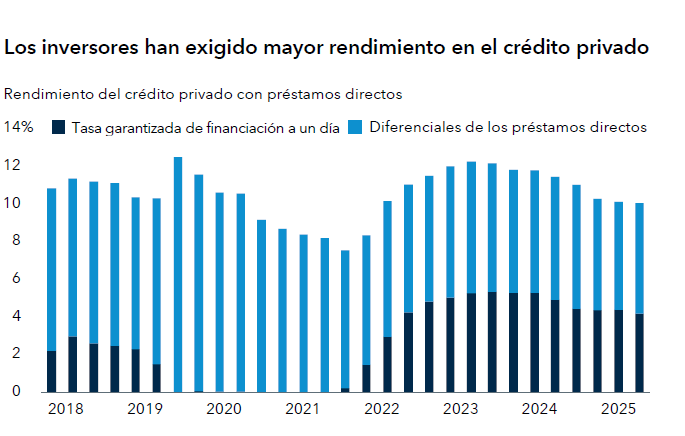
The attractive level of returns offered by the private sector has sparked investor interest, although the sector’s reduced liquidity and less transparency require an additional level of analysis and careful selection of managers.
Source: Bloomberg. Data based on net issuance by sector of North American investment grade credit. Information as of October 31, 2025.