
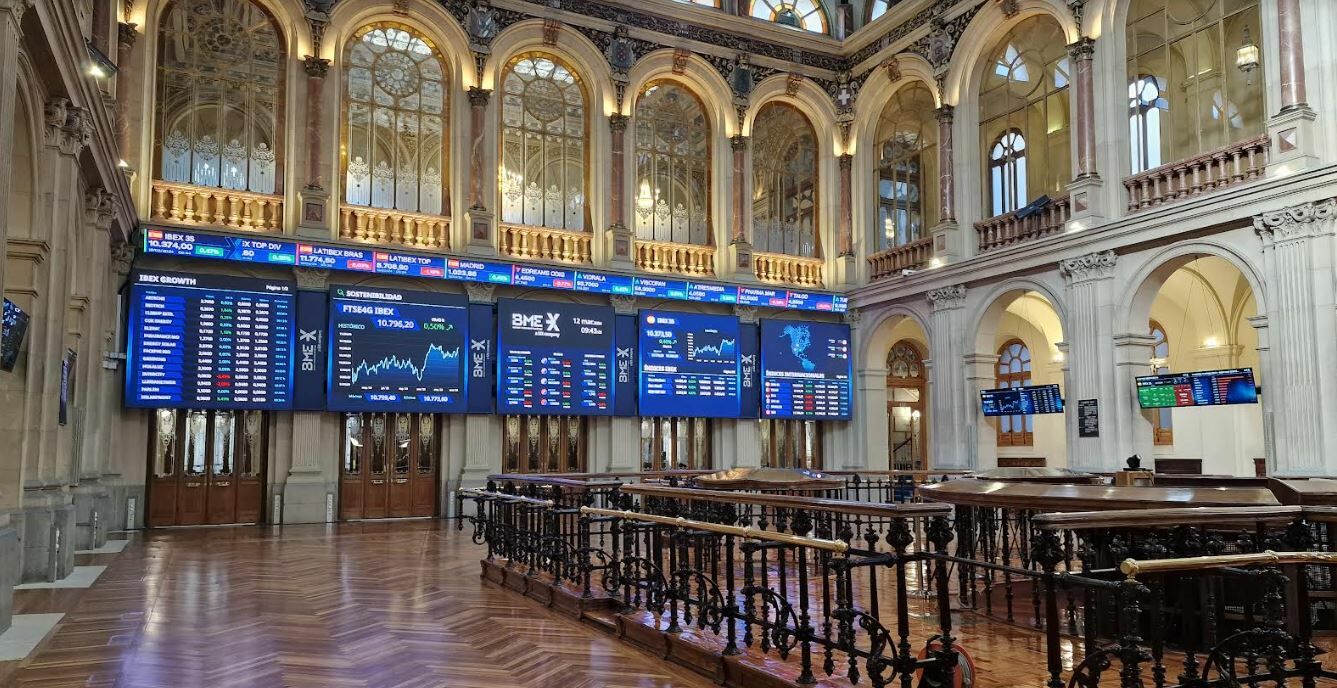
The IBEX 35 closed with a fall of 0.67% to reach 17,544.40 points. The most penalized stock has been Mapfre, with a drop of 2.40%, while Acerinox has dropped 2.38% and IAG (Iberia) has dropped 2.35%. On the advances side, Solaria has especially shone, with an increase of 3.37%, while Amadeus has added 2.12%.
The Madrid selective closes the week with a negative balance after a few days of turmoil in the world markets to the tune of the US president, Donald Trump. If the tension around Greenlandthreat of tariffs included, seems to have calmed down after the ‘framework agreement’ reached between the US and its NATO partners, now attention is directed towards Irangiven the possibility that the US will end up launching a military attack on the country.
Thus, The Ibex 35 concluded the week with a fall of 0.94%moving away from the historical highs of 17,710.90 points that it marked on Friday of last week.
Telefónica has escaped this Friday’s declines, adding two consecutive sessions of growth. Technical analyst Álvaro Nieto suggests that it could be the beginning of a rebound for a stock that has been having a very bad time since November of last year, when the new strategic plan was launched.
Among the protagonists of the day, Cellnex has closed the sale of Towerlink France, its data center business in France, to Vauban Infra Fiber (VIF). The operation, valued at 391 million euros, represents “a step forward in the strategic roadmap” of Cellnex, as it will allow the group to focus on its main areas of activity, it said in a statement.
In other news, the fund Kintbury Capital has increased its short position in Grifols to 1% of its capital, thus reaching its highest level since records began, according to information sent to the CNMV. In addition, the Millennium fund maintains an active position of 0.59%, unchanged since last November.
Caixabank has executed 31.99% of its share repurchase program in the first nine weeks since its launch, the maximum amount of which amounts to 500 million euros, according to the CNMV. The entity has acquired more than 15.6 million shares, for an amount of almost 160 million euros.
In the analysts’ recommendations, Goldman Sachs has raised the target prices of the two Ibex 35 SOCIMIs, Merlin Properties and Inmobiliaria Colonial, although only in the case of the first of them does it see a buying opportunity, with an upward potential of around 20%.
Worse luck for Redeia (REE), which has fallen to two-year lows and has also seen Jefferies significantly cut its potential.
ODDO BHF has reviewed two Ibex 35 securities this Friday, Acerinox and Bankinter, raising the target prices in both cases but maintaining a clearly differentiated message: it sees a path forward in the steel sector and recommends caution in banking after the strong rally in 2025.
In addition, Barclays has raised Inditex’s target price to 55 euros per share, from the previous 47.5 euros, although without potential from current levels.
The macroeconomic agenda of the day has been dominated by the PMI figures that have been known in both the eurozone and the US. The figures show that the growth of private sector activity in the euro zone has started the year maintaining the same rate of expansion as at the end of 2025, which represents a «quite lackluster» recovery, with an improvement in the situation in Germany, while France relapses again. The composite PMI index for the euro zone remained stable at 51.5 pointsafter the service sector data fell to 51.9 integers from 52.4 in December 2025, while the manufacturing PMI stood at 49.4 points, compared to 48.8 in the previous month.
In the US, the Composite PMI rises to a reading of 52.8, from 52.7 the previous month. The Services PMI was 52.5 and the Manufacturing PMI was 51.9. In the largest economy in the world, the consumer confidence prepared by the University of Michigan has also been known, and stands at a final reading of 56.4 in January, from a previous estimate of 54.0.
Wall Street and Europe down; oil skyrockets
But this improvement in confidence is not noticeable on Wall Street, where both Dow Jones, S&P 500 and Nasdaq are also expected to close the week with a negative balance. The Dow had entered this Friday slightly positive, but pessimism is finally taking over, while the S&P 500 and Nasdaq today recover some ground led by NVIDIA. However, the name of the day is Intel: the chip manufacturer plummets on the stock market after disappointing with its guidance for the current quarter.
Red numbers also dominate in European stock markets due to international tensions, although in a much more moderate way than in Spain. The EURO STOXX 50 is down 0.05%, while the German DAX has escaped punishment, with a rise of 0.17%. In Paris, the CAC 40 fell 0.07% and in London the FTSE 100 lost 0.08%.
During the early morning, Asian stock markets advanced after the Bank of Japan left reference interest rates unchanged: The Nikkei 225 in Tokyo rose 0.29%, while the TOPIX added 0.4%
In raw materials markets, Oil prices are advancing strongly this Friday, after US President Donald Trump has renewed his threats against Iranraising concerns about military action that could disrupt crude oil supplies, at a time when there is a closure at a Kazakhstan field. Trump has warned that an “armada” is heading toward Iran, but hopes not to have to use it, renewing warnings to Tehran against killing protesters or resuming its nuclear program.
Following these warnings, the price of benchmark Brent oil in Europe rose 2.51% to $65.67 per barrel, while US West Texas futures rose 2.58% to $60.59.
Gold, meanwhile, seems unstoppable in its climb to $5,000. Along with international tension, the underlying issue of the Fed’s independence is making investors seek refuge in the yellow metal, which today rises 0.86% in its spot variety to reach a price of $4,978 per ounce. Special mention for Silver, which has touched $100 an ounce for the first time in history.
The exchange rate between the euro and the dollar stands at 1.1756 dollars for each community currency.
In fixed income, the Spanish ten-year debt bond offers a return of 3.263%, which leaves the risk premium compared to Germany at just 36.29 points. The benchmark US bond pays 4.248%.