
-
It would be a “much healthier solution for the Venezuelan economy,” instead of dollarization.
-
Oliveros believes that banks can develop wallets or mechanisms to integrate cryptocurrencies.
The Venezuelan economy is at a turning point where the coexistence of various monetary signs is a de facto reality. Given this scenario, economist Asdrúbal Oliveros proposes the implementation of a “multi-currency” banking and payment systems model. This structure would allow the free circulation of foreign currencies, cryptoassets and other digital currencies under a flexible legal framework.
This Oliveros proposal moves away from the rigidity of official dollarization, which, he assures, would imply the «total loss of monetary autonomy.» Instead, the financial analyst suggests a scheme where the bolivar coexists without restrictions with the dollar, the euro and digital assets, such as bitcoin (BTC) or USD Tether (USDT).
«I think that this flexibility benefits the economy,» says Oliveros in dialogue with NoticiasVE. For the specialist, this solution is «much healthier» for the Venezuelan context, since it would officially validate that currencies such as the Colombian peso or the Brazilian real circulate in border areas. while the national bank offers accounts and integrated payment systems.
Under this model, The Venezuelan State would maintain its operations in bolivars. But the financial system would be enabled to process transactions in multiple currencies and digital currencies transparently.
The objective, as he explains, is that the banking sector can be an «active actor» in this ecosystem so that operations stop occurring outside the traditional circuit.
Banking integration with digital asset wallets
One of the most disruptive points of Oliveros’ proposal is the active inclusion of the banking sector in the digital currency environment. This taking into account that a considerable part of the population uses these assets as a savings mechanism and means of payment in the face of exchange rate instability in the oil-producing country.
«We are talking about around 25% of the population (7.1 million people) that use cryptocurrencies. It is no small thing that they can also pay with their wallets,” says Oliveros.
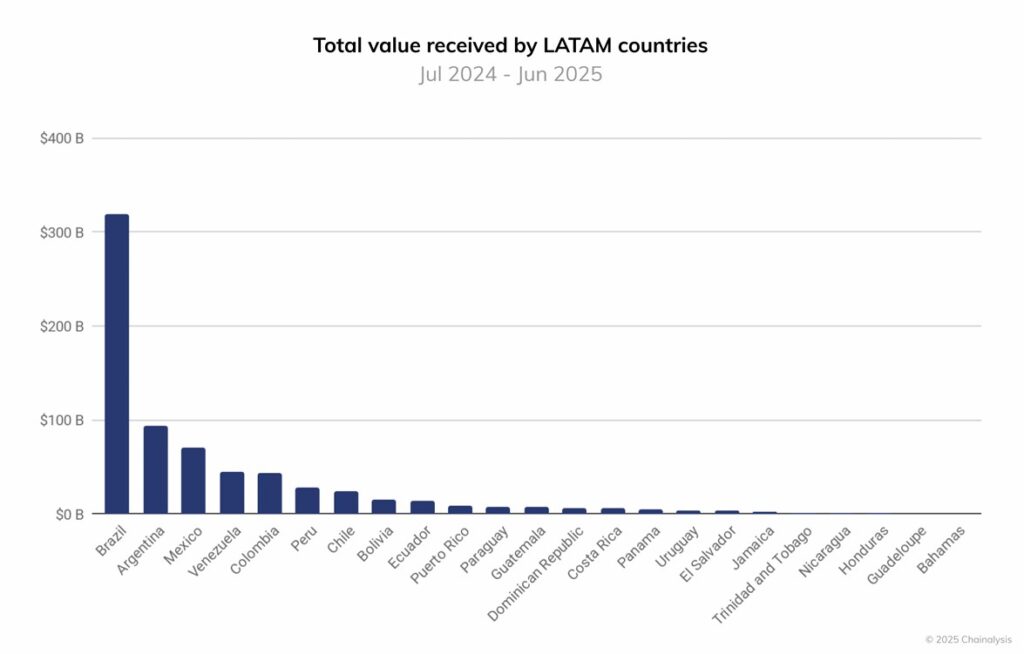
This estimate coincides with data from the Chainalysis firm, which estimates that the Caribbean country registered a volume of transactions equivalent to USD 44.6 billion in cryptocurrencies during 2025. This is seen in the following graph:
The university professor also maintains that the financial system should be integrated with these assets to remove current restrictions.
In Oliveros’ opinion, Venezuelan banking is capable of «developing wallets or integration mechanisms with some digital currency applications.» He thinks this would facilitate professional custody and the entry of new operators to the national market.
The multicurrency environment is already known in Venezuela
The idea proposed by Oliveros of a multicurrency environment for Venezuela, although it has not been made official, has been experienced in practice on the streets of the country for more than five years. There, informality has given life to a space where different currencies converge. Also, at the borders, where the use of the Colombian peso and the Brazilian real has become part of everyday life.
In fact, this reality persists today. In the state of Táchira, The Colombian peso remained the main payment currency in 2025. According to data from William Gómez, an analyst on border issues, the Colombian currency concentrated 64% of the market until December of last year, compared to 30% for the bolivar and 6% for the US dollar.
Now, there is no officialization of this dynamic, beyond a tacit recognition by the country’s authorities. This is because in 2022 they implemented the Large Financial Transactions Tax (IGTF) to tax operations in foreign currency, as well as cryptocurrencies.
Therefore, Oliveros warns that, to achieve this multicurrency environment, Structural changes are required in the regulatory framework. Specifically in the exchange agreements dictated by the Central Bank of Venezuela (BCV).
As he sees it, «the exchange agreement would have to be redefined, some points of the Banking Law would have to be modified and, probably, a presidential decree issued.»
The risk of being a logistical palliative in Venezuela
The proposal to formalize a multicurrency system in Venezuela would represent the legal recognition of financial fragmentation that already operates improvisedly in the country.
This, consequently, may not resolve the causes of financial instability. In any case, it would transfer the complexity of the informal market to the banking system. In fact, Oliveros’ proposal emphasizes that technology and exchange flexibility They are insufficient without a solid institutional foundation.
Therefore, as long as structural distortions and the scarcity of constant financial flows persist, a multicurrency model runs the risk of being a logistical palliative which, although it may facilitate transactions, will be incapable of restoring confidence and, furthermore, guaranteeing lasting price stability.