
After days of relative calm in the Venezuelan exchange market, monetary policy is once again resonating in the economy. The Central Bank of Venezuela (BCV) accelerated the issuance of bolivars and the exchange rate returned to its upward path.
According to BCV data, monetary liquidity, which is the amount of money in the hands of the public, increased 8% during the week of January 16. Thus, 948,419 million bolivars were put into circulation in the national economy.
The acceleration in monetary issuance occurred after a notable decline of -6.5% during the week of January 9. Then, 878,165 million bolivars were put into circulation.
This rebound occurred in a local context. Since last week, the government has been paying the so-called “economic war bonus.” These incentives are deposited on the Patria platform in bolivars, with amounts ranging from USD 50 to USD 120 at the current exchange rate.
At the same time that monetary liquidity has risen in Venezuela, the price of USD Tether (USDT) in bolivars (traded on the main P2P markets, such as Binance) has also been on the rise.
This digital currency has risen 15% in a week compared to the Venezuelan currency. It went from 460 bolivars on average seven days ago to 530 bolivars at the time of writing this report. This is seen in the following graph:
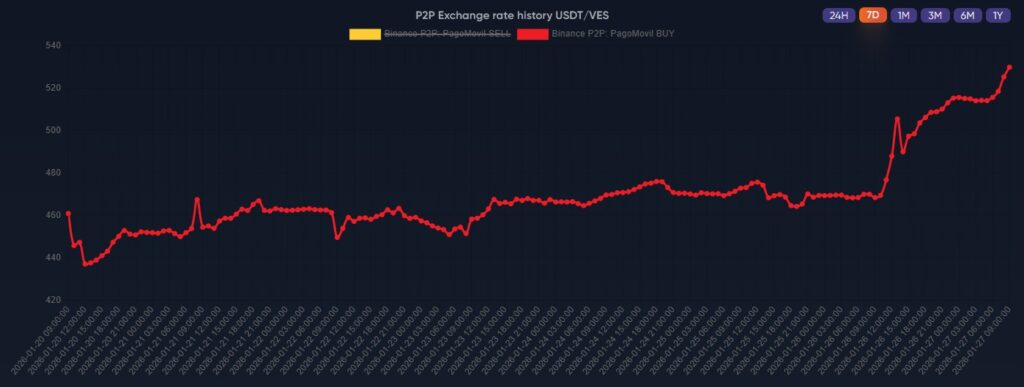
This increase in USDT does not go under the table, since it is part of the inflationary elements. It must be considered that, in Venezuela, the stable cryptocurrency issued by the company Tether Limited has been taken as a reference for the unofficial exchange rate in the Caribbean country. Above all, at the level of informal commerce.
Therefore, prices of goods and services in Venezuela tend to rise when USDT reacts in this way. Thus, increasing the cost of living for Venezuelans.
What do the specialists think?
To delve deeper into this topic, NoticiasVE spoke with a couple of specialists in economic and cryptocurrency matters. They are the economist and university professor Aarón Olmos and the economist and teacher Daniel Peláez.
Both specialists agree that the massive injection of bolivars, added to a limited supply of foreign currency, It is configuring a scenario of high volatility for the national economy.
Olmos, who is a professor at the Institute of Higher Studies in Administration (IESA), focuses on the disconnection between the increase in money in circulation and the country’s low productivity.
As the economist explains, we must always consider that «inflation is not corrected only by lowering prices or having more dollars, inflation is corrected in principle with more production.»
Under his analysis, the root of the imbalance is clear. «Whenever we have an increase in the amount of bolivars in the economy, and that increase is not accompanied by productive capacity (…) that excess liquidity or that amount of surplus bolivars will always be a problem, because it will push prices up,» he points out.
For his part, Peláez, former professor at the University of Margarita, reinforces this idea by pointing out that The increase in the monetary supply directly impacts the psychology of the market.
The specialist states that «an important point has been the increase in liquidity, but that can very quickly become exchange pressure.»
«Especially when people feel that there are more bolivars, but the same amount of dollars,» he warns.
Peláez, bitcoiner and P2P investor, explains that the expansion of money becomes critical «when this expansion of money is not accompanied by something credible.» «That is, a fiscal policy or a monetary policy, or even an exchange rate policy,» he explains.
USDT as a refuge in Venezuela
Once liquidity reaches the system, the market seeks refuge in fast-converting digital assets. Peláez assures that, given the lack of access to physical currencies, citizens turn to stablecoins.
«Specifically in our country, the USDT has been functioning as a kind of immediate access digital dollar, because it does not respect holidays, it does not respect weekends, it works 24/7, especially in P2P markets,» he points out.
That makes sense when considering that the Venezuelan bolivar is the most active fiat currency on Binance P2P. NoticiasVE reported that more than 220,000 updates have been registered in the order book, with bolivars, on that platform. This, accompanied by a volume of offers greater than 5.3 million dollarsaccording to data from P2P.Army.
For Peláez, this movement is not speculative, but one of survival. This is because «a part of those bolivars is looking for coverage, that is, to protect itself from any inflation process.»

However, this digital haven ends up dictating the pattern of prices on the street.
Aarón Olmos highlights that «the price adjustment transmission mechanisms of the USDT crypto asset seem to be much faster than other mechanisms that can affect us.»
This speed, alert, generates immediate distortionsince, according to Olmos, «without this clarity, everyone does what they consider based on their benefit, and unfortunately this harms Venezuelans even more.»
“The fact that the reference exchange rate for stable cryptoassets continues to grow in price makes things more complicated,” he laments.
The lack of physical currencies is fueling the fire
Olmos also remembers that the exchange gap expands “dangerously” and that the dissatisfaction of citizens with the lack of foreign currency through banks is «fueling the fire.»
For the economist, the current course of the economy is worrying. This is because «the speed of growth of the dollar against the loss of purchasing power of the Venezuelan (…) is pernicious, terrible for the salaries of Venezuelans.»
However, if the flow of dollars to the national banks is maintained through the oil deals between Venezuela and the United States, and monetary issuance is also stopped, it is possible that the exchange gap will narrow and that the exchange rate tends to stabilize, as happened in the first days of January.
The Venezuelan economy begins the year under a particular situation that is broken by the pace of monetary issuance. The possibility of stabilization lies in a delicate balance between oil revenues and fiscal discipline. However, as long as the bolivar continues to lose the exchange rate race, USDT will remain not only a haven of value, but also one of the favorite price references in an economy that has known how to embody volatility.