
-
NYDIG rules out an irrefutable correlation between quantum risk and bitcoin crash.
-
The quantum threat is existing, but it would still be distant for Bitcoin.
Quantum computing has become the dominant narrative to explain the recent bitcoin (BTC) price weakness. However, a detailed analysis by the New York Digital Investment Group (NYDIG) concludes that the data does not support quantum risk being the primary cause of the current decline.
Among the evidence presented, the company that specializes in custody of bitcoin and cryptocurrencies notes that the increase in Google searches for “Bitcoin quantum computing” It occurred in parallel with the price rebound towards previous historical highs. But the same did not happen during the sustained weakness of the price of bitcoin which has fallen 29% in the last month.
As seen in the graph below, the massive search peaks (January 2025 and October 2025) coincide almost exactly with the BTC rises. By January 2026, both lines fall. Interest in quantum computing declines as price corrects.
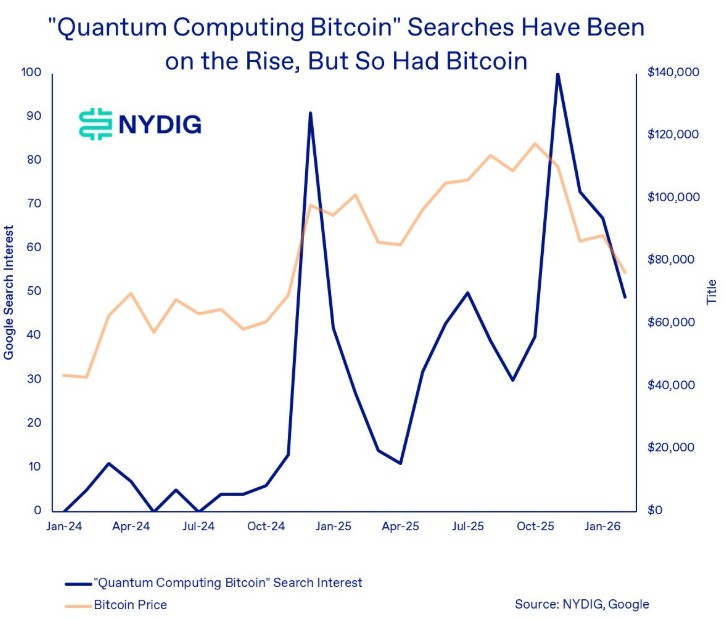
«The increase in searches for quantum risk coincided with price strength, not weakness. If the market was readjusting the price of bitcoin in the face of an imminent technological threat, we would expect the intensity of searches to drive or amplify the downside risk, not to accompany a period of gains,» the company explains in the report published on February 13, 2026.
The correlation between bitcoin and quantum tends to be positive
Another key evidence is the positive correlation between bitcoin and the stocks of companies in the quantum computing sector publicly traded companies, such as IonQ (IONQ), D-Wave Quantum (QBTS), Rigetti Computing (RGTI) and Quantum Computing (QUBT). This occurs when the prices of both assets move in the same direction.
In the graph below, you can see how, towards February 2026, the market shows a convergence phenomenon. There, even as the price of bitcoin falls from its all-time high of $126,000 to $70,000, its 90-day rolling correlation with quantum stocks rises sharply.
This technical measure, which scales from 0.0 (unrelated) to 1.0 (identical movement), goes from a low 0.2 to a significant 0.6. This fact indicates that bitcoin and companies in the quantum sector have begun to move in a much more synchronized way.
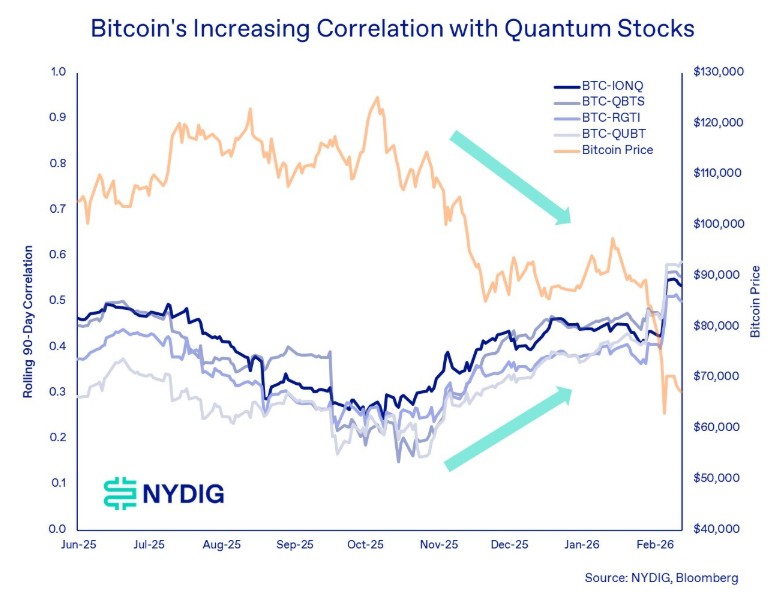
These correlations have strengthened during the recent sell-off. “If quantum advances were eroding trust in bitcoin, we would expect the opposite dynamic,” says NYDIG. That is, an appreciation of quantum stocks while bitcoin depreciates.
Instead, both groups of assets have moved in parallel, which points to a common factor: general risk sensitivity.
The firm argues that quantum computing companies are long-lived assets based on expectations of future growth, with high valuations and dependence on long-term results, similar to what happens with bitcoin.
«When liquidity is plentiful and investors feel comfortable supporting long-term growth, both asset classes perform. When risk appetite shrinks, both appreciate.» Therefore, the most plausible explanation for the recent decline is a broader macroeconomic repricing of risk in long-duration assets, rather than a specific technological catalyst.
Quantum risk is not ruled out
Despite this NYDIG conclusion, relevant people such as Willy Woo (trader and analyst) and Charles Edwards (CEO of the financial company Capriole Investments) have a different position. They have linked bitcoin weakness with growing quantum risk debate.
Woo notes that the 12-year bullish trend between bitcoin and gold has broken, attributing this in part to the market already pricing in the risk of a future “Q-Day.” Woo warns that quantum advances could recover old private keys from exposed public keys, as reported by NoticiasVE.
Such a situation would mainly affect the approximately 4 million BTC considered permanently inaccessible due to loss of private keys (due to forgetfulness, damaged hard drives, death of owners without informed heirs, etc.). These coins have not moved for years.
According to the analyst, the market I would already be discounting the risk that these coins return to circulation in the futuregenerating massive selling pressure (equivalent to more than 8 years of recent institutional accumulation). Something that would partly explain the break of bitcoin’s 12-year bullish trend against gold.
For his part, Charles Edwards, founder of Capriole Investments, also emphasizes the issue, indicating that “quantum risk” is beginning to play a relevant role in the downward pressure.
Edwards maintains that “the quantum threat drove bitcoin down” and that the lack of a clear answer on the part of the ecosystem generates concern among informed investors.
In this context, Capriole launched its own Quantum Index, a product presented as a defensive alternative. This index brings together shares of companies linked to the development of quantum technologies and is intended as a temporary hedge while Bitcoin does not advance in the incorporation of post-quantum protection mechanisms.
However, market data—such as the positive and growing correlation between bitcoin and these same quantum stocks—suggests that this index may not meet its primary protection objective. In environments of general risk aversion in long-duration, high-growth assets (as NYDIG argues), both bitcoin and quant companies tend to correct in parallel, reducing the effectiveness of the hedge.
Quantum threat is in early stage
Google recently warned that Quantum computing will soon force current encryption systems to changeas they could become vulnerable in the coming years. He is concerned that there are already malicious actors collecting encrypted data today—in so-called “store now, decrypt later” attacks—to try to break it later when sufficiently powerful quantum computers become available.
On the other hand, a company called Iceberg Quantum presented a study on its new architecture called Pinnacle. According to them, with this technology an encryption like RSA-2048 could be broken using less than 100,000 physical qubits. This is a significant reduction from previous estimates. This shows that progress in error correction is making the quantum threat seem less distant in some cases.
However, for Bitcoin specifically, the situation is different. Breaking its signature scheme (ECDSA) requires much more advanced quantum computers in terms of stable qubits and error correction.
In this sense, NYDIG concludes that Quantum risk is real and worth preparing for in the long term (e.g. migrating to strong encryption). However, he notes that market data right now does not show that it is the main cause of the recent price drop.
The data indicates that the market is in the bearish phase Typical of Bitcoin’s four-year cyclelinked to the April 2024 halving.
Historically, the year after the halving usually brings new all-time highs. In the current cycle, the peak of $126,000 arrived in October 2025. Then the following year—in this case, 2026—is usually a deep correction, with drops of 50% from the maximum.
What is happening in the current market fits into this dynamic. It is a natural clearing of the market that shakes out speculators, liquidates leveraged positions and filters out temporary or “tourist” investors.