
-
The Pokémon card was previously tokenized on the Liquid Marketplace platform.
-
The piece was originally acquired by Logan Paul in 2021 for $5.27 million.
The eight-digit figure reached this week at the Goldin auction house not only confirms the rise of collectibles as safe haven assets, but also closes, at least physically, one of the most controversial episodes in the brief history of tokenized real assets (RWA).
The Pokémon card, which the YouTuber and professional wrestler, Logan Paul, acquired in 2021 for just over $5 million, tripled its value in just five yearsdragging with her a $75,000 diamond necklace and a complex trail of contract disputes.
The commercial success of the operation contrasts with the checkered history of Liquid Marketplace, the platform co-founded by Paul himself. In 2022, the site attempted to democratize card ownership by selling 51% of its value in digital shards.
However, the market response was lukewarm, as only 5.4% of the tokens were placed, raising about $270,000 among investors who were looking for a share in the appreciation of the piece.
Controversy erupted later, when the nature of these tokens collided with regulatory reality. In June 2024, the Ontario Securities Commission (OSC) brought charges against Liquid Marketplace management, although not against Paul. They alleged that the platform operated without registration and that the tokens did not provide the promised legal ownership.
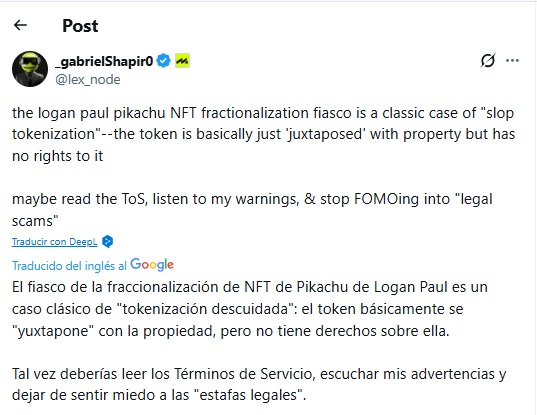
According to the regulator, there was a “total disconnection” between the co-ownership narrative and the real rights of users. Lawyers like Gabriel Shapiro, general counsel at Delphi Labs, described it as “poor tokenization.”
“This is a case of poor tokenization because a digital record was linked to a physical asset without establishing a solid legal bridge. The result is a total legal orphanhood for token holders.
Gabriel Shapiro, general counsel of Delphi Labs.
A buyback changed everything
Faced with regulatory pressure and technical failures on the web, Paul executed a buyback clause in May 2024acquiring the fractions again at the original sale price.
Although the influencer defended the measure as a way to protect users and reactivated the site with personal funds, to facilitate withdrawals this February, the debate in communities such as Reddit and X is intense.
Many investors maintain that, By buying back at face value, Paul excluded them from the profits of the astronomical 16.4 million auction.

It has not been the only case in which Paul is involved. In 2024, an investigation claimed to have found traces that implicate the famous American YouTuber in promoting investments in cryptocurrencies, without having revealed his links to those projects, as reported by NoticiasVE.
A warning for the future of RWA
The real asset tokenization phenomenon surpassed $10 billion in North America during 2025, fueled by the promise of sharding everything from artwork to real estate.
However, the Pikachu Illustrator case serves as a warning about the importance of independent custody and jurisdictional clarity. It is key to review whether the exit mechanism guarantees a real participation in the capital gain of the physical object, preventing the dream of digital co-ownership from evaporating in a forced buyback.
It means that, in the tokenization of real assets, as happened with Logan Paul’s Pokémon card in Liquid Marketplace, it is essential to review the exit mechanism. It is necessary to know the clauses that allow the investor to sell, transfer or exit the position voluntarily and without excessive restrictions. All this must be done before investing.
It is this exit mechanism that defines how token holders can convert their stake into real money, whether through secondary market sales, direct redemption, or product distribution following a sale of the physical asset.
The key risk is that many contracts allow the original owner or platform to execute a forced buyback at a fixed or predetermined price, usually the original issue value. This, without investors capturing the capital gains (the real increase in value of the asset).
Co-ownership promise fails
In the case of Paul, the repurchase of the fractions in 2024 it was made at the initial priceleaving holders without participation in the additional $11.5 million generated by the 2026 auction. A fact that erodes the promise of “digital co-ownership,” as debated on social networks.
This is how what appears to be a proportional stake in a luxury asset can evaporate if the exit mechanism does not automatically guarantee an equitable distribution of future profit.
To avoid these types of problems, investors should examine contractual terms (terms of service and smart contracts) for clauses on “exit rights”, “redemption”, “buyback” or “forced buyback”. And confirm if there is real secondary liquidity.
Also make sure that the token grants clear rights over the capital gainsnot just limited economic exposure.
In these cases, it is best to consult a lawyer specialized in tokenization of assets and finances, as an essential mechanism to distinguish between illusory co-ownership and a structure that truly aligns the interests of all participants.