
The Base Layer 2 distributed network, originally developed by Coinbase, announced this February 18 a change to its technical roadmap.
Wilson Cusack, engineering lead for the network, confirmed that the project will use its own code, specifications and infrastructure. This decision begins the transition towards a “unified stack” that gives Base autonomy over its protocol development. A unified stack It is a standardized architecture that allows multiple networks to operate under the same code and protocol, guaranteeing interoperability and shared security without fragmenting development.
Until now, the Base operated under the OP Stack technical standard, Optimism’s modular software. This architecture linked the network to the update cycles and design decisions of said ecosystem. By using this shared foundation, the project participated in the “Superchain”, a group of interconnected networks that share common governance and security.
To understand this relationship, one can compare the OP Stack to an open source operating system, similar to Android. Optimism acts as the main developer that delivers the base software to different manufacturers (the Superchain networks). When using it, all networks work under the same rules and can communicate with each other easily. However, Base has decided to develop its own software without dependencies. Although it will continue to be compatible with the ecosystem, it will no longer depend on update times or technical limits imposed by the original manufacturer.
The announced change implies that Base will manage its own code repository independently. Network nodes will need to follow Base’s technical specifications instead of Optimism’s. This operational sovereignty will allow the team to execute up to six network updates (hardforks) per year to integrate functions directly. One point to highlight is that after the first hardfork (the next step), the nodes will have to update their client software, or they will not be able to process transactions on the new network. Base did not announce the implementation date of this procedure. At the user level, the change will be practically imperceptible.
The goal of this new stage, as highlighted in the statement, is to achieve a processing capacity of 1 gigabytes or 1 billion units of gas per second. This level of scale seeks to support high-traffic applications and keep transaction fees at minimum levels. The technical team will prioritize network consistency, with the goal of achieving 99.99% blocks processed, according to the statement.
The Superchain ecosystem is made up of various networks seeking to scale Ethereum in a coordinated manner. Its most notable members include OP Mainnet (Optimism’s mainnet), Zora, Mode, Fraxtal, and more recent projects such as Unichain from Uniswap, Ink from Kraken, and Soneium from Sony. All of these networks contribute financially to a common fund in exchange for using the shared technology and benefiting from the security inherited from Ethereum.
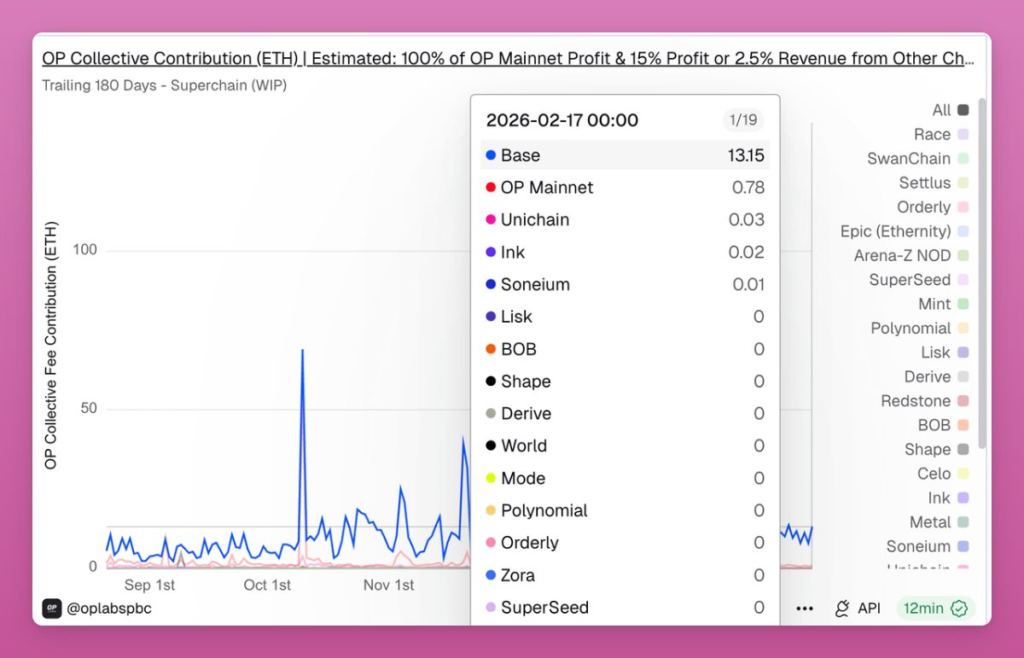
Base’s technical transition represents a drastic financial blow for the Optimism Collective, as this network’s exit from the Superchain revenue sharing scheme (which requires 2.5% of gross revenue or 15% of net profits) deprives Optimism of approximately 94% of its daily commissions. With the cessation of the 13.15 ETH that Base usually contributed, the OP token suffered its worst drop so far this year, collapsing 25% to USD 0.13.
Despite the economic impact on the ecosystem, Coinbase justifies this technical autonomy as a necessary measure to gain operational agility, reduce external dependencies and optimize its scalability without sacrificing the security of Ethereum.