
-
He claims that the next bull cycle will continue to be driven by institutional adoption.
-
Leishman says the percentage of BTC in investment advisors “is still a tiny fraction.”
Alex Leishman, CEO and founder of River, offered an analysis based on his firm’s own and public data to contextualize the price drop recorded since the beginning of 2026. According to the executive, although the asset has fallen significantly from its all-time high, the current scenario differs drastically from previous bitcoin (BTC) bear markets.
During his participation in the Bitcoin for Corporations event, Leishman was emphatic in pointing out that, despite the perception of crisis, the figures suggest a smaller scale compared to other historical cycles.
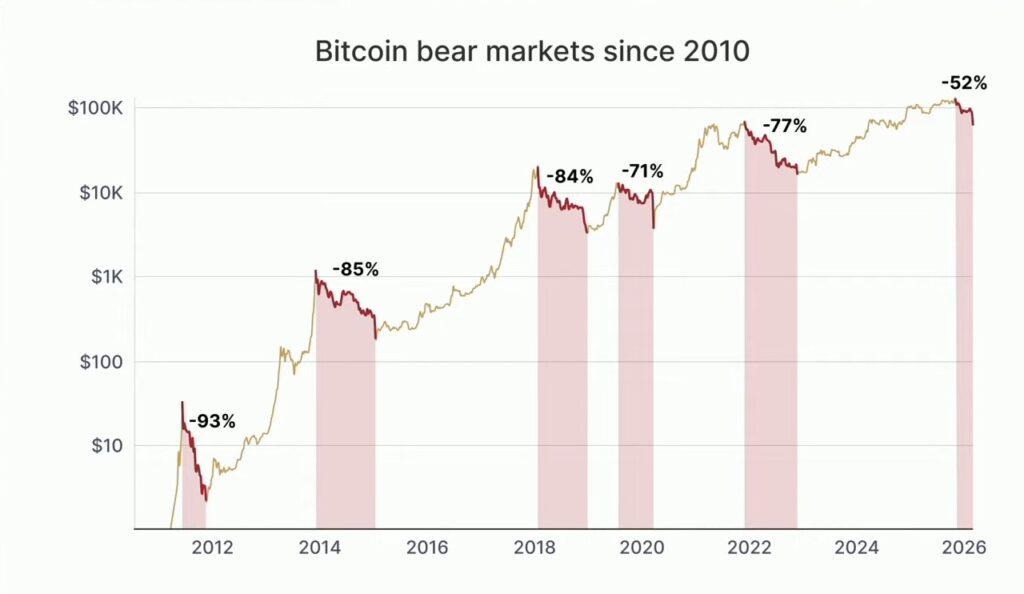
«We are in a kind of bear market. “The price of bitcoin has fallen nearly 40% since the start of 2025. However, this is just one of many bear markets in Bitcoin history, and in fact it is one of the smallest,” he said.
The fundamental distinction of this period, according to Leishman, is the profile of the buyers. River data indicates that while individuals have acted as “net sellers,” Institutions have taken advantage of the fall to accumulate.
«This bear market is unique. What makes it special is that it is the first bear market in the history of Bitcoin where we see an acceleration in institutional adoption,» explained the businessman. And he added that «those who bought bitcoin in 2025 were overwhelmingly institutions: companies, funds and governments.»
The following graph shows the different bitcoin bear markets since 2010 and their respective total falls:
Millions of bitcoin in the hands of institutions in 2035
Leishman’s analysis also suggested a change of command in Bitcoin ownership. This, by highlighting that, if in the first decade of the asset the network was dominated by retail users, The entry of actors like Strategy in 2020 marked a turning point.
The executive projected that, if the current trend continues, «by 2035, half of all bitcoin could be in the hands of institutions.» This is an estimate that would imply an accumulation of 9 million more BTC after 10 years. Considering that, currently, more than 2 million coins are in institutional custody, according to data from BitcoinTreasuries.
This movement is supported by traditional financial infrastructure. Leishman highlighted that 90% of top Registered Investment Advisors (RIAs) in the US already have positions in bitcoin. Also, more than 60% of large banks (including Citi, Bank of America and PNC) are developing related products.
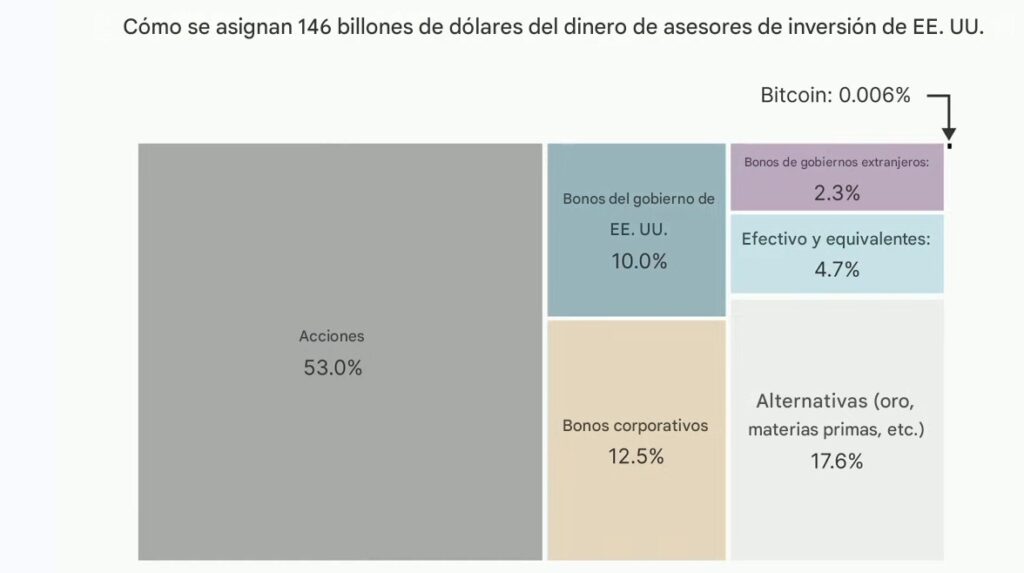
However, he warned that the exposure is still minimal, since the percentage of BTC in investment advisors «is still a tiny fraction,» with only 0.006% of the assets they manageaccording to their figures.
Leishman also broke down the behavior of mainstream companies that use bitcoin not only as a speculative investment, but as a store of wealth. He mentioned that River’s corporate customer base — which includes everything from farms to food stands — doubled last year.
«These businesses are usually controlled by owners who are already Bitcoiners and have decided to use BTC to preserve the assets of their company in the long term. In fact, 63% of them plan to keep their bitcoin indefinitely,” he stressed.
For the manager, this growth in operating companies is an indicator that the fundamental value of BTC is permeating the real economy, beyond price volatility.
Despite Leishman’s institutional optimism, technical and on-chain indicator analysis offers a much more cautious outlook for the short term. Analysts like Nick O’Neill suggest that bitcoin could reach $40,000 before the end of March.
Likewise, professional trader Willy Woo issued a warning on February 18, pointing out that the bearish trend is strengthening as volatility skyrockets. «I have bad news for perennial bulls. Bitcoin continues to strengthen its downtrend,» Woo wrote. He identified the formal start of this bear market in 2026, as NoticiasVE reported.
Faced with these signs of technical weakness, Alex Leishman maintains his thesis that institutional fundamentals will prevail over short-term indicators. “I believe that this market decline is temporary and that the next cycle will continue to be driven by institutional adoption, both by operating companies and by investment assets that have yet to be allocated,” he concluded.