
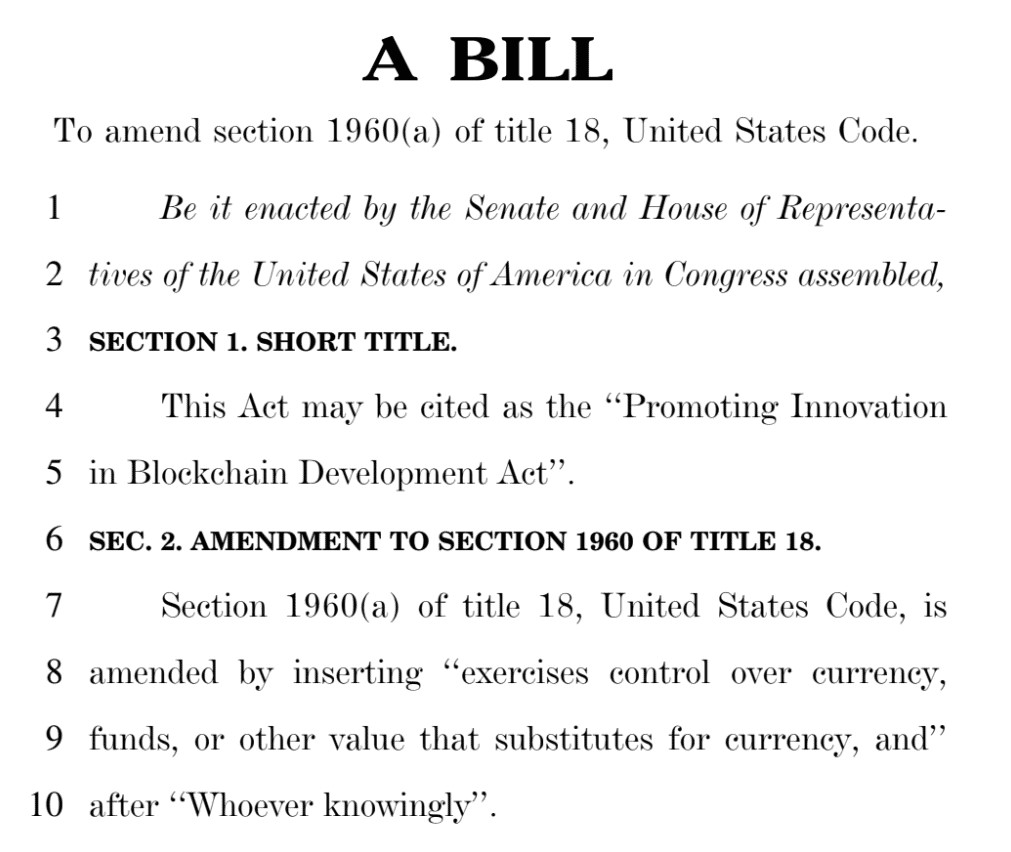
Three United States congressmen introduced the Blockchain Development Innovation Promotion Act of 2026 on February 26, a bipartisan initiative designed to shield Bitcoin developers from legal interpretations that equate them with money transmitters.
The proposal seeks to correct the application of section 1960 of the criminal code, which has recently been used by the Department of Justice to prosecute privacy tool creators and open source protocols.
This piece of legislation was introduced by Representatives Scott Fitzgerald, Ben Cline and Zoe Lofgren. The central objective is to establish a clear distinction: money transmission regulations should only apply to actors who exercise real control over customers’ digital assets.
By excluding those who only write code without managing outside capital, the project seeks to stop what the industry has called «regulation by execution», a phenomenon that has affected projects linked to privacy and decentralized finance (DeFi), such as the case of Tornado Cash and Samourai Wallet.
Congressman Cline stressed the need for this measure to maintain the country’s technological competitiveness. According to his statements, for «too long» excess federal authority «has blurred the line between bad actors and the innovators building next-generation technology.»
Something similar suggests Fitzgerald, who questions that for years software innovators and developers have been in the crosshairs of regulators. He agrees with Lofgren, who explained that we are currently seeing how the erroneous application of the current law It hurts innovation and drives developers out of the country.
This is not the only legislative effort in this direction. On January 13, Senators Cynthia Lummis and Ron Wyden introduced the Regulatory Certainty Law for Blockchain, as reported by NoticiasVE.
That proposal also emphasizes that infrastructure providers and software developers who do not have control of user funds should not be classified as money transmitters. In that sense, Senator Lummis has been emphatic in stating that it is time to stop treating software developers like banks simply because they write code.
The urgency of these laws arises after renowned court cases, such as those of Tornado Cash and Samourai Wallet, whose main developers are in prison. In both, authorities applied Section 1960 even though the programmers did not custody users’ digital currencies.
According to data from the DeFi Education Fund (DEF), the lack of clear rules has caused the United States’ participation in open source software development to fall from 25% in 2021 to 18% in 2025, as innovators migrate to countries with greater legal certainty.