
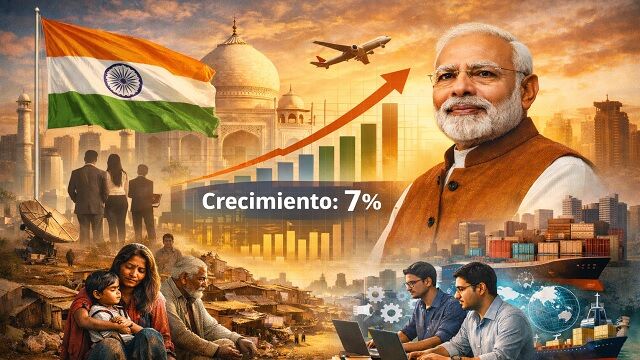
India has closed 2025 consolidating itself as the fourth largest economy in the world, after surpassing Japan and reaching a GDP of up to 4.5 trillion dollars. For the next few years, the Narendra Modi government has drawn up a roadmap in which economic growth is estimated at 7% by 2026 and between 6.8% and 7.2% by 2027. With an economy driven by the service sector and manufacturing, the country seeks to expand commercial influence through market diversification and the creation of new alliances. All this, in an international context characterized by uncertainty and the resurgence of protectionist measures.
The current situation in India is conditioned by its history and the power relations of more than two hundred years ago. In the 18th century, the subcontinent was one of the most prosperous regions in the world, as it had fertile lands, a large population and a very beneficial geographical location. Therefore, after the failure of the great Indian rebellion, the British Raj was officially formed in 1858.
Under colonial rule, the territory did not experience exceptional economic development or notable industrial advance. Abundant labor reduced incentives to mechanize production which led to a lack of industrialization. This productive system, together with extractive activities to export to the metropolis, as well as the constant increase in population, gave rise to high levels of poverty.
Faced with this situation and after the Second World War, Indian citizens carried out a series of peaceful protests, led by Mahatma Gandhi, and achieved independence in 1947. Once autonomy was achieved, the Indian government decided to opt for the nationalization of strategic sectors such as transportation, banking and energy, as well as a protectionist trade policy.
During the Cold War, India chose to remain neutral and thus obtained aid from both sides. In 1991, its economy suffered a serious financial crisis after which a liberalization process began, supported by the IMF and promoted by its then Minister of Finance and later Prime Minister, Manmohan Singh. This change allowed India to increase foreign investment and its foreign exchange reserves. During the 2000s, this process strengthened the rise of the Indian economy. However, despite macroeconomic advances, poverty continued at high levels, consolidating itself as a structural problem.
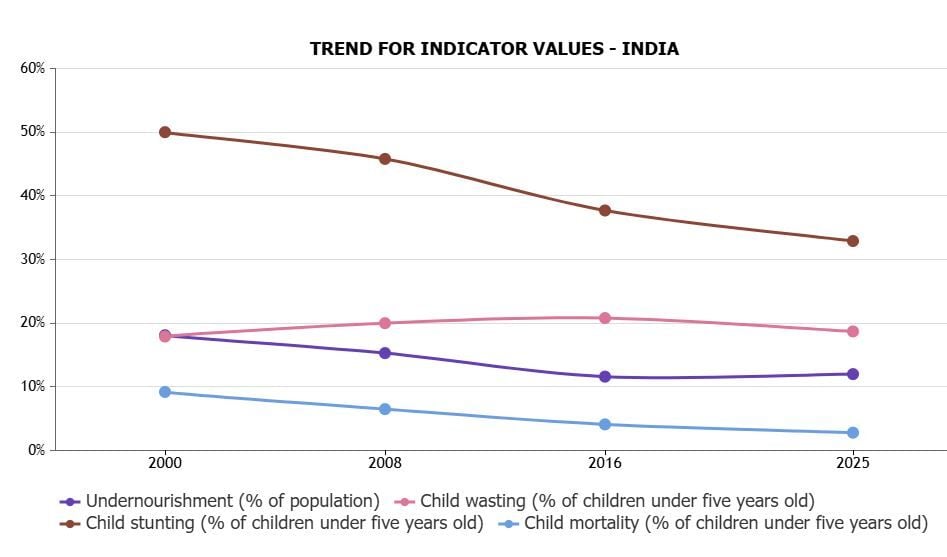
Currently, despite being the large economy that has grown the most in recent years, with an average of 6.5%, India faces great obstacles to compete with the main powers. Well, despite the growth of its GDP, its per capita income is very low, standing at $2,694.7 in 2024, a figure lower than that of Uzbekistan and similar to that of Angola. Furthermore, although levels are decreasing, in 2023 5.3% of its population still lived in conditions of extreme poverty and the country ranks 102 out of 123 on the hunger index. All this, together with a high percentage of young people who neither study nor work, a high representation of low productivity sectors and complex bureaucratic obstacles that have limited the growth of the Indian economy in recent decades.
To put an end to the job insecurity and trying to position itself among the great economies of the world, Narendra Modi and his government have designed an economic plan. The first step is to create a single market within the country, limiting the administrative barriers imposed on national trade. In addition, a fiscal transformation process will continue and investment will be made in infrastructure. The Indian government seeks to boost its economy based on the export of cheap services, such as data analysis or digitalization processes.
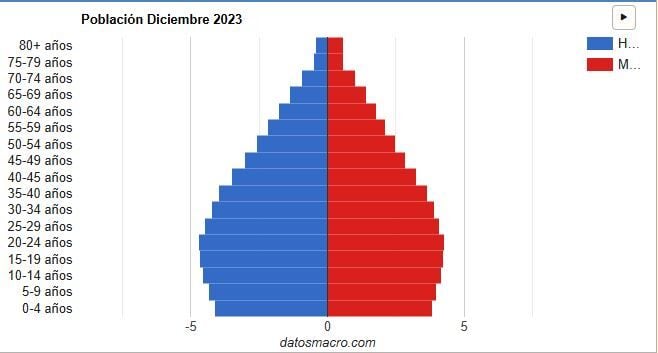
To carry out its economic plan, India has a characteristic that is not found in Western countries, a pyramid of young and growing population. Being the most populated country in the world will allow it to create economies of scale that increase competitiveness and promote economic growth, which will attract foreign investments, making its economy grow even more. Furthermore, with a young and employed population, pensions can be maintained, which increases social well-being.
In addition, India has a large diaspora spread throughout the world, which represents great economic support, since Indians are the largest recipients of remittances in the world. These transfers are not only financial, the transfer of knowledge is essential for the economic growth of the country and facilitates commercial relations.
Following its roadmap, the Indian government hopes to maintain economic growth of between 6% and 7% in the coming years. These estimates do not differ excessively from those published by the International Monetary Fund (IMF), which places the growth of the Indian economy at 6.4% for next year. This growth is due, in large part, to the increase in the services sector, which already represents around 50% of the country’s GDP. In addition, the great domestic demand works as a cushion against possible shocks that may occur abroad and has managed to keep inflation stable.
Supported by services and sectors such as green energyartificial intelligence and technology, India can become a new key piece of the world economy. Thus, it could also surpass the German economy in a few years if it is able to reduce bureaucracy to encourage the creation and promote the location of new companies in its territory. In addition, it has already signed important trade agreements, such as that of the European Union, and has begun negotiations with other Western countries such as Spain or Canada.
With these efforts, India tries to position itself as a counterweight to China and the United States, offering neutrality that allows it to reach new agreements without dismantling its relations with other Asian countries such as Iran. However, they must find the balance in which their economy is capable of maintaining its growth while promoting an increase in the well-being of its population.