
-
Oil and gas prices rise; several stocks are hit with bearish pressure.
-
Amid the conflict, bitcoin has remained stable around $65,000.
Despite the outbreak of the war between the United States and Israel against Iran, on February 28, bitcoin (BTC) has maintained a firm stance in the markets, resisting the geopolitical storm better than expected.
The Iranian response—which included missile and drone attacks against military, hotel, and oil facilities in Israel and several Gulf countries (Bahrain, Kuwait, Iraq, Qatar, Saudi Arabia, Oman, and the United Arab Emirates)—placed immediate pressure on global financial assets.
The initial volatility was intense, but bitcoin managed to stabilize quickly after absorbing the blow.
Specifically, the digital currency fell to $63,000 on the day the attacks began (February 28), then rebounded strongly towards $70,000 and consolidated. around $67,000 on the current day, as seen in the graph.
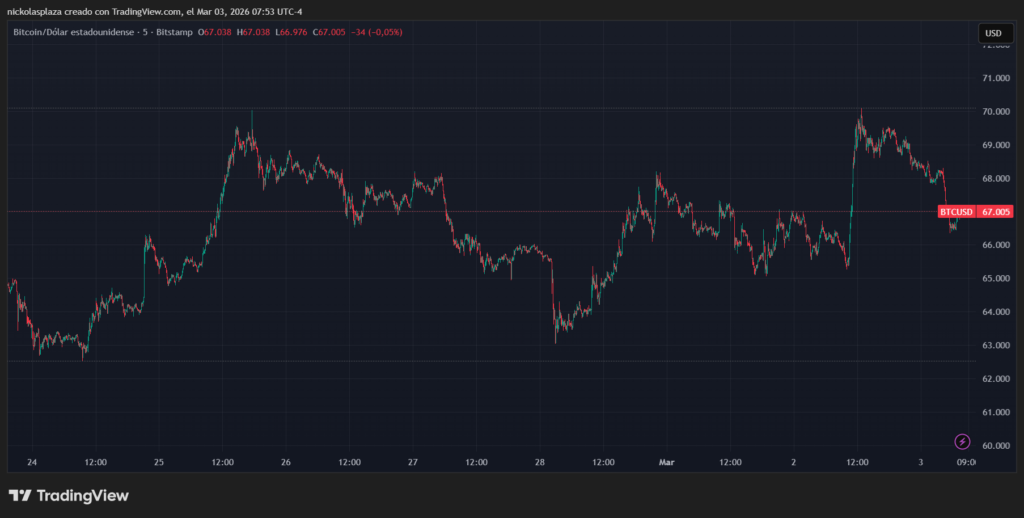
This movement represents an increase of approximately 3% in the last seven days and it is a sign of relative strength in the midst of chaos. In parallel, gold—a traditional refuge in times of uncertainty—remains above $5,000, highlighting the way in which investors are looking for alternative assets in the face of escalation.
This dynamic is also reflected in traditional markets. Wall Street recorded falls on Monday, March 2, with the opening, where the S&P 500 and the Nasdaq fell around 0.8%, although both indices show signs of partial recovery in the current day.
However, the connection between the war front and the financial markets It becomes even more evident when observing the energy crisis unleashed by the conflict.
Historically, bitcoin resists conflicts
The confrontation, which is now entering its fourth day, with no clear signs of de-escalation, has caused a severe disruption in the global oil supply. This, after the Iranian attacks on key infrastructure and the blockade – or paralysis due to risk – of the Strait of Hormuz.
It is a maritime passage that is the only access from the Persian Gulf to the open ocean, which makes it one of the most critical strategic points in the world, through which it transits. about 20% of global oil.
As a direct consequence, Brent crude oil has risen 8% in recent sessions, exceeding $83 per barrel—its highest level since the beginning of 2025. The situation has made exports impossible for most countries in the region, forcing Saudi Arabia to explore alternative routes with much higher costs.
This context of energy shock and inflationary risk contrasts with the historical behavior of bitcoin in similar crises. As reported by NoticiasVE, in April 2024 the currency fell 7% after the escalation between Israel and Iran; Likewise, in February 2022 the start of the Russian invasion of Ukraine took BTC to $34,000.
However, in this episode of 2026, bitcoin has managed to sustain itself, and even show greater resilience, in the midst of the development of military operations.
This current strength could indicate that investors are beginning to perceive bitcoin as a safe haven of value comparable to gold in times of extreme geopolitical instability.
Even so, uncertainty about the course and duration of the conflict persists: the president of the United States, Donald Trump, has indicated that the war actions could extend for four weeks or more.
At this time, there is a possibility that The stability of the asset does not respond entirely to its role as a «refuge», but rather to a waiting strategy on the part of the holderswho usually avoid massive sales in anticipation of new events that could drive the price even higher.