
Venezuela is consolidating itself as one of the epicenters of the digital economy in Latin America and this is confirmed by a new report from Chainalysis. The firm that studies the movements of cryptocurrency networks now points out that the country received flows for an estimated value of 44.6 billion dollars in the last annual period, a figure that shows the integration of these assets into the national financial fabric in the face of the collapse of the traditional system.
The document, released on March 5, 2026, records that the majority of transactions carried out in Venezuelan territory, between July 2024 and June 2025, It focused on retail users who owned wallets with balances of less than $10,000.
For Chainalysis analysts, the total volume mobilized reflects deep distrust in the local banking system. Therefore, citizens preferred stablecoins to manage remittances and mitigate the erosion of purchasing power caused by chronic hyperinflation.
Annualized inflation during 2025 was in the range of 600-650%, and remains the highest in the world according to estimates by economics professor Steve Hanke, of Johns Hopkins University (one of the most prestigious academic institutions in the United States). He claims to be the only accurate source, since the Central Bank of Venezuela stopped publishing consistent data since October 2024.
While the Government of Venezuela sought to formalize and supervise the sector by creating the National Superintendence of Crypto Assets (SUNACRIP) and a network of state exchange platforms—including support for the now-defunct state-backed crypto asset, the Petro—Venezuelans flocked to international cryptocurrency exchange platforms, largely reflecting low trust in the state’s offerings.
Informed by Chainalysis.
“Cryptocurrencies continued to offer Venezuelans a financial lifeline amid persistent hyperinflation,” adds Chainalysis in the Crypto Crime Report 2026. The document highlights that, despite the State’s efforts to control the domestic flow, “ordinary citizens and government-affiliated actors preferred access through global exchanges to preserve and transfer value.”
The dilemma of shadow regulation
At the geopolitical level, the phenomenon acquires a strategic dimension. While individuals use these channels for economic survival, there are indications that government entities used stablecoins to liquidate oil exports, as reported by NoticiasVE.
This usage pattern would sought to evade international sanctionsfollowing cross-border transaction models already observed in jurisdictions such as Iran and Russia.
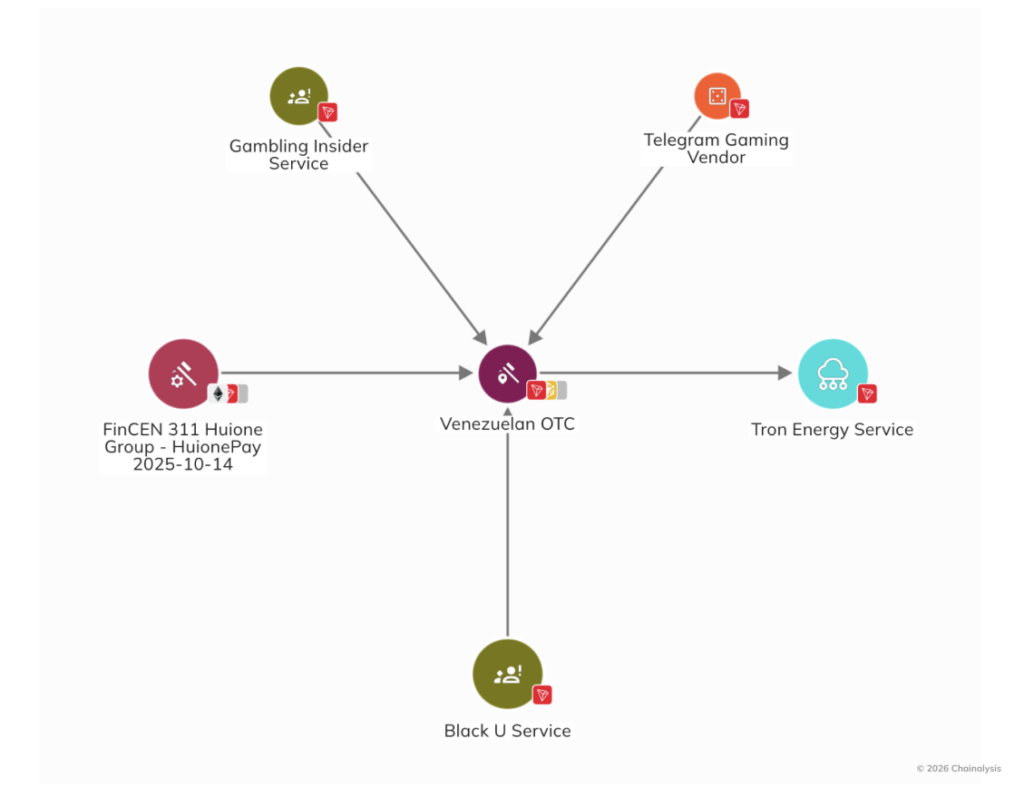
This duality places Venezuela in 18th place in the global adoption index, on par with regional powers such as Brazil and Argentina. However, the rise of informal networks and over-the-counter (OTC) brokers, which connect local finances with the global ecosystem, has raised international alarms due to the risks of money laundering and opacity in the origin of funds.
This is why Venezuelan lawyer Raymond Orta Martínez, director of the Venezuelan Institute of Technology Law, calls for USDT (Tether) to be specifically regulated in Venezuela. He believes that the Venezuelan State must protect citizens from possible wallet freezes due to sanctions from the Office of Foreign Assets Control (OFAC).
Orta proposes tax, accounting and traceability of funds to prevent money laundering and capital legitimation, without prohibiting its massive use as a refuge against inflation and a transactional tool in the informal dollarization of the country.