
The American financial institution Wells Fargo filed a trademark application with the United States Patent and Trademark Office (USPTO) for the name WFUSD. This legal movement, detected in official records this March 10, signals the bank’s intention to formally integrate into the cryptocurrency ecosystem.
The application is currently listed as “active and pending,” having met the minimum submission requirements and awaiting assignment to an official government agency examiner.
The documentation presented by the banking institution reveals a strategy that encompasses multiple facets of modern financial technology. According to the USPTO, the application covers class 009, comprising downloadable software for managing digital assets, cryptocurrencies and tokens.
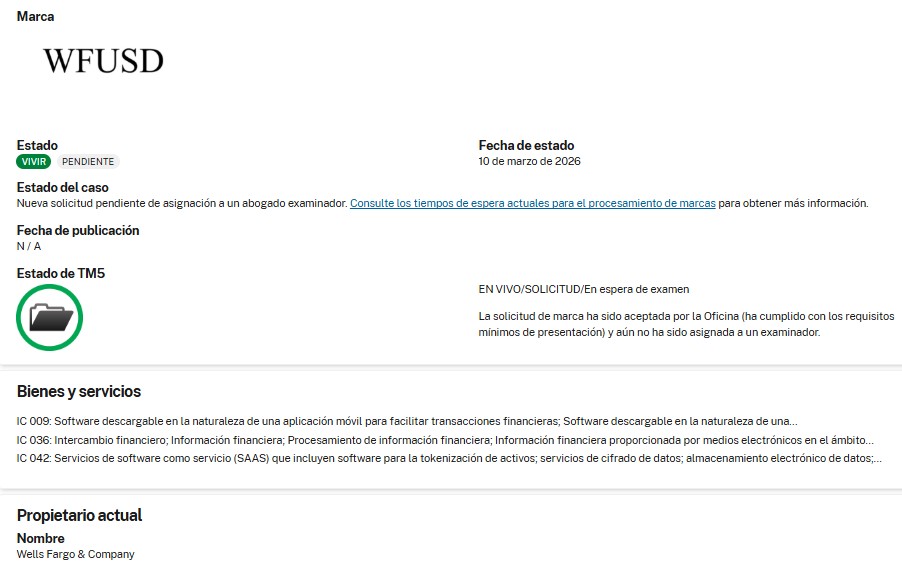
Specifically, it mentions wallets and software to process transactions with cryptocurrencies or stablecoins. This technical approach is complemented by class 036, focused on financial services. This, according to the registry, covers the exchange of cryptoassets, custody services, issuance of security tokens and financial settlement services through cryptocurrency networks.
Perspective on internal payments infrastructure
The selected name, WFUSD, follows the standard naming convention of US dollar-pegged stablecoins (USDT and USDC). By registering this trademark, the bank is laying the legal foundation for an internal payments network for institutional clients.
The record suggests that they will not be limited to payments, but rather They are looking for a comprehensive platform to issue and trade traditional financial assets, such as bonds and funds, in digital format. This technical infrastructure is detailed under technology services class 042, which includes software as a service and platforms for real-world asset (RWA) tokenization and smart contract management.
The bank’s filing comes as traditional financial institutions and global banks increasingly embrace digital assets, exploring tokenized assets and stablecoins. The digitization of banking services through decentralized networks allows for faster and more efficient settlement of cross-border and corporate transactions.
Competition in the US banking sector
The Wells Fargo initiative does not occur in isolation in the North American financial landscape. As NoticiasVE reported in November last year, JP Morgan, the largest banking institution in the United States, launched its own deposit cryptocurrency called JPM Coin, aimed at its institutional clientele.
Deposit tokens are digital representations of a traditional bank deposit that operate on a cryptocurrency network. They seek to combine the security and regulation of a bank account with the inherent efficiencies of cryptoassets, allowing money to move instantly between global accounts of large corporations.
The adoption of these tools by commercial banks represents an evolution in the way institutional capital interacts with new technologies. While bitcoin (BTC) remains a decentralized and global asset, Banks choose to create their own controlled digital environments to offer digital currency services to their users.
The development of WFUSD suggests that the US market is heading towards a phase of greater competition between private issuers of dollar-linked tokens, where trust in the issuing entity plays a determining role for institutional adoption.