
-
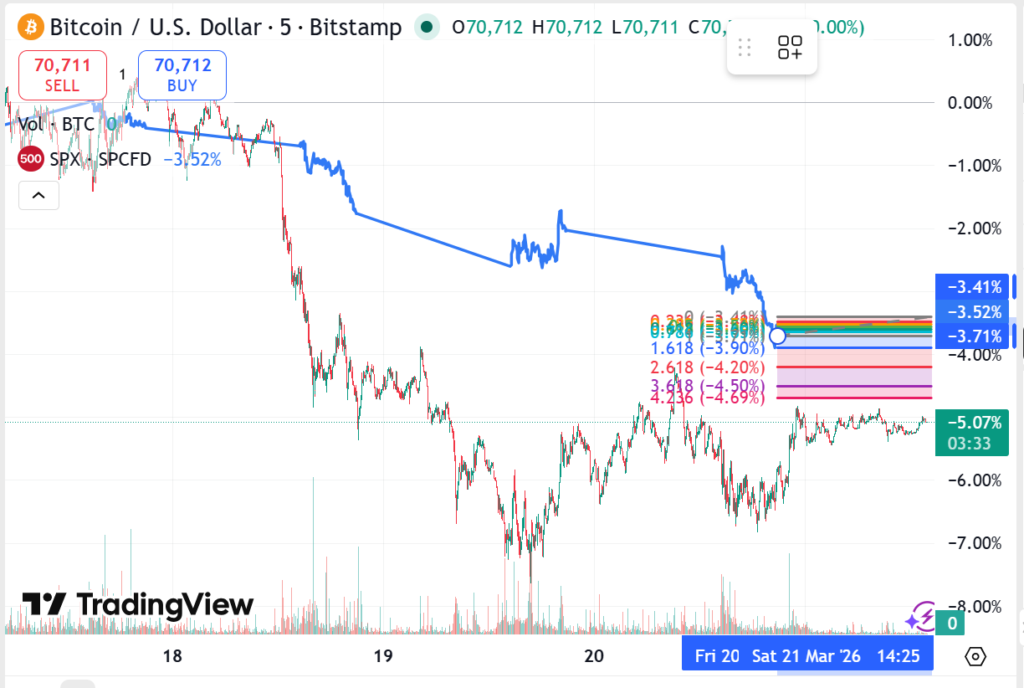
Bitcoin fell to $69,398 before closing above $70,000.
-
Bitcoin ETFs recorded net outflows of $52.11 million that day.
The financial day of this Friday, March 20, 2026, marked by volatility that directly affected the bitcoin (BTC) market, will be recorded as a great event of technical complexity for global markets.
The “triple maturity” phenomenon (or triple witching) mobilized a record $5.7 trillion in stock optionsindices and exchange-traded funds (ETFs) on Wall Street. This is the confrontation with the largest expiration for a month of March since 1996, according to data from Citigroup, an event that forced institutional traders to a massive rebalancing of positions in just a few hours, before the expiration of options was consummated.
In this high-stress scenario, bitcoin demonstrated remarkable resilience. Despite the simultaneous expiration of some $2.1 billion in cryptocurrency options contracts, mainly on the Deribit and CME platforms, the pioneering digital currency managed to defend the psychological support of $70,000.
Although volatility dragged the price to a low of $69,398 during the session, The price quickly stabilized in the range of $70,500neutralizing the fear of a systemic collapse after the closure of Wall Street.
However, the success of technical support contrasts with a visible cooling in institutional appetite. SoSoValue data confirms that Spot bitcoin Exchange Traded Funds (ETFs) recorded a net outflow of $52.11 million this Friday, chaining three consecutive days of negative flows that accumulate more than 300 million dollars in withdrawals since March 18. This reversal in the investment trend suggests that big capital is adopting a cautious stance in the face of an increasingly restrictive macroeconomic outlook.
The pressure on risk assets is compounded by external factors that limit global liquidity. The decision of the Federal Open Market Committee (FOMC) to maintain interest rates between 3.5% and 3.75%, added to the rise in oil prices due to the war between the United States, Israel and Iran, configures an environment of risk aversion due to the increase in inflation, derived from higher costs in transportation and production.
What do analysts say about what’s to come with bitcoin?
Some analysts highlight bitcoin’s current resistance, interpreting it as a sign of market maturity. For example, André Dragosch, head of European research at Bitwise, notes that BTC acts as an early indicator of macroeconomic conditions, holding near $70,000 while other traditional assets show greater weakness. For him, this suggests that the asset already incorporates risks such as inflation and geopolitics.
Other perspectives agree that support around $70,000 serves as a solid demand zonewith post-event stabilization and potential for recovery if maintained, reflecting a stronger institutional base than in previous cycles.
On the contrary, other analysts warn of risks of correction in the coming weeks. Nic Puckrin, co-founder of Coin Bureau, describes the current context as a bear market rally, with possible declines and key resistance at $73,000 if a short-term rebound emerges.
Puckrin emphasizes that events like Expiration of options usually generates subsequent weakness (days to weeks), based on historical patterns from 2025 where the price of bitcoin increased on the day of the event, but fell consistently afterward.
Additional sources highlight that consecutive outflows in ETFs could dictate a new quarterly correction if current support fails, although the impact is considered more technical and short-term than structural.