
What adjustments have we made to the portfolios?
After energy stress, back to previous drivers
What we, like most observers, had initially considered to be a brief military intervention by the United States in a sensitive region for the world economy, has escalated to a shortage of oil and natural gas supplies to Asia and Europe. Faced with a 50% increase in the price of oil, financial markets have discounted a stagflation scenario: Higher inflation would force central banks to raise interest rates, thus slowing the economy to stagnation. This narrative is reminiscent of 2022. Back then, wages increased following the Covid-19 pandemic due to labor shortages, and prices of goods and services also rose as a result of problems in supply chains. Applied to the current situation, a stagflation scenario seems unjustified to ussince the increase in prices is mainly due to the increase in energy costs. Therefore, We hope that financial markets will soon return to focusing on artificial intelligence and private credit. We identify the biggest market distortions in bonds.
Exaggerated pessimism on bonds
The loss of purchasing power of American consumers due to rising gasoline prices negatively affects Republicans in the upcoming November midterm elections. Our main scenario assumes a prompt de-escalation in the Middle East. Where have exploitable distortions been generated in financial markets? Expectations about the evolution of interest rates have taken a turn: in February, rate cuts were still expected, for example, by the US Federal Reserve, but now the market is pricing in rate increases. We consider this to be exaggerated. We take advantage of this situation and increase the duration of global government bondswhich should benefit from a decrease in inflation fears and a relaxation of interest rates (see chart). Just dropping US yields to the level of early March would generate 5% gains on a 20-year bond. On the other hand, we close the position in government bonds in AUDwhich benefited from a 10% increase in the commodity currency. Except in inflationary phases, we continue to consider that the duration of government bonds has an important diversifying effect in a mixed portfolio.
Chart: Exaggerated increase in yields (US example)
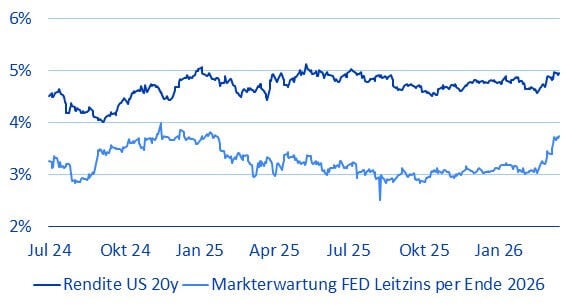
Fuente: Bloomberg, Zürcher Kantonalbank
Aviso legal para el gráfico: The performance figures relate to the underlying index. Any information about historical performance does not indicate current or future performance, and any estimates regarding future returns and risks are for information purposes only and are not a reliable indicator of future results.
Equities remain preferred, with regional adjustments
The global equity market has lost around 8% in USD terms since its peak in late February. The partially noticeable euphoria of late February has subsided, which, together with continued corporate earnings growth, supports our overweight in equities. At the regional level, specific adjustments are imposed: USA has lost significantly less in the Iran crisis, but faces headwinds from its labor market (partly due to AI) and weakened private credit sector. The emerging markets have been less favored than in previous quarters, as investors are pricing in overly ambitious expectations for large AI companies. On the contrary, the Swiss equity market presents itself differently, with overly pessimistic prospects already priced in. We made no changes to alternative investments and remain overweight gold following the price correction. Notably, alternative investments such as insurance-linked bonds successfully contributed to diversification during a turbulent March.