
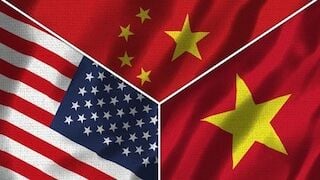
This practice has turned Vietnam into the main target of criticism by the US government. As noted Financial TimesChina’s exports to the region increased more than 20% last month, which has contributed to compensate for the fall of direct trade with the United States.
This trend He has revived the suspicions that Chinese companies are using Southeast Asian countries as a platform to avoid tariffs punitive by the Trump administration.
Southeast Asia, in the center of commercial tensions
The practice of the Transhipdo, which consists of sending products to a country to be re -rectified or minimally modified and then exported to another destination, has taken a central place in the tariff negotiations between Washington and several countries in Southeast Asia. American officials consider that this strategy is being used as an indirect route to continue exporting Chinese goods to the North American market, thus avoiding the high tariffs imposed by the US.
The American commercial representative, Jamieson Gerer, plans to address this issue during the Asia-Pacific Economic Cooperation Forum (APEC) in South Korea. There, the countries involved hope to soften tensions, in a context in which Washington and Beijing have agreed to a temporary truce in their commercial war.
Vietnam, in the spotlight
Vietnam is under special observation. In recent years, it has established itself as a manufacturing hub in the region, thanks to the departure of production from China after the first protectionist measures of the Trump era. The country now maintains the third largest commercial surplus with the United States, only surpassed by China and Mexico.
Despite this economic success, he has been repeatedly accused of allowing illegal transford. In April, the Trump administration imposed a 46 % tariff on Vietnamese products, although subsequently granted a 90 -day extension.
Prime Minister Pham Minh Chinh, during an encounter with American executives this week, acknowledged that this issue is one of the main priorities of the US in commercial negotiations. In response, Vietnam has begun to reinforce controls on this practice.
The diversion of goods, a difficult practice to track
Many companies install assembly operations in third countries in Southeast Asia or apply transformations that allow altering the country of origin of the product, complying with legality. However, Others simply resort to reffration, without adding real value, a maneuver that is illegal and difficult to track.
Recent Chinese customs data reveal that exports to the region increased by 21 % in April, coinciding with a similar fall in shipments to the US increase was especially marked in Vietnam, Indonesia and Thailand, which reinforces the idea that part of the redirected trade ends in the US market under a new label.
Commitments with the US to avoid sanctions
Since the new tariff wave was announced under the principle of reciprocity promoted by Trump, other countries such as Indonesia, Thailand and Malaysia have shown their willingness to increase surveillance over the transford.
In addition, Vietnam, Indonesia and Thailand have started conversations with the US to increase their purchases of American products and reduce non -tariff barriers.
Despite these commitments, fear of the consequences of adopting firm measures against Chinese companies persists. China is the main commercial and investor partner of most Southeast Asian countries.
Acting against their interests could trigger tensions that these governments want to avoid, in a context where many have so far maintained a balanced foreign policy.
The pressure grows and some countries could be forced to choose
Vietnam and Indonesia have based their international policy on a non -aligned strategy, such as the so -called «bamboo diplomacy» that Hanói applies. This doctrine has allowed them to cultivate close relationships with both China and the United States, without explicitly positioning themselves in either block.
However, experts consulted by Financial Times They agree that this situation could change. As the US demands more strict rules of origin and concrete measures to avoid commercial diversion, some Southeast Asian countries could have to make decisions that put their traditional neutrality at risk.
The struggle between tariffs, origin and geopolitical alliances has placed Vietnam and its neighbors in a crossroads difficult to avoid.