
To equal circumstances, Human beings prefer more goods in the present than in the future. Now, this preference intensity is different in each human being. Even the same person can vary their preferences according to the time and circumstances. The fact that we all prefer the present goods to the futures, but with different intensities, it causes them to arise beneficial opportunities for all based on temporary preference of the agents who want to exchange. For example, those who value much more present than the future will want to exchange with those people who, more valuing the present than the future, do not do so with such intensity.
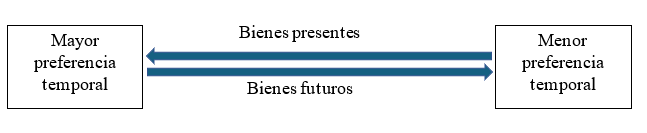
In these exchanges, those who offer goods present in exchange for obtaining greater goods in the future are known as Savings. And a “time” market arises in which goods and services are exchanged. The price that arises in this time market is known as interest rate.
We all prefer 100 euros today to 100 euros in the future, but A person with high temporary preference will require 110 euros If the acquisition of 100 euros delays a year (it is only willing to postpone its consumption in exchange for 10 more monetary units). Another person with the lowest temporary preference is willing to delay the 100 euros in exchange for 101 euros within one year (It is willing to postpone its consumption in exchange for 1 more monetary unit).
The market includes the price of this time market: the interest rate, which can be called as The temporary preference social rate. Or, in other words, The interest rate is the market price of the goods present according to future goods. In this example, the interest rate could be set between 1% and 10%. And if these two people represent the extremes of society, the interest rate would be approximately 5%. Therefore, If there is a lot of savings in society, that is, little temporal preference, the interest rate will be lower. On the contrary, If there is little savings, that is, a lot of temporary preference, the interest rate will be greater, indicating that society wishes to consume.
If necessary, take a few minutes to reread and process this last paragraph.
Source: Carlos Arenas Laorga
In the day to day we see multiple interest rate exchanges. Perhaps the first one that comes to mind is that of a bank loan. But not only. ORn Contract on behalf of others is also an interest rate contract. A saver that has a company pays today (monthly) workers to appropriate all the benefits in the future. And it is that the bank loan market is a tiny part of the time market; It is simply easier when seeing the interest rate because we observe it directly, but tOda The productive structure of the economy uses interest rate as a coordination price. That is why they are so important.
Therefore, the interest rate is the price of the goods present based on future goods, and includes the social preference social rate.
But be careful Interest rates are usually defined in economics schools such as money. This definition is a error conceptual That comes, among others, from Keynesianism and continues to be explained by all those who have not really understood the essence of interest. Keynes said that the interest rate is generated with the supply and demand of money, but no. This really determines is the price of monetary unit, its purchasing power. The demand for money, also ensured the English economist, would be determined by the interest rate, but the interest rate would be determined by the demand for money … Keynes falls into a circular reasoning. And it is nothing but the regressive theorem of Misey money that explains the determination of the demand for money. That has nothing to do with the interest rate.
Understanding the essence of interest, it can be seen that, far from what schools of thought such as Keynesian, Temporary preference and interest rates are nothing more than the two sides of the same currency, in which a human natural law (temporal preference) is reflected in a price (interest rates).
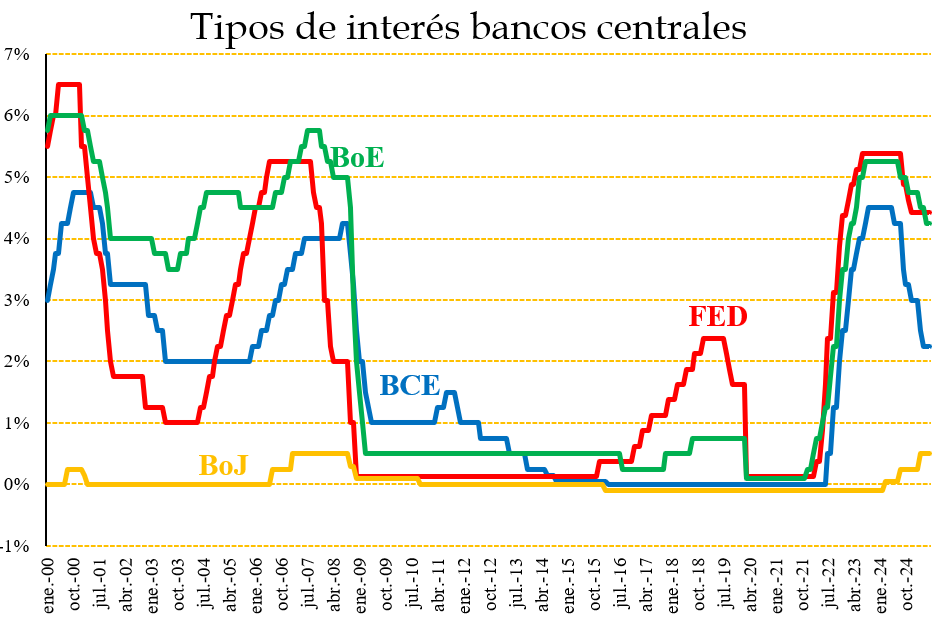
Other costal flour would be to explain that The interest ratethe most important price on the market, It is not free. That is, it is not based on supply and demand, but is imposed through central banks (central, such as those centralized planning bodies of the extinct USSR). It is as if the price of the potatoes was regulated. The bad thing here is that the regulated price is the most important. That is why we do not really know what the temporal preference is. AND From here they derive a good part of the bad investments that become crisis. But this is also another issue that we are not going to deal with.
Article based on the book The courage of ignorance