

The climb of any value is usually a reason for joy, but it is that technological actions have risen rapidly for five consecutive months in the middle of Optimism for artificial intelligence or AI and the possible interest rate cut of the Federal Reserve. This has also led investors to take protection With an increase in sale optionsaccording to Bernard Goyder en Yahoo Finance.
The price of covering itself to a 10% drop of ETF research qqq trustthe largest bottom in stock market that replicates the NASDAQ 100during the next month he is in his higher level since 2022 compared to the cost of protection against a similar rebound.
«The market is at maximum, the volatility in minimums. I think there are many easy arguments to justify coverage,» he said Greg Boutle, Director of Variable Income Strategy and American Derivatives at BNP Paribas SA. «September is also usually a little calmer seasonally.»
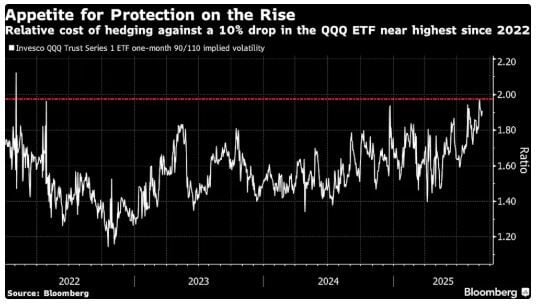
This indicates a growing concern to a series of events that will influence the market during the next month, including the Fed decision on interest rates on September 17 and the consumer price index report that will be published later on Thursday. According to Nomura Holdings Inc., the deviation between purchase and sale options (Put-to-Call) In QQQ, only the 8% of time in recent data.
Growing uncertainty
«Since exposure to high -performance technological companies seems attractive from any point of view, the more the group rises, the more investors are forced to protect themselves to a possible collapse of the market,» according to Charlie Mcelligott, Nomura cross asset strategist. This is further promoting the deviation between purchase and sale options at a time when the demand for purchase options remains relatively low.
«It is likely that the coverage has been added to protect the long -term variable rental portfolios from a possible market drop,» According to Christopher Jacobson, co -director of Derivative Strategy in Susquehanna International Group. Undoubtedly, the deviation between purchase and sale options measures the relative cost of the sales and purchase options, and not the real price paid by investors for falling protection, which is lower than that registered in April, during the peak of uncertainty of the commercial war.
While high volatility indicators are not giving alarm signs (The vix index is below 16), There is a sense of obvious nervousness beyond great technological actions. On Tuesday, an operator paid around 9.3 million dollars for bearish options on the SPDR S&P 500 ETF Trust, a position that pays if the S&P 500 It falls 3.6% before September 19. And on Monday, an investor bought a long -term coverage against a 58 % collapse of the S&P 500 before December 2026 by 13.4 million dollars.
«These movements make sense considering that actions usually have a lower yield in September, with the market falling 56% of the time, the greatest fall of any month since 1927,» according to data from Bank of America.
For Boutle, the current situation of stock markets is similar to that of 2019when a solid streak in the first half of the year gave way to foci of weakness in the second semester, just after the Federal Reserve reduced interest rates.
Recommends your customers to buy Protection against a 5% drop in S&P 500while selling insurance against a deeper fall, which according to him is unlikely to materialize.
«We focus on superficial coverage instead of the most flexible,» Boutle said.