
Why now?
Bitcoin is no longer a marginal experiment. Digital assets represent the 1.7% of the overall portfolio of traded marketswhich marks its landing as a class of institutional assets. Bitcoin represents on its own 56% of the total capitalization of the cryptocurrency market, as shown in the following graph, which reinforces its condition of active anchor in digital markets.
The true issue for investors is no longer whether Bitcoin must be part of a portfolio, but how much to assign.
The tests
In blind tastings, consumers have historically preferred Pepsi, but they finally choose Coca-Cola for pure custom. Investors run the risk of making the same mistake: holding on to known frames ignoring the Bitcoin advantages. A 2% assignment Challenge that bias without checking your portfolio.
- High reward, low cost: A Bitcoin 2 % allocation in a 60/40 global portfolio added a 1.3 % annual profitability for just 0.19 % additional volatility. The 0.97 resulting information ratio is exceptional for asset management standards, where most strategies fight even half of that level.
- Low correlation is secret sauce: The low correlation of the bitcoin (around or below 20 %) with the variable income and fixed income guarantees that the volatility of the portfolio barely increases.
- Asymmetric yields: The Bitcoin was the most profitable asset in eight of the last 11 years. In the three years of delay, the performance was much lower at the asset level, but only marginal at the portfolio level.
- Resistance to bass markets: Even during the cryptoinviernos in which Bitcoin collapsed individually more than 70 %, the 2 % assignment only slightly reduced the profitability of the portfolio.
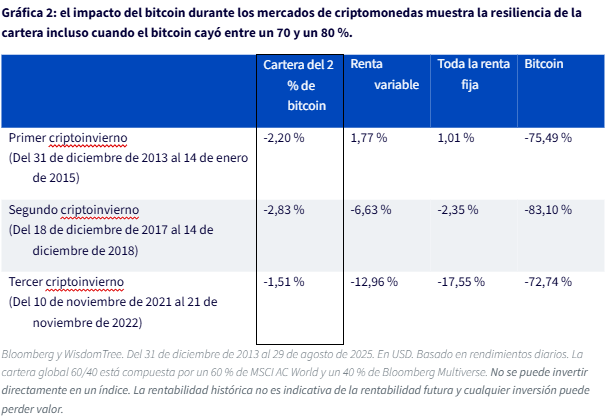
As shown in the previous grapha disciplined assignment of 2% It provides up -to -unbassed up -to -down rise exposure.
Neutral allocation with protections
Not having bitcoin in a multi -active wallet is not being «neutral.» It is an active infraponderation, a structural commitment against this kind of rapid assets. However, Bitcoin remains volatile: profits usually occur in bursts and falls are inevitable. The solution is a disciplined roadmap that balances the opportunities with risk control:
- Systematically unravel: Avoid the deviation of the allocation and crystallize the profits.
- Wallets subjected to stress tests: Make sure the falls remain contained during cryptoin viens.
- Establish a model: Execute historical tests and in different windows with respect to your reference point.
- Supervil was: Perform volatility, maximum falls and performance ratios over time.
- Periodic review: Check the assumptions as adoption, regulations and correlations evolve.
This pragmatic process guarantees a restrained assignment (around 2%) that takes advantage of Bitcoin ascents while maintaining the firmly controlled portfolio risks.
Conclusion: an intelligent and restrained trend
An assignment of 2% It is not radical. It is a strategically thought trend, since:
- Take advantage of the asymmetric advantage.
- Increases risk only partially.
- Align with the Invertible global market.
- Responsibly scale within a traditional framework.
For wallets looking for so much resilience as relevance2% in Bitcoin is no longer optional, it is the smartest starting point.