
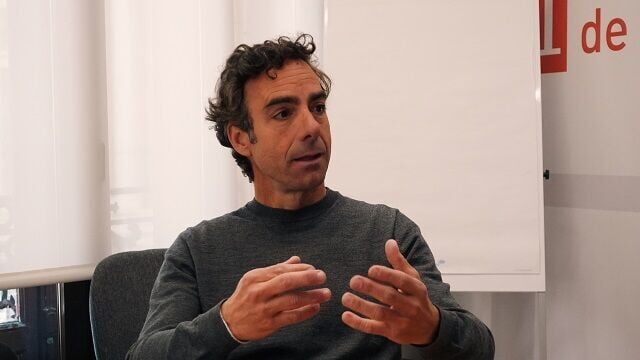
Javier, considering your experience in financial markets, how do you think artificial intelligence is redefining data analysis and investment decision making? Do you see a future where fund managers are replaced by algorithms?
We are undoubtedly facing an immense change. To put a metaphor, in the 80s the arrival of the Bloomberg terminal revolutionized finance. Because? Because he concentrated all the information in the same place, accelerating decisions and transforming the way to invest. I was on bank and I remember that customers already asked: «Is this in Bloomberg?» It wasn’t just a screen, it was a cultural change.
Artificial intelligence is on the same path, but multiplied by ten thousand. Although it seems like a productivity software, it is actually rearranging how companies work, how assets are valued and how capital moves. Bloomberg opened the door to automation; The AI, on the other hand, is becoming the basic infrastructure on which everything works. There will be no finance, companies or business models without artificial intelligence.
In the specific case of financial analysis, AI allows you to process impossible information volumes for a human, detect invisible patterns in classic models and generate value in new forms of analysis. For example, I have trained in the creation of my own GPTS, but not the food of the network, but of verified data. In my case, I use all the knowledge of Warren Buffett so that my model analyzes companies with Value Investing criteria. That makes the difference: it is not about using the generic AI, but about creating systems with unique, well -labeled and governed data.
Will it replace the managers? Yes, largely. Many people talk about a role change, to go from being stock pickers to machine supervisors. But the reality is that 70% of the volume in the US is already in the hands of algorithms. What is coming is greater precision, speed, data governance, elimination of emotions … It is a real revolution.
And what role can artificial intelligence play in asset token?
Here I see it more as an optimization process. The help in all phases: from the initial assessment of a token to liquidity management. Signatures such as Wellington Management are already applying in regulatory compliance, because it allows to expedite workflows with security and without errors.
In practice, AI automates processes such as KYC, data verification, oracle integration or real -time pricing. It can even generate Smart Contracts automatically: from dividend payments to regulatory property or compliance transfers. All this reduces human errors and accelerates the emission of tokens. In addition, thanks to predictive analysis and advanced liquidity management, tokenization will be increasingly efficient and transparent.
To manage all this volume of data, is Blockchain essential?
Blockchain brings security and traceability, and that is not a minor issue. Today half of the data that circulate can be false or of doubtful origin. A distributed network can certify origin, integrity and property, reducing manipulation and reinforcing transparency.
In addition, the tokenization of the data itself allows them to use them without moving them, taking the model to the data instead of sharing sensitive information. The challenge is that all this climbs well, that respects privacy and is not too expensive to operate.
Artificial intelligence in crypto, defi and algorithmic trading Does it represent more opportunities or more risks?
The two things. IA adds a brutal efficiency layer: multiplies the speed and precision in algorithmic trading and optimizes defi processes, from liquidation bots to strategies in several chains.
But it also amplifies risks: flash crasshes that are self -food, saturation of strategies because all models use the same signals, or even attacks that manipulate algorithms. We have lights and shadows.
Right now IA is developed just a handful of great technological ones. Is there a risk of power concentration?
Completely. Before we talked about the big banks like those who controlled the system. Now they are technological, and the risk of centralization is very real. We are seeing it in the markets: the Magnificent Seven in the US concentrate much of the development of AI. That replicates the asymmetries of the financial world.
The alternative would be an AI distributed in web3 networks, but for now it is more a promise than a reality.
To close, what advice would you give to a retail investor who wants to take advantage of artificial intelligence in its investments?
The first is not to get carried away by the Fomo. AI is not an empty concept: we must analyze how it impacts the sectors and concrete companies. Does margins improve? Does competitive advantages reinforce? Do you demand a lot of investment in computation? That is the key.
Remember what happened with Terra in the Internet bubble: it was enough to announce a website for the action to shoot. We cannot repeat that error.
The investor must diversify: invest both in companies that provide infrastructure (chips, computation, data) and in which they develop software with the ability to set prices. And if you enter crypto or defi with AI, you have to understand the mechanisms very well.
In the end, the recipe is the same as always: discipline, rebuilding, risk management and distrusting without foundation fashion narratives.
Discover ours Free course for subscribers with Javier Molina of digital assets and cryptocurrencies