
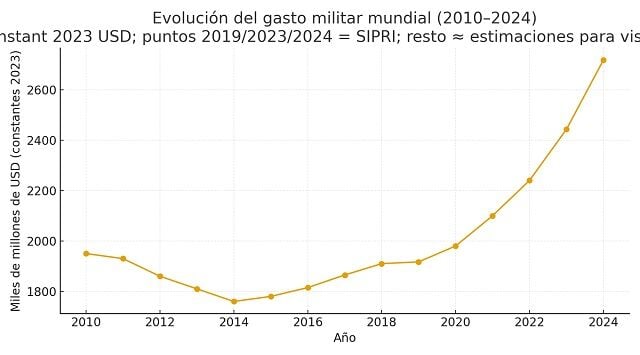
Since the end of the Cold War the countries had not increased their expense in defense. In 2024 the world military expenditure reached 2,718 billion dollars and already represents 2.5% of world GDP. With an increase of 9.4% compared to 202 the tenth consecutive year of growth is reached. More than one hundred countries have increased their defense expenditure in the last year and with it governments seek to increase their power of persuasion and their ability to deal with future threats.
The use of force to achieve territorial objectives, a trend of the nineteenth century, seems to have returned to international order. The current model, created after World War II and based on multilateralism and international organizations, seems to be in decline in the face of the law of the strongest. The Crimean War in 2014, the Russian invasion of Ukraine in 2022, the Azerbaijan offensives in the Karabaj Nagorno or the genocide perpetrated by Israel in Gaza have forced the increase in defense of the affected countries, and their neighbors.
These attacks, united to the impunity of the international community, have normalized a global interventionist drift. Not to fear strong reprisals, other countries could decide to join this trend and carry out a military incursion into foreign territory. In addition to the already active offensives, one of the largest spotlights focuses on a possible Chinese invasion of the island of Taiwan.
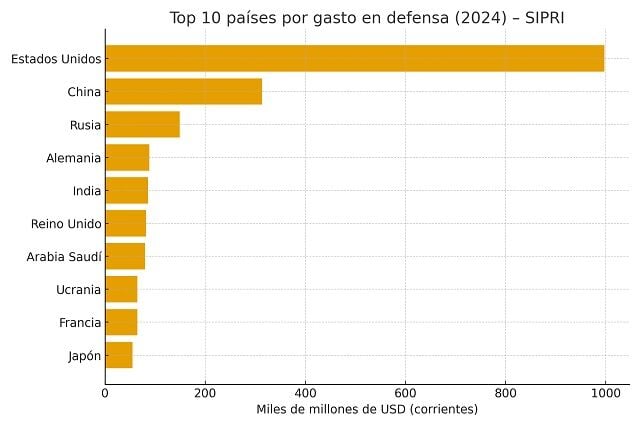
All this has come at a time when there are alliances that have weakened even though the threats persist. This is the case of countries that are part of NATO. The United States is the country with the highest expense in defense of the world, exceeding 968 billion dollars in 2024. Thus, the countries of the Alliance have outsourced their defense sector under the US umbrella, which has allowed them to strengthen their welfare state during the last decades.
But this has changed. With the beginning of his second term, Donald Trump has demanded an increase in investment in defense by the members of the Alliance. The hardness and inconsistency of US President’s decisions at the international level has made the United States a less reliable partner and, now, European countries seek their military independence. To do this, the European Commission has announced a plan that consists of an investment of 800,000 million euros in defense during the next four years to promote its own industry.
However, European rearme is not easy. In order to increase the expenditure in defense, European governments have three possibilities: cut in social expenses, increase taxes or increase public debt. To facilitate this investment, the European Commission Plan includes new fiscal rules that exclude this expense from the national debt computing.
But it is not enough, the United Kingdom has already announced cuts in international aid to deal with this increase in spending. It remains to be seen how European economies will face this new budgetary reality but in Spain, Pedro Sánchez has assured that social benefits will not be affected by the increase in defense spending. For its part, France has reported that it will try to finance this expense with the increase in economic activity that derives from this new investment.
In addition, the rearme does not consist only of achieving a greater number of soldiers and arms capabilities. The EU must seek military independence by promoting its own industries and developing connections between the armies of the member countries to achieve greater power of persuasion.
Investment in security within the current context requires applying new technologies and including artificial intelligence within the sector. In this way, it can be increased in capacity and precision while the number of soldiers on the battlefield is reduced. In addition, security is not based exclusively on dealing with a physical invasion of the territory, countries must be able to defend themselves against other threats such as cyber attacks, economic blockages or natural disasters.
All this increase in generalized military spending does not make the world a safer place, on the contrary, its insecurity increases. This dynamic known as the security dilemma states that increasing defense spending increases insecurity since the rest of the countries perceive it as a threat and respond also increasing their military capacities. Thus, a loop is generated that encourages rearmament and that can have serious consequences such as an arms race or even a war escalation.