
According to on-chain data, the total value locked (TVL) on the Ethereum network is consolidating the upward trend to new all-time highs that began this year. According to data from the TokenTerminal explorer, this is above 373 billion dollars (USD).
It should be noted that the TVL represents the total amount of money that is deposited in the financial applications that operate on the network, mainly in decentralized finance (DeFi) protocols. In this sense, it works as an indicator of trust and economic activity within the ecosystem.
Among the highlights of the value in the network is the supply of stablecoins, which, as NoticiasVE reported, has set a new record last week of $180 billion.
Amid the rise in the total value locked in Ethereum, the implementations of new contracts developed on the network remain downward. This since 2022, falling from more than 600,000 to 18,000 per week, as the following graph from the TokenTerminal explorer shows.
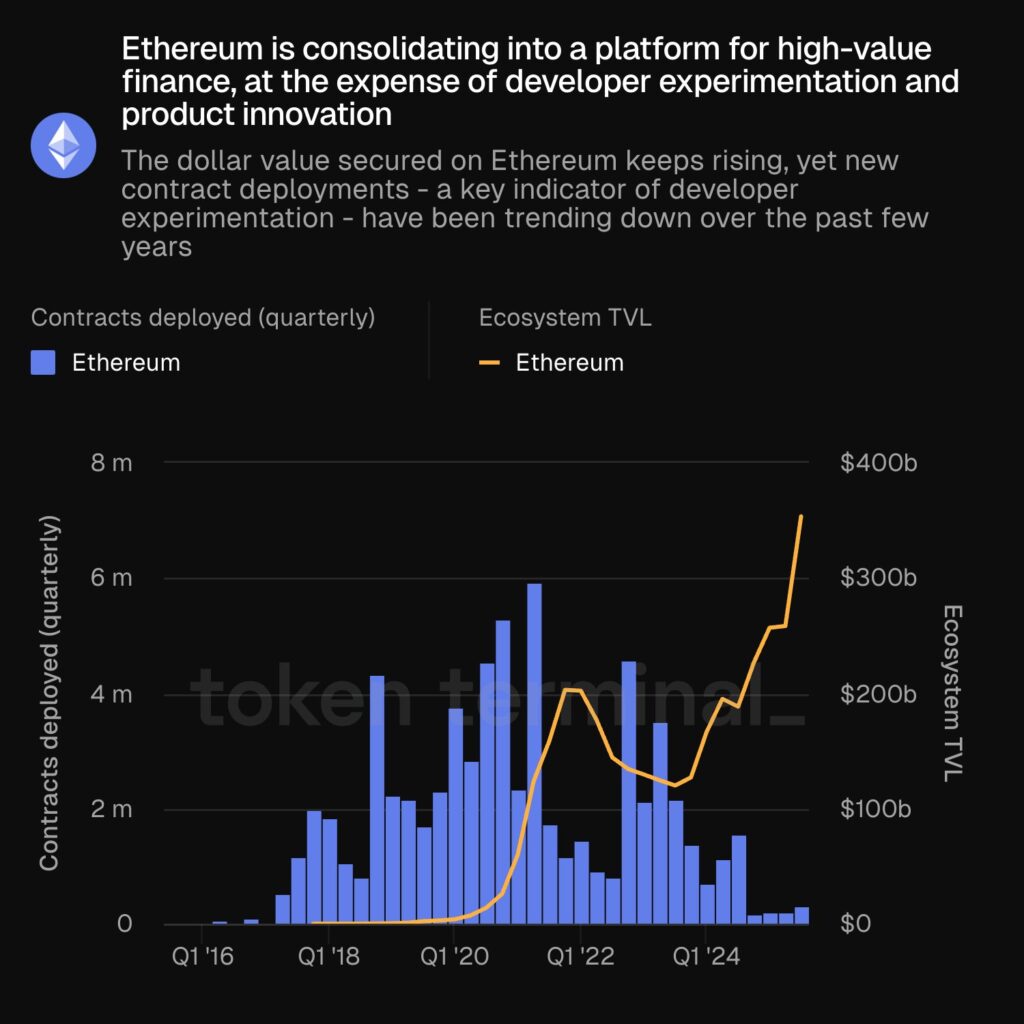
This behavior suggests a structural change in the use of Ethereum. The mainnet (L1) is increasingly focusing on financial transactions and products, which could be displacing developers towards second layer (L2) solutions or to other networks where operating costs and speed favor experimentation.
For Token Terminal, this shows that the network has become a platform for high-value finance. Therefore, he believes that “re-enabling innovation on Ethereum L1 will unlock another 10 to 100x TVL growth.”
In other words, a more favorable environment for smart contract experimentation and deployment could significantly multiply the economic value circulating on the network.
These comments come in response to a post by Ethereum security researcher Justin Drake, who celebrated progress toward “real-time testing” on the mainnet.
Drake highlighted that progress in cryptographic testing has been “nothing short of extraordinary.” He noted that in May, the SP1 Hypercube system managed to verify 94% of Ethereum L1 blocks in less than 12 seconds using 160 RTX 4090 graphics cards, while in October Pico Prism reached 99.9% with just 64 RTX 5090s and an average latency of 6.9 seconds.
The researcher explained that these advances in zkEVM tests are bringing Ethereum closer to a model where even lightweight devices such as a Raspberry Pi or a phone could validate blocks, reducing dependence on large computing equipment or the cloud.
«The vision of Lean Ethereum is gigagas L1 and teragas L2. Gigagas L1 (10,000 TPS) means high-value payments, commerce, and social applications directly on the mainnet,» Drake wrote, comparing the current moment to the «lightbulb» of technological history.
In this context, while technical progress towards a faster, lighter and more decentralized Ethereum is celebrated, there are those who warn that product innovation and developer experimentation remains a pending challenge to sustain the growth of the ecosystem.