

In old Europe it is not common to see a top leader of a central bank buy in the market. Only in the case of an unusual Mario Draghi have we seen him drive or travel on a plane in economy class like any other citizen. Nothing to do with the Fed of yesteryear, when Alan Greenspan did not miss a single social gathering with cake in Washington, with its corresponding photos.
But this time, we have seen a preview of Christine Lagarde with photos shopping in a market in Florence, where today begins that two-day meeting of the ECB, one of the two that are usually held a year outside of its usual setting, the institution’s Frankfurt headquarters. And in the market, he has talked about prices, to indicate that «We have to make sure they continue to go down because it is important.»
What will happen to interest rates at this meeting?
Lagarde has admitted that there has been a price increasebut indicates that it is lower than that of two years ago and that these are still above the 2% objective set by the ECB, although it has also recognized that the increase in the CPI is higher in the case of food.
A preview to point out that inflation is not a concern now, but that it is not time to continue either, after eight cuts and 200 basis points, lowering interest rates in the eurozone on Thursday, which is what the market is already pricing in. Let the price of money, among the countries of the single currency, remain as it is right now, at 2% in what many consider its neutral rate.
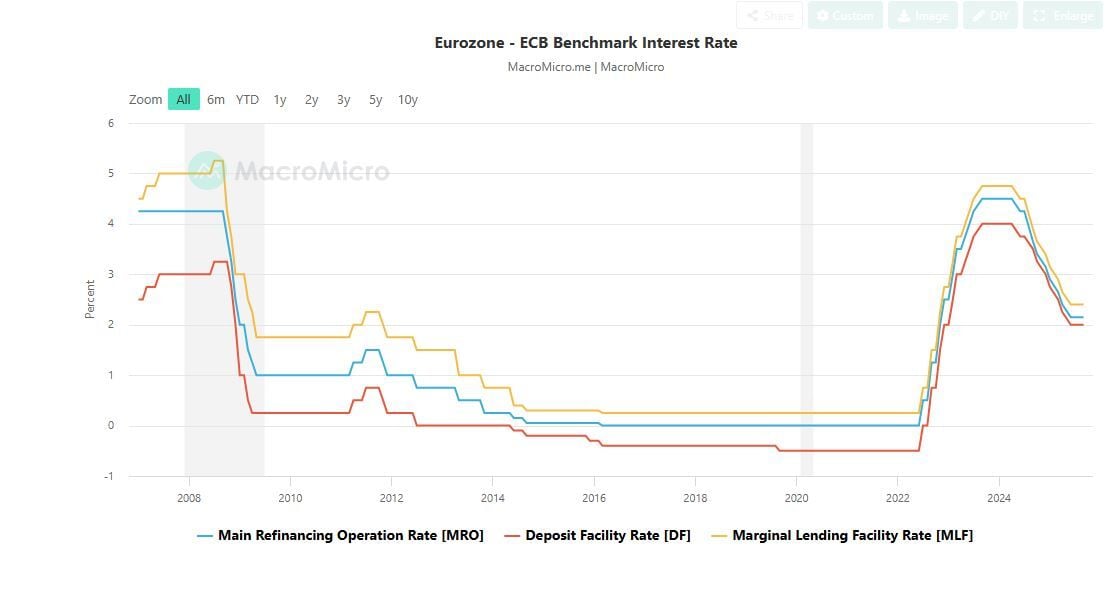
But the ECB, although it can keep the price of money unchanged right now, does not comment on whether it will keep them at this level or there is room for them to continue falling. Meeting by meeting, data by data, is the officiality that Lagarde sets on behalf of the ECB, without projecting what may happen, a very different dynamic than the one they established at the beginning of the declines, because they anticipated more and that is what the market and investors lived off of.
For Michael Field, chief European markets strategist at Morningstar, “it seems that the ECB will maintain Interest rates stable at 2% for third consecutive meetingand in a recent survey economists agree on this probable result. We certainly see logic in this decision, given inflation and the health of the underlying economy.”
And he considers that 2% to be «a reasonable level that should provide solid support to European companies seeking financing and investment in the coming months, and could also further boost regional equity markets.»
This is also indicated by the usual survey among Reuters analysts, despite the slight rebound in inflation to 2.2% from the previous 2% in August. And the reason is that the minutes of the September meeting noted that its policy was ‘sufficiently robust’ to manage any inflation shock that may arise.
But…Why aren’t rates moving lower in the eurozone?
We ask ourselves, therefore, why interest rates in the eurozone cannot be lowered further. For Vanguard senior economist Shaan Raithatha highlights that «the lack of moderation in recent economic activity and inflation data closes the possibility of a new ‘safety cut’ from the ECB. We eliminated what would have been the last cut from our forecast and «We now forecast that the official interest rate will remain at 2.00% until the end of 2026.»
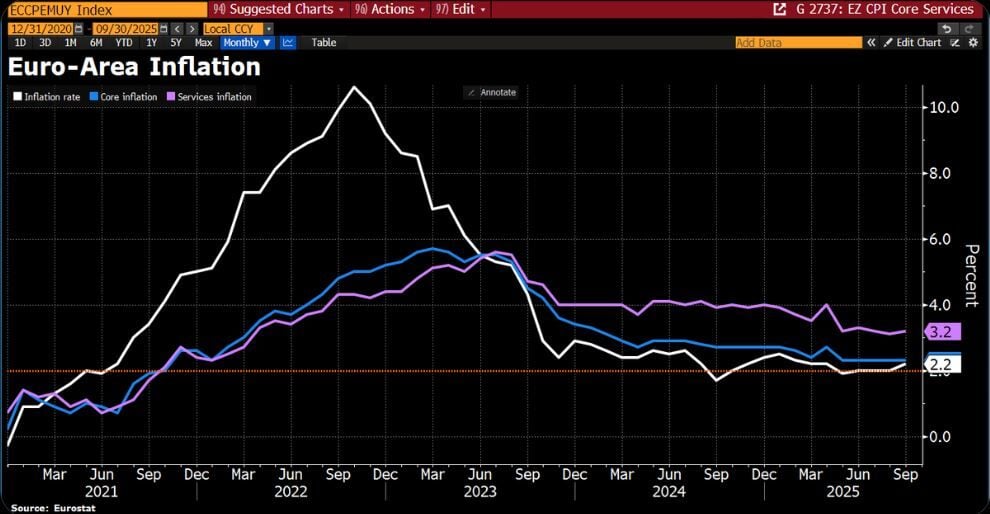
Furthermore, Deutsche Bank does not project short-term changes for interest rates in the eurozone. Instead, the German entity considers the possibility of moderate rate increases from the end of 2026 if Germany relaxes fiscal rules and the eurozone labor market remains solid. If inflation becomes more difficult to control, Rates could rise slightly to 2.5% in 2027 and 2.75% in 2028.
What will happen in the future with rates?
Although this meeting is clearly considered transitional, the one in December could have a greater impact and importance for the financial markets, according to market experts.
From UBS, its analysts point out that «the ECB discussions could form a «bridge» towards its «most important meeting» in December, when officials will present broader economic forecasts covering 2028 for the first time.»
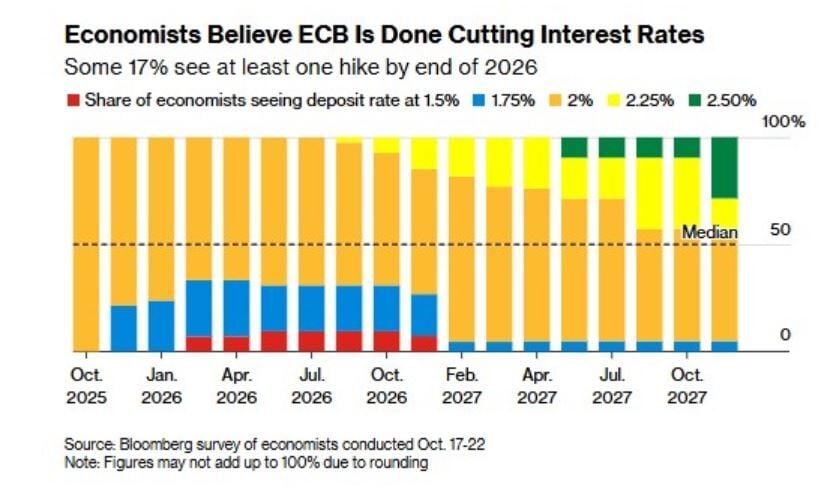
Already at Bank of America they point out that «ECB cuts are more a story of «when» than of «if»; This is our strongest conviction. We still expect a cut in December and March, but the conviction in December is becoming less. The longer it takes to provide modest stimulus, the more likely it is that, once it is cut, it will be stuck there and the normalization that we now expect at the end of 2027 will never occur«.