
NVIDIA’s results, the biggest report of the quarter, are out after the close on Wednesday, and AI star CEO Jensen Huang is back in the spotlight amid the growing promises of AI spending and how these tech companies — big and not so big — are going to pay for it all.
Data center revenue at record levels
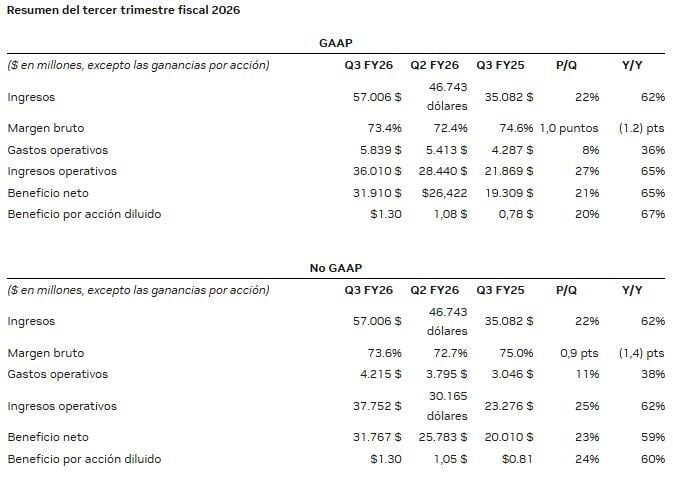
The company has announced a earnings per share of $1.30s, above the $1.25 consensus estimate, with record revenues of $57.01 billion, compared to the $54.92 billion estimated. This represents an increase of more than 62% over the 35.1 billion revenues recorded in the same period of the previous year.
Of this income, Data Centers also recorded record figures of 51.2 billion66% more than a year before, driven by three platform changes: accelerated computing, powerful AI models and agentic applications. «Blackwell sales are through the roof and cloud GPUs are sold out,» said Jensen Huang, founder and CEO of NVIDIA. «Demand continues to accelerate and accumulate through training and inference — each growing exponentially. We have entered the virtuous cycle of AI. The AI ecosystem is growing rapidly — with more new foundational model creators, more AI startups, in more sectors and in more countries. «AI goes everywhere, it does everything, everything at once.»
The company’s «computing» income in Data Centers or GPUs was a record of 43,000 millionan increase of 56% year over year and 27% sequentially. Network revenues reached $8.2 billion, an increase of 162% year-over-year due to the introduction and continued growth of the NVLink compute fabric for GB200 and GB300 systems. Networking revenue increased 13% sequentially, driven by growth in XDR products InfiniBand, NVLink™ and Ethernet solutions for AI, while delivery times and supply availability varied compared to the prior quarter.
Los Gaming income for the third quarter they were up 30% year-over-year due to continued demand from Blackwell. Gaming revenue decreased 1% sequentially as channel inventories have reached more normalized levels heading into the holiday season.
The income of Professional Visualization for the third quarter increased 56% year-over-year and 26% sequentially, driven by the launch of our new DGX Spark™ and Blackwell sales growth.
The income of Automotive sector for the third quarter they increased 32% year-over-year and 1% sequentially, driven by continued adoption of our autonomous driving platforms.
However, the GAAP and non-GAAP gross margins for the third quarter decreased from the prior year, as the company’s business model shifted from offering Hopper HGX™ systems to full-scale Blackwell data center solutions. As expected, GAAP and non-GAAP gross margins increased sequentially as Blackwell increased its mix and improved cost structure. On the other hand, GAAP operating expenses for the third quarter increased 36% year-over-year, and non-GAAP operating expenses increased 38% year-over-year. The increases were primarily due to computing and infrastructure costs, increased compensation and benefits from salary increases and staff growth, as well as engineering development costs for new product introductions.
Cash, cash equivalents and marketable securities were $60.6 billion, up from $38.5 billion a year ago and $56.8 billion in the prior quarter, primarily due to higher revenues, partially offset by share buybacks. Operating cash flow was 23.8 billion, up from 17.6 billion the previous year and reflecting revenue growth.
During the first nine months of fiscal year 2026NVIDIA returned $37 billion to shareholders in the form of stock buybacks and cash dividends. At the end of the third quarter, the company had $62.2 billion remaining under its stock buyback authorization.
NVIDIA will pay its next quarterly cash dividend of $0.01 per share on December 26, 2025 to all shareholders of record on December 4, 2025.
Fiscal fourth quarter outlook above forecasts
The forecast for the fourth quarter of fiscal year 2026 is as follows:
• It is expected that income are 65,000 million dollars, +/- 2%. Analysts’ estimate is 61.6 billion.
• It is expected that GAAP and non-GAAP gross margins are 74.8% and 75.0%, respectively, +/- 50 basis points.
• It is expected that GAAP and non-GAAP operating expenses be approximately 6.7 billion and 5 billion, respectively.
• It is expected that other GAAP and non-GAAP income and expenses be approximately $500 million, excluding gains and losses on unlisted and publicly offered equity securities.
• It is expected that the GAAP and non-GAAP tax rates are 17.0%, plus or minus 1%, excluding any discrete elements.
With a market capitalization of $4.6 trillion, more than the market capitalization of all but 33 listed companies in the world, the results represent «an important moment of validation of the AI revolution and a positive catalyst for technology stocks heading into the end of the year, as some investors continue to underestimate the magnitude and scope of AI spending,» he says. Manuel Pinto, XTB analyst.
Nvidia is at the center of the AI boom, and counts all the big cloud companies and AI labs as clients. All the big AI labs are using Nvidia chips to develop next-generation models, and a handful of companies called hyperscalers have invested hundreds of billions of dollars in building new data centers around Nvidia technology in unprecedented developments.
Last month, Huang said Nvidia had $500 billion in chip orders in calendar 2025 and 2026, including the upcoming Rubin chip, which will begin shipping in volume next year. Analysts are focusing on learning more about what Nvidia sees coming from the world of AI infrastructure next year, because the top five AI model developers in the US use the company’s chips.
Will the results help him get out of the side in which he has been immersed for months?
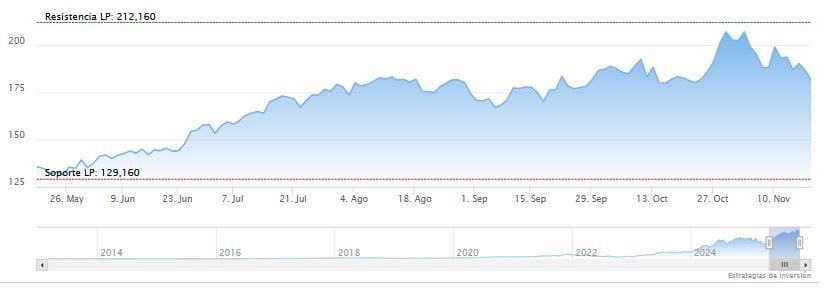
José Luis Cava, independent analyst He believes that the most relevant thing to look at is the revenue from the data segment to see if the “historical investment in artificial intelligence infrastructure” is justified. You may be interested: Today everything revolves around Nvidia, levels to watch. The price of the chip manufacturer has reflected the growing uncertainty in the technology sector and, since last October 29 it managed to become the first listed company to exceed 5 billion dollars in capitalization, its shares have already accumulated a decline of 12.4%, after ending yesterday’s session at 181.36 dollars, the lowest at closing since last October 22.
Since August 28, the date on which the previous results were published, technology has moved flat…. «a lateral movement within an upward trend. Despite the strong drawdown of Bessent’s liquidity, the fact that the price remains sideways is very good,» says this analyst. Once the results are published, Cava highlights, it is best to stay still. «The $200 level is a wall due to the sale of street options and support is at $160. As long as it remains between $164 and $200, there is pure noise in the value.»
Today the value has closed the session with increases of more than 2% that have taken it above $186 and after hours it is rising more than 4%, up to $193.78.
Despite doubts about whether the company will be able to maintain the growth rate, the truth is that the analyst consensus maintains a positive potential for the value above 25%according to the Reuters consensus, which draws a price target of $235.29. Of the 65 analysts collected by Reuters who cover the stock, 59 continue to maintain their buy recommendation on it.
In recent sessions, several analysts have raised their price targets on the stock – among them BNP Paribas, Exane, Stifel and Bernstein – and reiterate a buy recommendation for the stock, reflecting that the confidence of large market institutions remains intact and they even foresee a strong appreciation in the price of Nvidia shares on the stock market.
Among the positive milestones for the company is the alliance with Microsoft and Anthropic to scale Anthropic’s Claude on Azure using Nvidia technology. This agreement strengthens long-term demand visibility for Nvidia GPUs and services. Additionally, Brookfield launched a $100 billion AI infrastructure program with Nvidia as a founding partner. This institutional channel will likely drive Nvidia computing demand for several years.