
-
Bearish indicators come into play in the cryptocurrency market.
-
Ted Pillows sees a more complicated scenario if bitcoin loses the $80,000 level (USD).
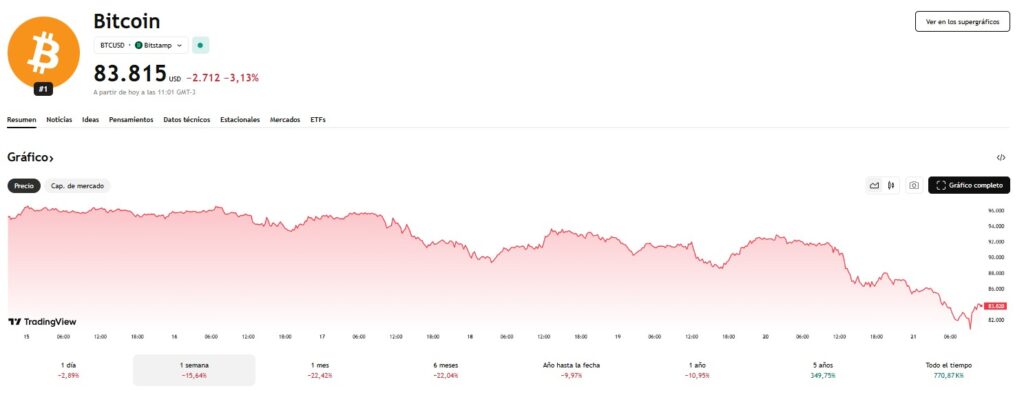
The price of bitcoin (BTC) fell, approaching the $80,000 (USD) area, a level that keeps the market in suspense after several weeks of weakness. A massive wave of withdrawals put downward pressure on the price and ignited debate among traders and analysts about whether it is time to sell or take advantage of the fall to accumulate.
This correction could give way to a period of lateralization near these levels or even a rebound if buyers manage to defend the area. Although, as NoticiasVE reported, if the selling pressure becomes exasperated, lower prices would not be surprising.
Among those who identify possible purchase ranges is trader Scott Melker, host of the podcast The Wolf of All Streets. In his opinion, the key investment point is in lower prices than the current one. This is how he expressed it on the social network X: «$74,000 is strong support. I will buy more there if we get to that level. If that support fails, the real opportunity will be bitcoin at $55,000.
Melker also noted that in previous cycles, every time the price lost the 50-week moving average (MA) like now, it ended up retracing back to the 200-week MA, forming a multi-month bearish period.
Currently, the 200-week MA is at $55,000, so that could be the low zone of a bearish streakfor the analyst. However, he warned that “that does not mean that it will happen again; The sample size is small.
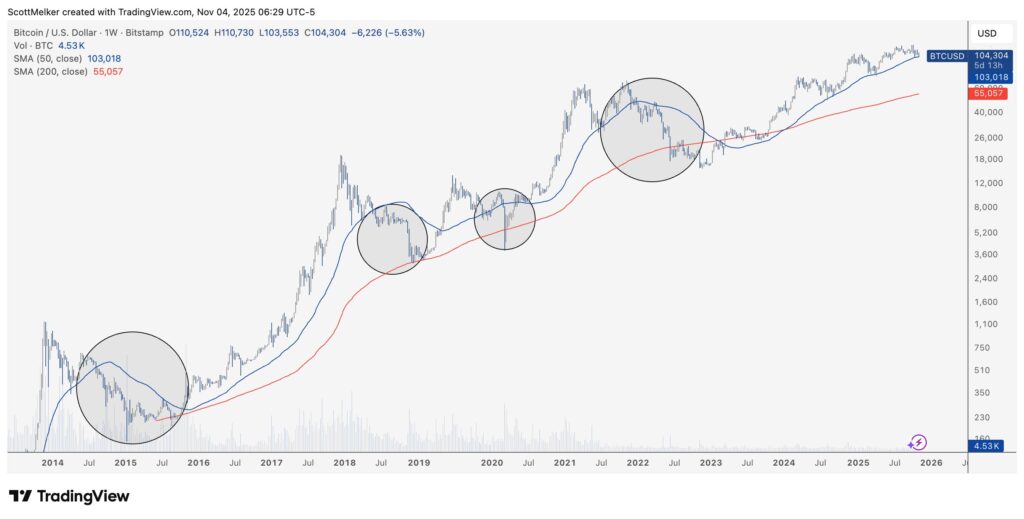
The analyst resorted to the historical context to put the current decline in perspective, indicating that a decline like the one now has not always meant the end of the bullish cycle.
«I’m old enough to remember when bitcoin went from $65,000 to less than $30,000 in just 30 days in 2021, and yet that year is remembered as one of the most bullish in crypto history. A 55% drop in the middle of a bull market. Then it rose again to 69,000,” he mentioned.
The feeling worsens and the alerts grow
For his part, the technical analyst known as «Rekt Capital» points to signals that, in his view, invalidate previous bullish structures. «Bitcoin failed to recover the 50-week exponential average (the 50 EMA). When the price loses this level and does not recover it, the bullish structures that we had are broken and the general trend (the macro) becomes bearish. he qualified.
It should be noted that the MA and the EMA, although they are often mentioned in a similar way, are different tools. The MA (simple moving average) averages the prices of the analyzed period without distinguishing between recent or old data, while the EMA (exponential moving average) gives greater weight to the most recent candles. That’s why the EMA tends to react faster to sudden changes in the market, while the MA reflects broader trends.
Meanwhile, the trader Ted Pillows sees demand levels that could support the price in the current area: “Bitcoin has decent buy orders around $80,000–82,000 on Binance.” However, he warns that if this level fails «bitcoin will go directly to $74,000.»
Bitcoin’s decline intensifies the debate over whether to buy the pullback or sell. Specialist Quinten Francois believes that market sentiment is at one of its worst moments in years: “The sentiment is worse than during the FTX collapse and the COVID crash. Yes, we can fall further; Nobody knows where the bottom is, but in a couple of years you will dream of buying at these prices.
Between rebound expectations and fears of further deterioration
These positions coexist with the vision that, in the long term, bitcoin could once again seek record prices, as has happened in previous cycles.
However, it is important to remember that past behavior does not guarantee future results.
That is to say, Any recovery will depend on the real balance between supply and demandin addition to the macroeconomic context that sets the course of the market.
The only thing close to consensus is the need to avoid impulsive reactions: the price of bitcoin, as its own history demonstrates, moves between cycles of euphoria and deep corrections that test even the most experienced traders.