
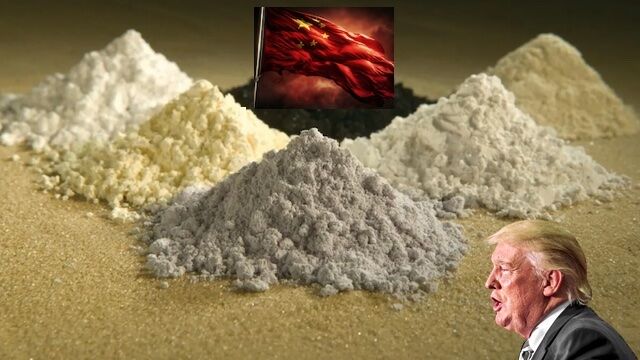
The US dependence on this element worries the industry and the Government, especially now that China, its main supplier, maintains restrictions that threaten to strangle supply.
The US authorities have strengthened their support for the most exposed domestic manufacturers and warn that the lack of stable access to yttrium could put strategic industrial projects at risk. The situation, far from being resolved, has intensified as trade tensions have increased and global inventories have begun to decline.
What is yttrium and why is it so important for the industry?
Yttrium is a rare earth element with decisive applications in high-performance technologies. It is used in heat resistant ceramic coatingsessential to protect components subjected to extreme temperatures.
It also plays a critical role in industrial lasers, sensors, superconductorsproduction of semiconductors and in certain materials used in aviation and space systems.
Its ability to improve durability, thermal stability and energy efficiency has made it a strategic raw material whose demand has not stopped growing.
In an already concentrated market, China largely dominates the extraction and refining of this material. This control gives it decisive power in global supply chains that depend on relatively small but essential volumes so that the technology and military industries can operate normally.
The situation of GE Vernova and the support of the US Government
Reuters revealed a few weeks ago that the Government of The US is providing direct assistance to GE Vernova, a benchmark in the manufacture of gas turbines, to guarantee access to yttrium.
The company relies on the element for protective coatings that allow turbines to withstand extreme thermal conditions without degrading. Without this material, the production and performance of this equipment could be seriously compromised.
The company’s CEO, Scott Strazik, confirmed that GE Vernova is investigating possible substitute materials, although he acknowledged that these replacements entail cost and performance penalties that the industry would prefer to avoid.
The government support is intended to cushion these risks and ensure that the company can maintain its industrial capabilities while Washington seeks strategic alternatives.
China tightens controls and uncertainty soars
In April, China tightened export controls on several rare earth materials, including yttrium, in what many analysts interpreted as a direct response to US tariffs.
The White House stated after bilateral meetings in late October that Beijing was willing to ease these restrictions, but Beijing has not issued official confirmation.
Meanwhile, sectors such as aerospace and semiconductors continue to experience supply voltagesfalling inventories and price increases.
This scenario has led some specialized media to describe the situation as a emerging rare earth crisisin which the availability of critical materials is being used as a tool of economic and diplomatic pressure.
A strategic response: national reserves and industrial autonomy
Faced with this situation, the United States has reinforced its national strategic arsenala mechanism designed to guarantee access to essential materials in times of interruptions. In certain circumstances, These resources can be temporarily assigned to companies to cover industrial or military needs.
The strategy points in a double direction: shielding the supply chain against contingencies and, at the same time, promoting its own productive capacities that reduce foreign dependence.
Although the road to complete autonomy is long, Washington understands that yttrium and other rare earths have become a critical vector for its economic security and technological competitiveness.