
-
Only 33,000 ETH are in the exit queue, less than 1% of those waiting to enter.
-
Technical factors and market speculation drive the rise of Ethereum staking.
Ethereum staking is going through a significant expansion phase, marked by an unprecedented entry queue of almost 4,100,000 ethers (about $9.4 billion), waiting to join the validation process.
At the same time, the exit row is barely around 33,000 ethers (ETH), which represents less than 1% compared to almost 4.1 million ETH waiting to enter. A difference that highlights the marked predominance of user interest in blocking capital on the network, rather than withdrawing it.
The data presented above can be seen in the following Validator Queue graph:
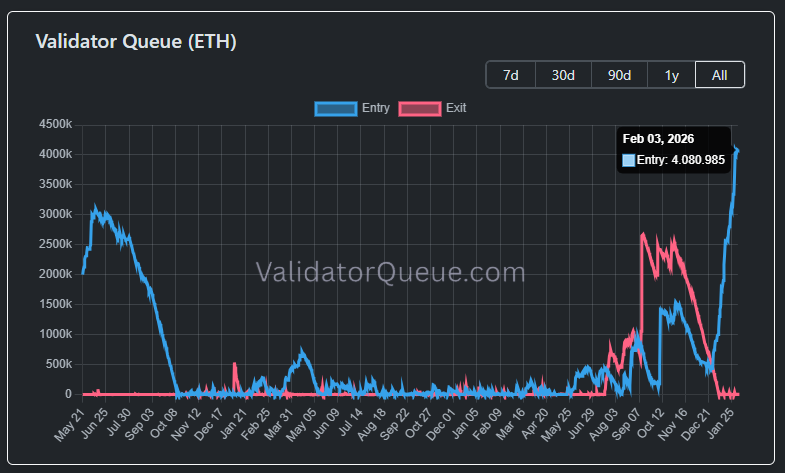
The input row represents the volume of ethers that have already been deposited and are waiting their turn to be activated as validators. It is important to note that, in Ethereum, entering staking it’s not immediate– There is a daily limit of activations to preserve network stability.
Due to these delays, the current wait times to be an Ethereum validator are up to 71 days.
In the midst of this process, the amount of ether waiting to enter staking has been skyrocketing since the end of December. As NoticiasVE reported, the figure went from 1.4 million ETH registered on January 7, to the current level of more than 4 million. This implies a growth close to 193%.
Currently there are around 36,600,000 ETH locked ($84.18 billion) in the consensus mechanism (Proof of Stake, PoS). A figure that represents 30% of the current supply, as seen in the following graph:
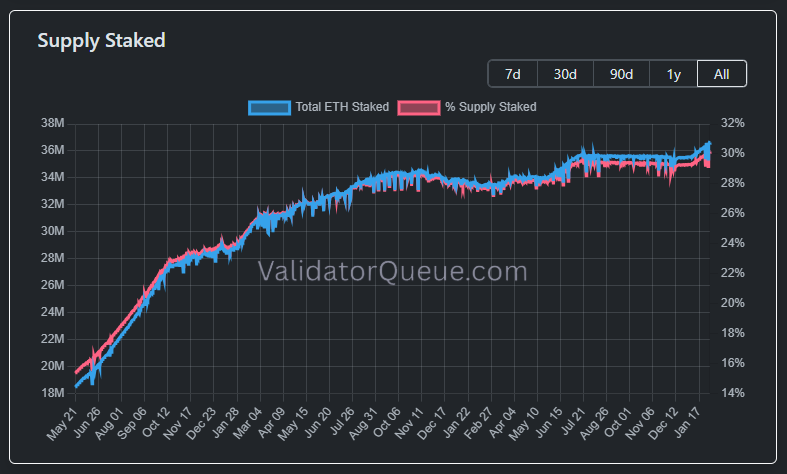
This marked imbalance between the funds entering and those leaving is framed in a particular situation: the amount of ether blocked in the system is at all-time highs.
Why is a new all-time high reached?
Staking is the mechanism by which Ethereum users lock ether coins as collateral to participate in transaction validation and network security. All this, in exchange for rewards.
Among the factors that drive staking are: some technical and others market. Among the technical ones it is worth mentioning the updates. Starting in May 2025, following the Pectra update, validators can stake a total of 2,048 ETH. An increase compared to the previous maximum amount, which was 32 ETH per validator.
These changes also enabled these participants to better manage their nodes, in addition to increasing the amount of coins for each of them.
Additionally, the growth of ethers in the entry queue can also be read in light of the price of ETH, which at the time of this note fell towards the $2,200 area. A level that discourages sales and pushes many investors to seek returns via validation, while they wait for a recovery to sell later.
Something different happens when the trend is in the opposite direction. As observed last October, when the exit queue reached 2.4 million ETH compared to 1.3 million in the entry queue. It happened in a context in which the price was around $4,600, close to its all-time high, which suggests that at that time Part of the market chose to take profits and abandon positions.
It must also be considered that many investors could consider the increase in companies incorporating ether into their treasuries as a sign of confidence. Due to this, they see it as favorable to enter staking, speculating on a future price increase.