
El Salvador has crossed the threshold of financial experimentation to enter a phase of urban transformation powered by bitcoin (BTC). What was born in 2021 as pioneering legislation, today manifests itself in a series of infrastructure projects and special economic zones that seek to anchor the global technology sector in the territory.
However, this architectural deployment still has the pending task of demonstrating that digital currency can improve the ordinary economy of a population that still observes change with caution.
The adoption of Bitcoin as legal tender in September 2021 was proposed under three fundamental promises of the Executive: banking a largely excluded population, reducing the costs of remittances, which support 20% of the Gross Domestic Product (GDP), and attracting foreign capital.
Although data from the Central Bank show that the use of bitcoin for remittances has not yet displaced traditional methods, the Government decided to deepen the commitment. Therefore, the digital currency stopped being a figure in the Chivo Wallet application to become the ordering axis of territorial planning and national sovereignty.
Under the management of the National Bitcoin Office (ONBTC), the country is outlining “intervention nodes” that function as social laboratories. On the coast, Bitcoin Beach (El Zonte) operates as the benchmark for a circular economy where the asset is the standard.
On the other hand, in the heart of the capital, the National Library (BINAES) acts as a beacon of digital literacy, where access to technology can be seen as the first step towards financial inclusion.
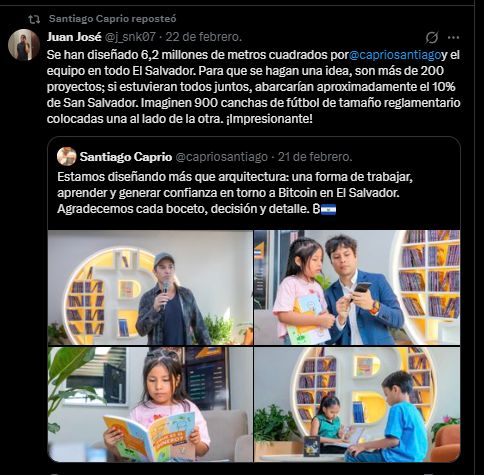
This transition towards the physical is led by Santiago Caprio, architect and urban planning advisor linked to networks of experts from thea United Nations Organization (UN). Their approach suggests that for a digital currency to be accepted, its environment must convey stability:
We are not just designing architecture; It is a way to work, learn and build trust around bitcoin in El Salvador.
Santiago Caprio, director of the Nation Development and Design Agency.
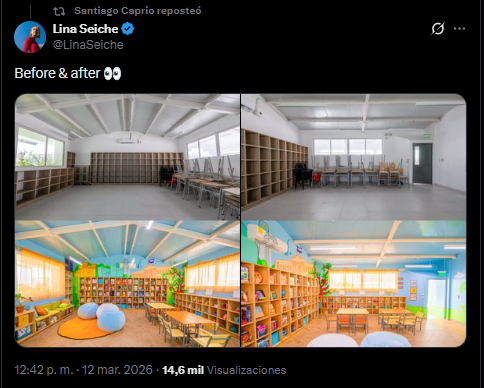
A school classroom in El Salvador has been remodeled to become a library and self-study area. The photographs show the space before the intervention, with bare walls and basic furniture. And after the intervention, with colorful paint, shelves with books, toys and additional decorative elements.
The initiative is part of a project that seeks to provide 500 similar classrooms with educational materials and reading resources, according to the original publication by bitcoiner Lina Seiche and her brand Little HODLer.
The ONBTC announced, in January 2026, the creation of two new «Bitcoin Zones», which will function as special economic areas to integrate digital technologies in sectors such as finance, tourism, data mining and commerce, as reported by NoticiasVE.
These zones include tax incentives (such as exemptions on income, asset and customs taxes). Also reliable energy infrastructure (taking advantage of geothermal and renewable sources for «firm energy»), high-speed connectivity and facilities to install data centers, Bitcoin mining farms or innovation hubs.
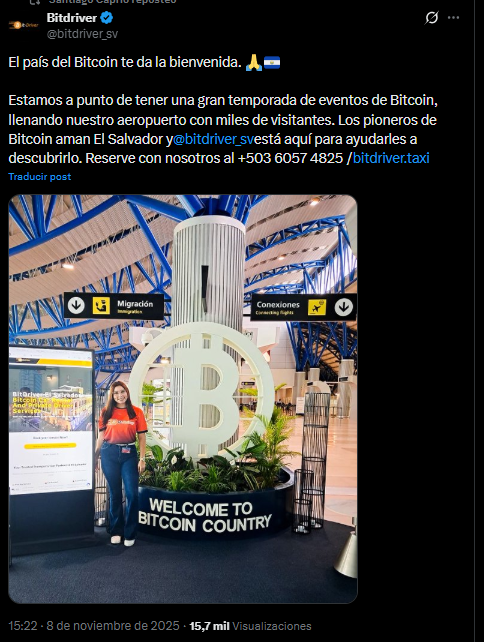
The announcement was made as part of the strategy to bolster bitcoin adoption and attract foreign investment in digital innovation, although the exact locations were not publicly revealed in initial reports. These ads They align with the urban and digital transformation of the countrypromoted by the government of Nayib Bukele.
Despite the ambition of these projects, the debate persists. While avant-garde architecture begins to modify the Salvadoran horizon, critics and international organizations point out the risk of creating «bubble cities» disconnected from the country’s rural reality.
After all, it is clear that the success of this urban metamorphosis will not be measured only by the aesthetics of its buildings, but by its ability to integrate Salvadorans into the bitcoin value chain as part of the digital economy that these walls aim to house.