
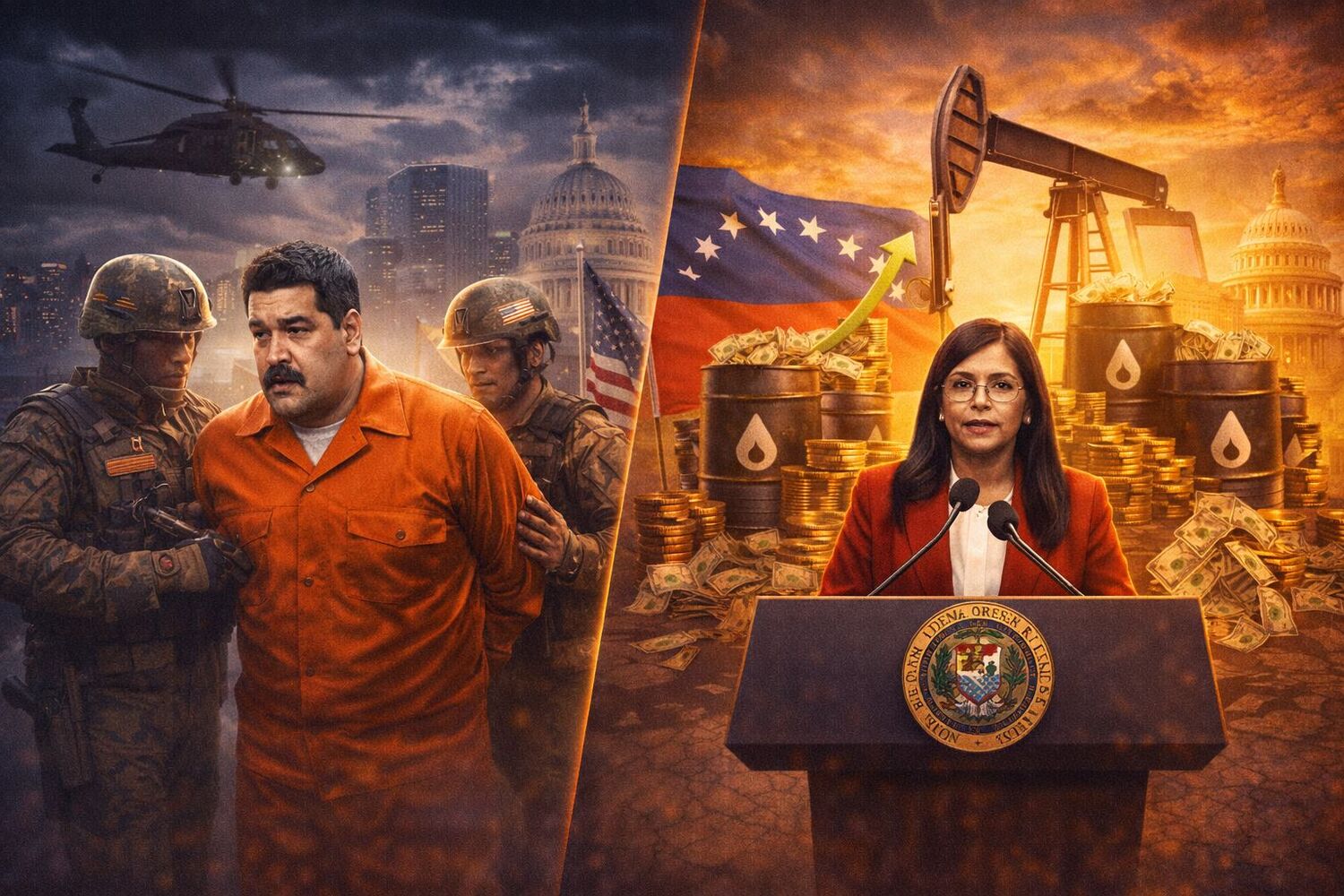
Knowing that it is impossible to know Trump’s plan, we are going to try to explain some possibilities of these events, just as we did with the tariffs. And, by the way, just as the head behind the tariffs was Peter Navarro, here it is clearly Marco Rubio.
1. Initial objective: remove Maduro
It seems obvious that this was the main objective without which no next stage of the plan can take place. Madura was a threat because of the drugs that went to North America, because of the sale of oil to the bloc of countries less similar to the United States, and because of many other things…
Beyond the judicial accusations, the US logic was twofold: weaken the Chavista regime after decades of tensions, and neutralize a political rival that had consolidated in Venezuela a model of authoritarian power and alliance with powers such as Russia, China and Iran.
2. Power transition
After the fall of Maduro, Delcy Rodríguez was appointed interim president by the Venezuelan Supreme Court of Justicein the midst of institutional chaos and controversy over the legality of the US operation. And it was Trump directly who said that he did not want María Corina Machado because she did not have the support of the country, a machada that is not so much.
This step, from my point of view, represents the heart of the strategy: not only to overthrow the regime, but de-chavize the Venezuelan institutional structurecleaning – in theory – the entire state apparatus of corruption, drug trafficking and authoritarian practices. That is, a transition regime that facilitates an orderly exit. The problem is that this interim government lacks clear legitimacy and could become a puppet of Washington. Let us not forget that Trump publicly declared that the US. They would temporarily govern Venezuela until a transition of power was achieved. That is, we will de-Chavez the structure until elections can finally be called.
Imagine that now a government other than Maduro is put in place. It gets messy. Army in suspense, with no option to do anything effective even if it has the presidency… You can make bread with some cakes. It is not easy to overthrow a regime, but it is much more difficult to build a democracy. And it seems that the United States has learned the lesson from Libya, Iraq, and a very long etcetera of its global interventionism.
3. Democratic elections in a few years
The official roadmap aims to hold transparent elections within a period of 2 to 3 yearsonce the control mechanisms of the old regime were dismantled.
While part of the Venezuelan opposition demands immediate and free elections, other actors suspiciously view the prolonged US presence as an obstacle to genuine democracy. Furthermore, the Venezuelan constitutional context does not easily contemplate these deadlines without profound reforms, which could prolong the transition status much further than desired. This point will be an internal political battlefield and a source of international criticism of Washington.
Remember that in Spain we also had to make a transition of several years from dictatorship to democracy. And that, in theory, those who took over the institutions were in favor of carrying out this modification of the structures.
4. Refloat the Venezuelan oil industry
Venezuela continues to be the country with the largest proven oil reserves in the worldbut after years of mismanagement (and sanctions), production had collapsed, as we have already said. Refloating this sector is, without a doubt, one of the central economic objectives of the US strategy.
Trump has announced that between 30 and 50 million barrels of crude oil will be transferred to US ports for sale at market price, with the idea that the proceeds benefit both Venezuelans and Americans. We’ll see…
But this plan has a clear logic, namely, recover Venezuela’s oil potentialthereby benefiting the local economy (at least in theory) and generating energy rents that could also alleviate tensions in the world market.
5. Benefits for the US
Beyond the humanitarian and democratic rhetoric, it cannot be denied that oil plays a central role in this intervention.
Entering a country with vast hydrocarbon reserves and straightening out its production not only has a geopolitical impact, but also a direct economic impact for American companies and for the Treasury itself. This type of control of key resources to influence global markets has been a classic component of American power since the postwar period.
It is true that Venezuela may be rich again, but the United States is going to take its fortune along the way. Let no one doubt it. Well, no one doubts it…
By the way, making Venezuela rich again is no joke. Between the years 2010-2020, your GDP per capita fell -88.96%. I repeat, -88.96%. And lifting millions of people out of poverty is not bad at all. As you see in this graph, Venezuela is below even low- and middle-income countries. A disaster.
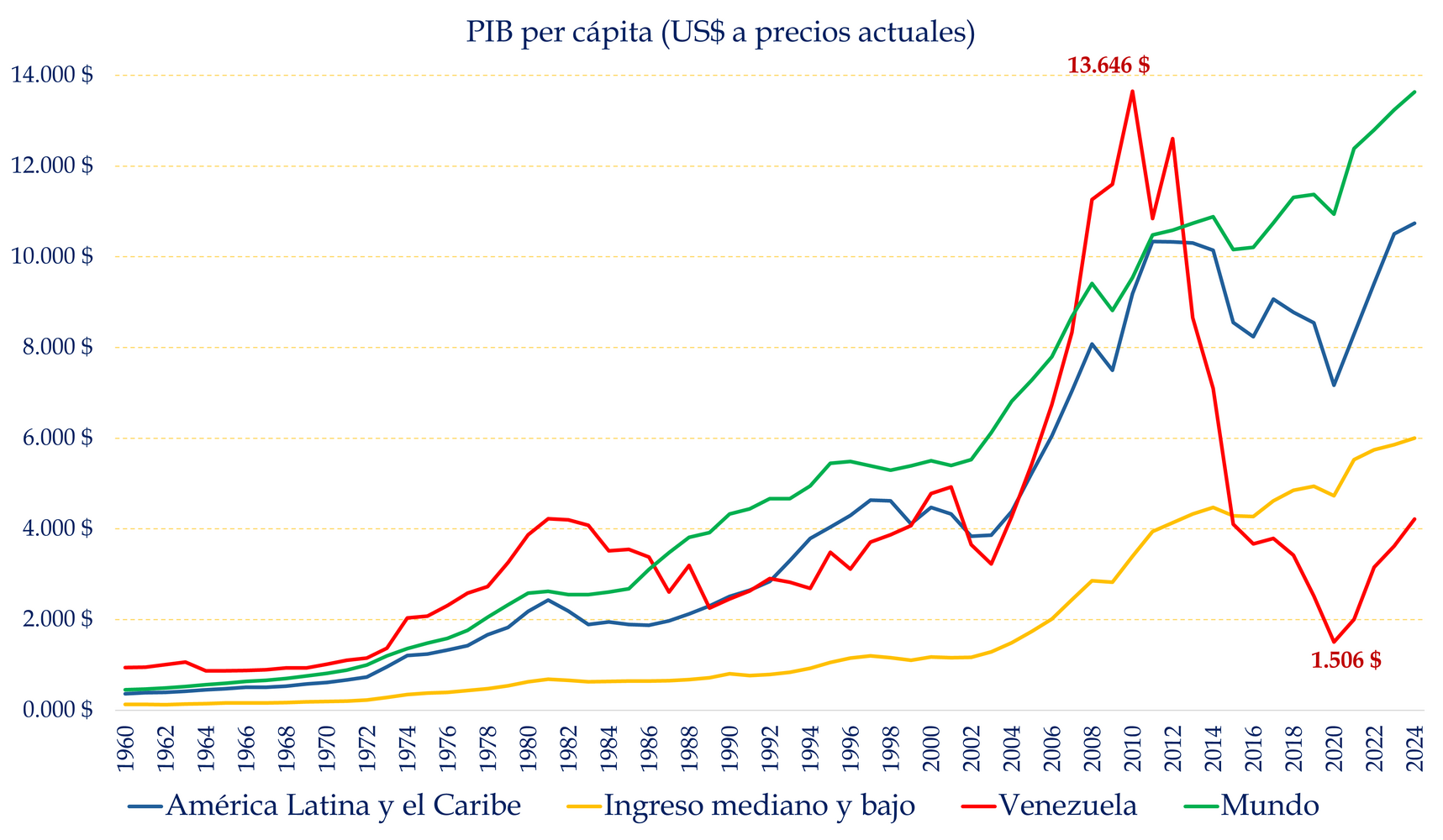
Source: Carlos Arenas Laorga
6. Cheap oil, low inflation and room to lower interest rates
What does Venezuela have to do with US monetary policy and its possible growth?
In the global economy, the price of oil is a central input. Lower energy prices reduce production and transportation costs, which tends to moderate global inflation. If the US manages to increase oil flows with Venezuelan production, it could help contain inflation. With inflation under control, the Federal Reserve would have more flexibility to lower interest ratessupporting domestic economic growth without the usual risks of inflationary pressures. And not only economic growth, but a revaluation of the stock markets and a possible debt reduction. All this sounds familiar to you, right?
We’ll see how the film evolves, but it’s not going to be a quick thing, that’s for sure. The important thing is that it is the best for Venezuelans, that there are no disturbances of order, or deaths. That little by little the country will be rebuilt and its wealth will emerge again. Dismantle a regime, reconfigure Venezuelan institutional power, and—no less important— putting oil back into play, are not minor undertakings.
Now, although it may be a wonder, the risks are enormous: from international rejection, to uncertainty about the Venezuelan democratic transition, to possible revolts.
If this works, the world will have witnessed one of the boldest interventions of the 21st century. If it doesn’t work… there could be far-reaching economic, political and humanitarian consequences.