
-
BTC resists everything. It moves more value than Visa and is the leading asset of the decade, says the specialist.
-
In a world of exploding debt and financial censorship, bitcoin is the only sovereign asset.
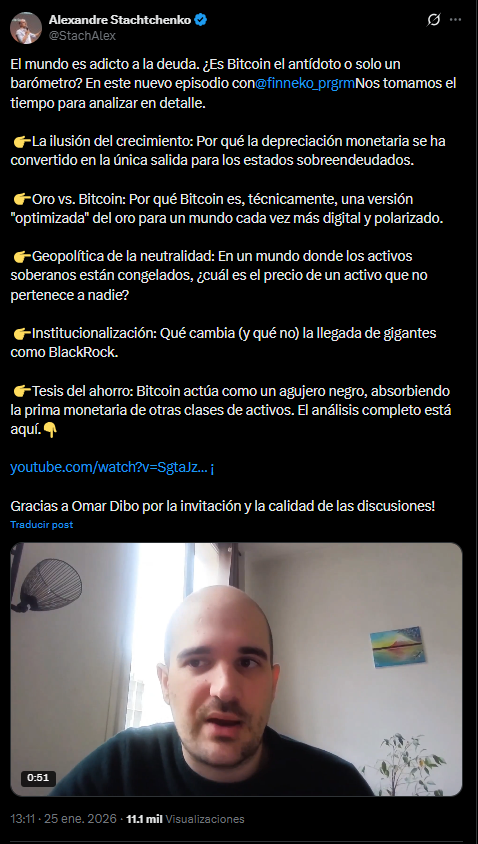
In a financial system marked by record public debts and constant erosion of purchasing power, bitcoin (BTC) is increasingly presented as a sovereign way to preserve wealth in the long term. This is according to Alexandre Stachtchenko, director of strategy and communication at Bitstack and one of the most influential voices on the pioneering digital currency in France.
In a recent interview on the Whatever It Takes podcast, Stachtchenko introduced bitcoin as the only truly sovereign asset and resilient in a world where high public debts are inevitable and the devaluation of fiat money is structural.
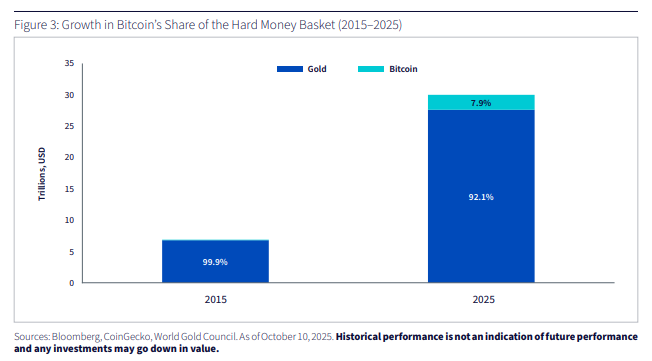
«It does not produce flow, it does not distribute dividends. It is a nugget of digital gold,» he said. Its value lies in its absolute scarcity (only 21 million units) and its “au porteur” (bearer) character, meaning that no one can freeze or confiscate it without the private keys.
«When money is created, the first to receive it – politicians and financial actors – buy rare assets before prices adjust. When it reaches the citizen, it is already devalued,» he explained, alluding to the Cantillon effect.
Therefore, bitcoin offers individual sovereignty, which for Stachtchenko “is that BTC is the only asset that you can own in full ownership in the digital world.”
To illustrate its role as an «exit door», he resorted to the case of Venezuela saying that «many people said that when they left the country they took away their gold and money. With bitcoin there are 12 words in your head that cannot be taken away from you.»
He then warned: “you don’t want to end up like a Lebanese,” alluding to Lebanon’s banking crisis (since 2019), where millions lost real access to their dollars even though the balance was still on the screen.
He referred to the crisis that continues today without full resolution. As NoticiasVE reported at the time, Lebanese banks imposed strict informal capital controls. This is due to the massive lack of liquidity in dollars (the currency in which most deposits were denominated).
Depositors could not withdraw their dollars and therefore banks froze or drastically limited withdrawals in foreign currency. In practice, many people could only access small amounts of Lebanese pounds (which were devalued by more than 90% against the dollar), or nothing at all in dollars.
Bitcoin, “digital gold” and geopolitical tool
Stachchenko defends the “digital gold” analogy by pointing out that bitcoin shares rarity, neutrality and resistance to manipulation with gold, but adds divisibility and instant transferability without intermediaries.
«Gold is not a payment system. Bitcoin is. It is peer-to-peer, auditable by anyone.» He then mentioned real examples that confirm this. From rulers to opponents in Venezuela. Also transactions between Russia and China in de-dollarization plans. “Bitcoin is used even by enemies,” he highlighted to refer to its neutrality. Bitcoin proves this because it is used by opposing actors, he said.
Real challenges and a generational horizon
In his analysis, Stachchenko acknowledges that the lack of native privacy on the public bitcoin network remains a major obstacle: «Today you can reconstruct someone’s entire financial history with a single transaction. That’s not scalable for everyday payments,» he said.
It also addresses the price, and although it avoids short-term forecasts, it maintains that “bitcoin will pass the million dollar mark. The question is when and in what context.» Hyperinflation that devalues the dollar or gradual recognition as a global reserve of value? «We don’t know that yet.»
The French bitcoiner sees the future of bitcoin as a generational process. «It is not about overthrowing the current monetary system in 15 years. It is about offering a robust alternative when the flight from fiat reaches its exponential phase.»
In that sense he stated that Bitcoin is being built as a robust parallel infrastructure and neutral that will be ready when the fiat system—due to its own internal dynamics—reaches a point of no return or deep crisis. That moment may arrive in 20, 50 or 100 years, depending on how debts, inflation, geopolitical tensions and loss of confidence in institutions evolve.
Meanwhile, each generation that adopts bitcoin (first the pioneers, then the millennials, then generation Z and beyond) strengthens the network, reduces its relative volatility, improves its usability and increases its real interest in defending the currency created by Satoshi Nakamoto, as the Frenchman pointed out.
That is why he speaks of an “exit door” that does not promise quick wealth, but rather sovereign control. That, about heritage in a world where that control is increasingly eroding. He doesn’t see it as a short-term bet, rather as a bet that, sooner or later, people will need a real and functional alternative… and bitcoin will be there, having survived and matured for decades.