
-
The development of artificial intelligence could make several industries obsolete.
-
In addition to this, political and macroeconomic uncertainties impact the markets.
With bitcoin (BTC) trading around $68,000, 46% below its all-time high marked in October 2025, the question dominating the market is clear: why did it fall? Although there are various factors, part of the answer points to the recent performance of technology stocks linked to artificial intelligence (AI).
Bitcoin is moving in parallel with traditional software stocks «They are currently under pressure from AI-driven disruption,» economist Holger Zschaepitz, professor at the Free University of Berlin and financial reporter, said on February 15.
The specialist explained that «the restructuring of the software sector is also affecting bitcoin through a liquidity channel: many software developers and technology investors own bitcoin and could be selling it to obtain cash, using it as an ATM.»
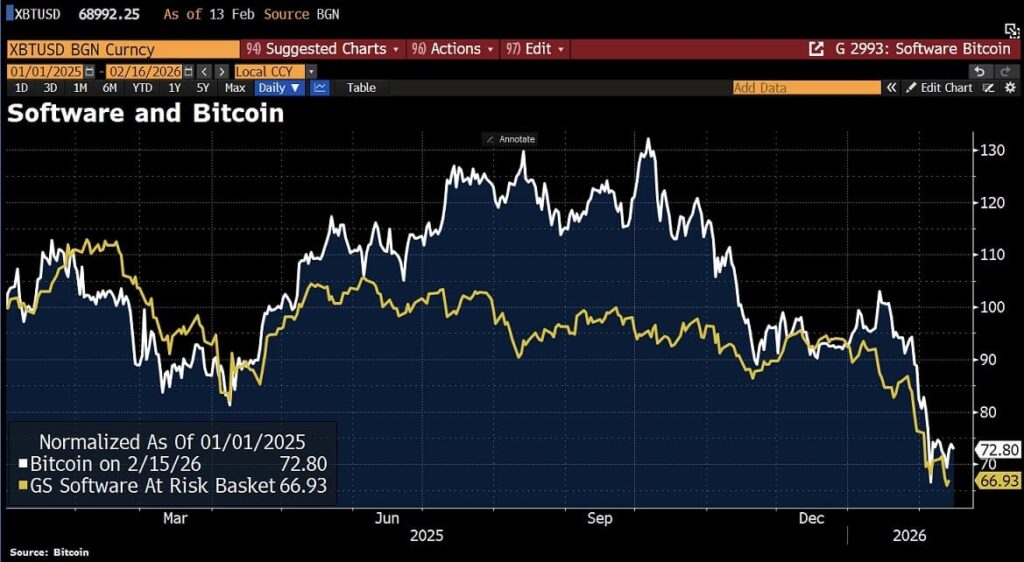
The correlated movement between bitcoin and the software sector responds to a growing risk aversion on Wall Street. This behavior, according to Bloomberg analysis reviewed by NoticiasVE last week, is driven by the uncertainty surrounding the real impact of AI on the productivity and profits of large technology corporations.
Investors fear that traditional technology industries, which require, for example, software developers, become obsolete due to the development of AI. That’s why stock valuations in the sector are falling.
In turn, the growing risk aversion in the technology stock market is partly due to fear of an “AI bubble”. Analysts warn that the sector’s profits could be overvalued given the excitement over the rise of this technology.
Caution among technology investors
Investors’ caution is also reflected in the behavior of the Nasdaq 100 (NDX), the main stock market index of technology stocks. Currently, it is at 24,500 points, 6% below its historical maximum marked in October 2025 at 26,100 points.
On the other hand, the S&P 500 (SPX), an index of the main 500 listed companies – not just technology companies – set a new record this year, at the end of January, at 7,000 points. Now it is at 6,800 points, just 2% below.
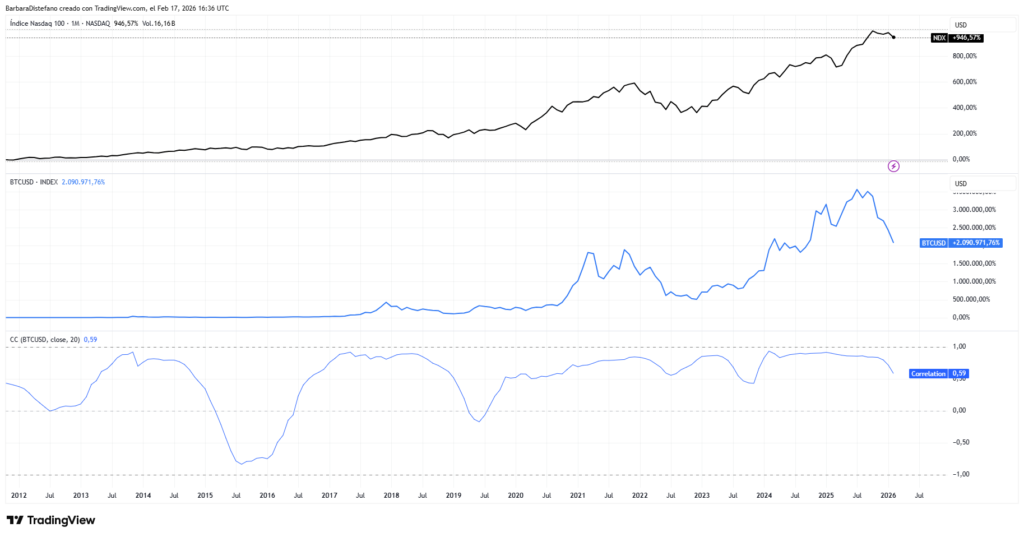
Throughout its history, bitcoin remained mostly correlated with the Nasdaq 100as seen below. The explanation behind it is that these are technological assets that are usually influenced by conditions such as global liquidity, innovation and risk appetite.
It should be noted, however, that the current fall of bitcoin does not only respond to the general feeling about the AI technology sector. There are underlying macroeconomic factors that are having an impact, such as the uncertainty generated by President Donald Trump’s tariff threats and political pressure for the Federal Reserve to cut interest rates.
According to analysts such as Daniel Muvdi, head of markets at Quantfury, bitcoin is acting as an early indicator of a period of widespread risk exit. The SPX has been on an upward trend for more than three years, which may be reflecting excess optimism.
A context marked by concerns
A is the panorama Concern is added in the bitcoin market due to the development of quantum computing. It is estimated that in the coming years this technology could decode private wallet keys if the network does not implement resistant solutions. This technological risk would also be contributing to sales pressure, while promoting initiatives to mitigate the threat.
«We have pressure from several sides: concerns about the global economy (interest rates, possible recessions…), money outflows from bitcoin funds (ETF) in recent weeks, and an environment where people sell out of panic rather than fundamentals,» says Ulises Mendieta, human capital specialist at NoticiasVE and psychologist with experience in psychotrading.
Against this, it stands out that there are large buyers of bitcoin such as institutions that continue to accumulate at current prices. “The appropriate attitude in these scenarios is the combination of calm, discipline of the investment plan and long-term perspective,” he noted.
«I do not rule out a long period of ‘up and down without clear direction’ that will test the patience of many,» Mandieta said. However, in his opinion, speaking from a long-term perspective, «the bullish cycle has not been broken, it is only on pause and cleaning up excesses.»
Meanwhile, others see the beginning of a crypto winter that could deepen and extend into the year. Although, structural factors of bitcoin such as its programmed scarcity and self-custody continue to maintain positive long-term expectations among enthusiasts.