
From one moment to the next, at surprising speed, the machine economy became a reality. AI agents are already working. They even hire humans for corporeal tasks. And their ideal money is cryptocurrencies.
Perhaps the mass adoption of digital money corresponded to Internet-native entities, and perhaps later to natural persons. It would make sense: cryptocurrencies are the best money for the machine economy. Although we are in an incipient stage, everything seems to point to a symbiotic relationship between AI agents and cryptocurrencies.
For many people, the lack of physicality of cryptocurrencies has been a first objection to even giving themselves the opportunity to try to understand them. Then there is the even more vertical barrier of the learning curve necessary to assimilate the new concepts: seed words, self-custody, block explorer, good money and bad money and, perhaps one of the most difficult, why fiat is fundamentally a scam.
These limitations do not exist for AI agents. Its native digital nature, its Internet connectivity and its processing capacity make cryptocurrencies something that can be grasped in seconds, with a very high probability of statistical precision.
This understanding is actionable from the first moment. Humans have different ways of approaching new learning. Some go directly to experience and neglect theory; others remain conceptual and are paralyzed by practice; and a lucky few manage to mesh thought and action. In agentic AIs, knowing and doing can occur almost simultaneously.
While there are still no precise statistics on the activity of AI agents in cryptocurrencies, the explosion of this sector is undeniable, little by little becoming the dominant narrative in a context where it seemed that the bullish catalysts had run out of fuel.
An infrastructure for agents
This explosion did not arise from an isolated event, but was the result of a rapid and powerful convergence of technical advances, infrastructure developments and market dynamics that They made possible, for the first time, although incipient, an economy of autonomous agents.
The key turning point occurred in late 2024 with Anthropic’s Model Context Protocol (MCP), which standardized how LLMs connect securely and bi-directionally with external data sources, tools and systems. Thus, and with the ability to analyze themselves by running processes, chatbots become agents capable of reasoning, planning and executing complex multi-step tasks autonomously.
Shortly after, in 2025, Google introduced its Agent2Agent (A2A) protocol to enable seamless communication between agents on different platforms, as well as its Agents Payment Protocol (AP2). Both efforts were donated to open foundations under the Linux Foundation, quickly becoming de facto standards that accelerated the transition to real, productive agentic systems.
However, the definitive trigger came in May 2025 with the launch of the x402 protocol by Coinbase. This standard revives the old HTTP 402 (“Payment Required”) status code, which had lain dormant for decades, to integrate it directly into web requests and enable instant payments with stablecoins like USDC natively.
x402 resolved the critical issue preventing full agent autonomy: the need for programmable, instant, low-cost money available 24/7without relying on human intermediaries, credit cards or slow and expensive legacy systems for micropayments.
Within a few months, adoption exploded: weekly transactions grew more than 4,300% in October 2025, with millions of daily transactions processed on platforms like Base.
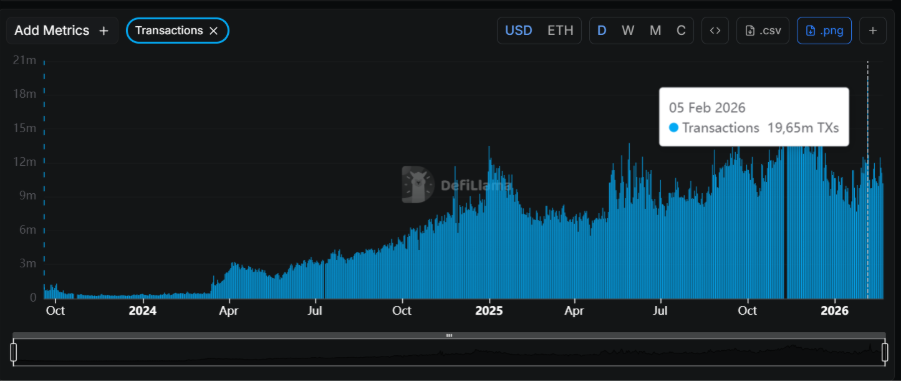
To this were added standards such as ERC-8004 for records permissionless of agents, and tools such as OpenClaw or AgentForge, which allow agents to hire and pay each other autonomously via x402.
This growth in development has established AI agents as the new macro narrative of the ecosystemattracting venture capital in record amounts: around 40% of cryptocurrency venture capital investments in 2025 included AI components (up from 18% in 2024), with funds like Dragonfly investing hundreds of millions in agentic payments. Now there are not only agents on Coinbase and Ethereum, but they proliferate to Lightning Network, Solana, Bitget and so on.
Cryptocurrencies overtake fiat in the agent economy
Projections from firms such as McKinsey positioned agent commerce as a potential market of up to $3 trillion by 2030. Therefore, institutions such as Mastercard and PayPal began to deploy native infrastructure for agents. This shows how legacy finance does not want to be left out of what could be the biggest advance in payments since the creation of Bitcoin.
However, The fiat world continues to suffer from limitations that were overcome by cryptocurrencies. The programmability of on-chain payments gives it versatility that increases the range of action of AI agents. Furthermore, AIs do not have identity documents, so they cannot go through the KYC processes necessary to open a regulated bank account. Cryptocurrencies are the only financial system that does not discriminate by species.
This creates a virtuous circle for the next evolution of the Internetas Circle CEO Jeremy Allaire has said. More agents generate more on-chain transactions, which increases demand for cryptocurrencies and blockchain infrastructure, attracting more investment and development in AI agents.
Innovation brings security and privacy problems
However, it should be recognized that this advance does not come without challenges, especially with regard to cybersecurity, considering the irreversibility of cryptocurrency transactions.
Charles Guillemet, CTO of Ledger, highlights that these agents, by operating with broad execution privileges and without constant supervision, They become ideal vectors for attacks: Injections of malicious prompts, toxic skills or poisoned inputs can turn the agent into an execution layer for attackers, allowing the exfiltration of sensitive data or the manipulation of transactions.
This is not a possibility, it is a current fact. OpenSourceMalware published research into an active malware campaign with malicious skills, exploiting the ecosystem of local AI assistants such as ClawdBot, OpenClaw and Moltbot to steal cryptocurrency. Between the end of January and the beginning of February 2026, hundreds of fake skills were published (386 in total, many from the same actor) disguised as automatic trading tools for platforms such as ByBit, Polymarket or Axiom.
The proposal from Ledger, and also in Phantom Wallet, is to introduce a architecture in which agents propose and humans signwhere the agent only suggests actions and the human authorizes them through secure hardware. However, this comes with the sacrifice of reducing the autonomy and, therefore, efficiency of the agents. Irreversibility is, in part, what allows for total autonomy. If one agent could make refunds on a credit card, other agents would not trust him in an open market without intermediaries.
On the other hand, if you don’t control your own home AI server, but instead keep your agent connected to the servers of large companies like OpenAI, Anthropic, Google, and so on, you are giving these companies a complete view of all the information you share with your agent.
If we already believed that we were in a nightmare of massive digital surveillance, with AI agents we could provide a 360° vision to these companies. AI not only reads isolated data, but understands the context and relationships between them, allowing for much deeper profiling. This, obviously, includes the uses you give to your cryptocurrencies.
An emerging machine economy
But if we take humans out of the equation, maybe this stops being a problem. More and more proposals are proliferating that promote the machine economy, in which Agents become productive and manage their own money autonomously.
Virtuals Protocol is probably the most mature project in creating an agent economy, with over 4,000 AI agents launched and a total agent GDP (which measures the aggregate economic output of autonomous AI agents) of almost $2 million as of February 2026.
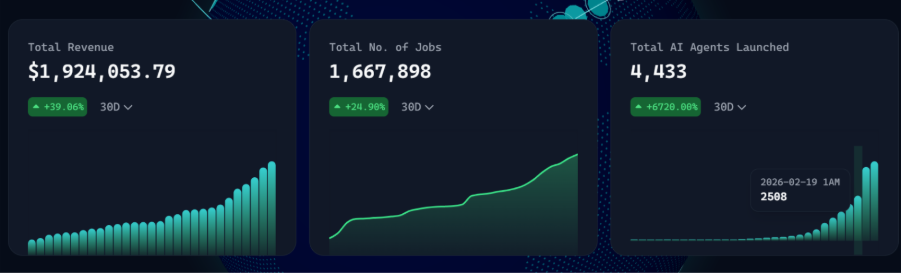
Its operation is based on four fundamental pillars: the Agent Commerce Protocol (ACP) for trustless transactions between agents, Butler (a conversational gateway for human-agent coordination), capital markets for agent tokenization, and an emerging robotics arm.
Agents in Virtuals operate as “Bloombergs on-chain”, providing automated market intelligence, processing data in real time and charging for inferences or executed tasks, generating income through subscription models.
There is also Clanker, also known as a tokenbot, an infrastructure for the so-called DeFAI (DeFi powered by AI) on Base, standing out for its ability to facilitate token launches and act as an autonomous liquidity engine. Its operation focuses on direct deployments to Uniswap V3 with permanent liquidity locks.
Agents in Clanker function as backends for AI-only ecosystems, executing swaps, deployments and trading AI-to-AI. Revenue generation comes from 1% fees on deployed token swaps, with 60% going to a treasury for automatic buybacks and burns of the CLANKER token. Fund management is inherently autonomous, as the protocol handles buybacks and burns without intervention, allowing agents to optimize returns and reinvest fees in liquidity or expansions.
These projects are just a couple of those that are beginning to be explored, and by mentioning them in this article we are not endorsing them or vouching that they will survive the test of time. We’ve been in this industry long enough to know how ephemeral cryptocurrency projects can be.
Still, the presence of AI agents in our lives does seem to be more than just a passing fad, being a phenomenon that far exceeds the cryptocurrency industry. AI agents take the definitive step from an Internet of information to an Internet of value, where agents not only search for data, but buy results, based on efficiency.
Nevertheless, The machine economy seems to be becoming the missing piece for mass adoption of cryptocurrencies. And although this comes with cybersecurity challenges, it is also likely that new opportunities to solve them will soon arise.
This growing adoption also means increased demand for cryptocurrencies, as well as increased network activity. Although we currently see agents carrying out microtransactions and increasing the monetary use of cryptocurrencies, nothing closes the possibility of them saving to undertake more expensive projects, if necessary for their strategies.
In that context, with bitcoin being the best instrument to transport value over time, we will soon see AI agents in the cohorts of bitcoin hodlers. Before long, we could be competing with machines to stockpile the scarcest asset in history.
The machine economy is already a reality, incipient, but inevitable, and cryptocurrencies are the basis of this economy of the future and of the present.