
The bitcoin (BTC) and cryptocurrency ecosystem is facing a paradigm shift driven by artificial intelligence (AI). What has until now been a market dominated by retail speculation and institutional investment could be transformed into the critical infrastructure of a new machine economy.
According to an analysis by Citrini Research presented in a futuristic and hypothetical scenario, a flood of artificial intelligence agents is projected in different areas of society and the economy. Something that will even put jobs at risk.
Given the advance of AI, it is also expected that they will use the rails of decentralized networks as their default financial system, which would boost the adoption of cryptocurrencies. Analysts at that firm believe that, by 2028, AI agents They will look for faster and cheaper options than traditional bank cards.
For them, the majority will opt to use stablecoins through the Solana network and second layers of Ethereum, where settlement «will be almost instantaneous and the cost of the transaction will be measured in fractions of a cent.»
To delve into this projection, NoticiasVE spoke with the director of the School of Computing at the Central University of Venezuela (UCV) Robinson Rivas.
He agrees that AI will be a catalyst for cryptocurrency adoption and highlights the technical superiority of these systems compared to traditional banking.
«For the Bitcoin network, if the response time on a low priority operation can be one hour, that is much better than the response that SWIFT gives, for example, where we are talking about a couple of days. So, there the opportunity for adoption is enormous. And it is enormous and it is open, because it does not depend on having to go through the filter of a financial institution or an authorized intermediary to be able to carry out financial operations,” he comments.
Rivas also highlights that AI automation removes barriers to entry that have historically protected traditional financial markets.
«Anyone who wants to operate on the New York Stock Exchange, or who wants to exchange, make investments on an international financial level, requires licenses and requires very high payments, and the commissions are enormous, that is not within the reach of the common citizen. While to operate on networks and other decentralized economy systems, it is enough to enter and have the corresponding keys. So, that is an opportunity for democratization,» he says.
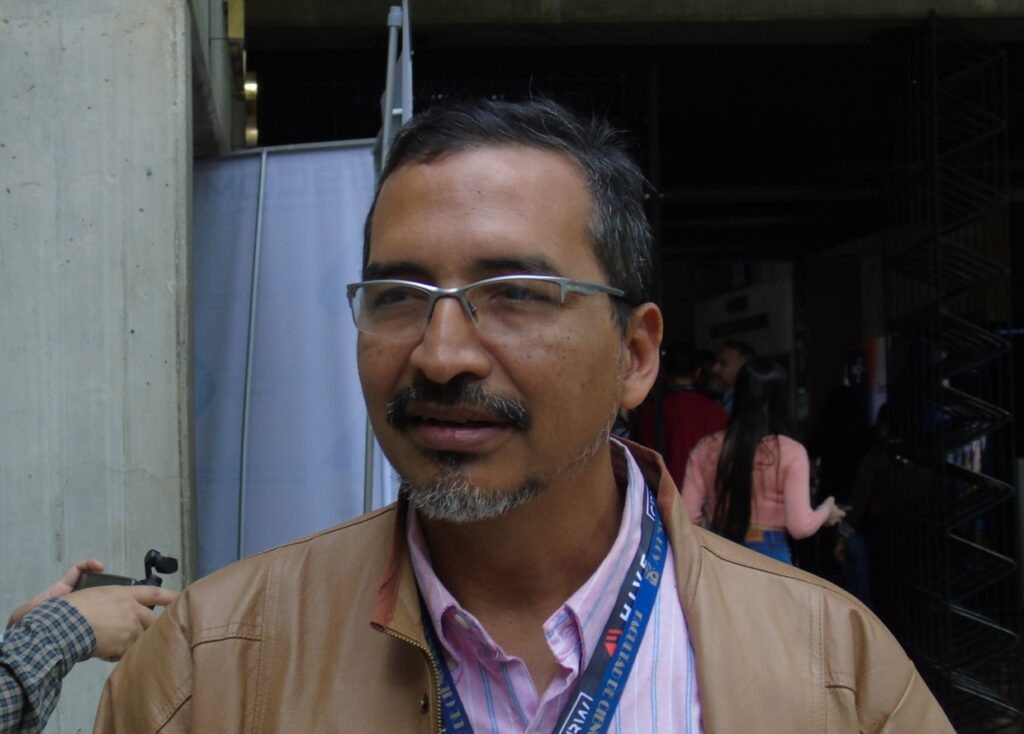
Professor Rivas’s explanation is in line with the futuristic scenario of Citrini Research analysts, because the participation of AI agents in the cryptocurrency sector would not only imply an explosion of real utility and an unprecedented volume of transactions in this market. Going further, the role of digital currencies in global trade would be redefined.
The fact is that, by not being subject to geographical limitations or banking hours, these autonomous agents could find in decentralized technology the ideal environment to execute international payments, arbitrations and settlements.
This phenomenon suggests an accelerated disintermediation of traditional banking. The above is because, to the extent that AI agents prefer stablecoins and bitcoin for their technical efficiency, conventional financial institutions They could face a massive outflow of deposits and fees.
The AI “black box” phenomenon
However, this total autonomy carries technical and systemic risks. The complexity of AI models can generate a phenomenon known as «black box»«, where the algorithm’s reasoning escapes human understanding.
Professor Rivas warns about the consequences of delegating financial control to systems that can fail unpredictably:
Systems become so complex and so large that it is beyond the understanding of an individual person to know how artificial intelligence reasoning is being done, and that is very dangerous, especially in the financial field. If there is some software failure or some information failure or some manipulation that causes the artificial intelligence systems to fail, and we can never rule that out, the human response time and the human understanding time may not be enough to recover the damages.
Robinson Rivas, university professor.
Despite these risks, the specialist highlights the operational efficiency of a bot within a distributed network is unquestionable. According to him, by possessing a private key, an AI agent can interact with the Bitcoin protocol autonomously. This eliminates the need for centralized oversight that slows down processes at traditional payment companies.
According to Rivas, “the obvious advantage is that you can carry out operations and create new innovative ways of interacting with the network taking into account different factors. You are no longer obliged to follow a traditional financial pattern or depend on the financial advice of a company, but different entities and people can operate their own algorithms.
This instant response capability and the elimination of intermediaries such as Visa or Mastercard position digital asset networks as the preferred settlement layer for artificial intelligence.
As pointed out in the NoticiasVE editorial, published this February 22, The fiat world continues to suffer limitations that were overcome by cryptocurrencieswhich increases the range of action of AI agents who, unlike individuals, do not have identity documents. Therefore, a future is feasible in which more agents generate more on-chain transactions, increasing the demand for cryptocurrencies and decentralized infrastructure. Conducive to more AI investment and development.
Stability in markets with economic difficulties
Asked what the advantages of these AI agents would be for the adoption of bitcoin and cryptocurrencies in unstable economies or with high inflation rates, as is the case of Venezuela or Argentina, the specialist highlighted the «guarantee of refuge in stablecoins or in digital assets of greater weight, such as bitcoin.»
“Although it has fluctuations, it already seems to be clear to everyone that BTC is an important refuge, much more so than fiat money,” says Rivas.
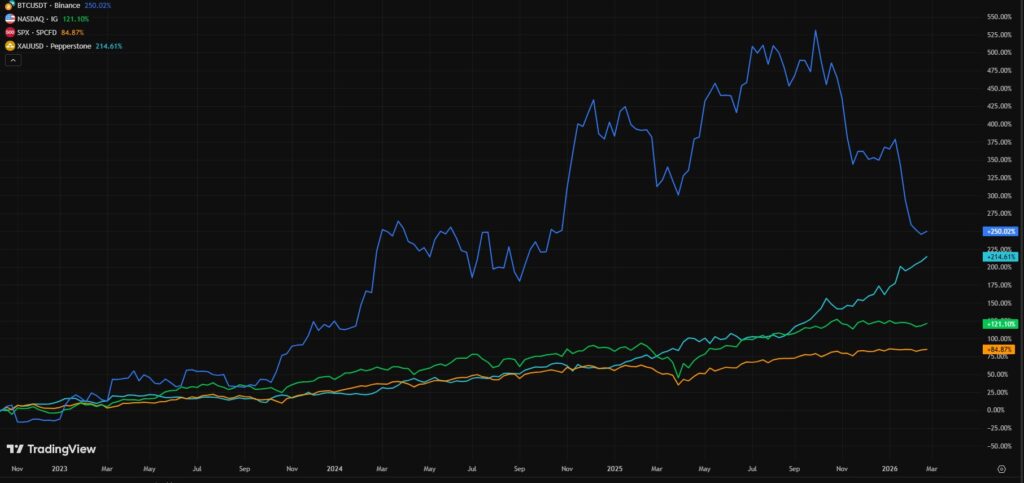
In this way, it refers to the fact that Satoshi Nakamoto’s creation has been established as a reserve of value for users and companies, outperforming gold and the main stock stocks in the last five years, as seen in the graph below.
Rivas also suggests that, while mass adoption has been expected for years, the ultimate push may not come from individuals, but of automation with AI at a commercial level.
«It will seem that in the future it will not be driven by individuals in P2P operations, but by operations at the merchant level. And that’s when it starts to become more popular and simpler and more economical, that’s when I believe that ordinary citizens will come behind,» he says.
However, the horizon is not without difficulties. The massive integration of AI and digital asset mining could consolidate new monopolies of computing power. Which would lead to concentration on the flow of stablecoins and cryptocurrencies, and a centralization of the emerging financial sector.
Rivas highlights that there is a fear that wealth will flow disproportionately to the owners of computing infrastructure and large mining pools. And he qualifies this concern by pointing out that Centralization is already a phenomenon present in the sector.
«I wouldn’t say Nvidia and the manufacturers [de tecnología para IA]. «I would say that now it is the large mining pools that concentrate that computing power and make there be a centralization no longer based on the banks, but on these large actors,» he says. «It is a risk that I believe will continue to arise, each time that gap is going to grow more,» he adds.
Indeed, computing power is currently dominated by large mining pools, such as Foundry USA, which concentrates 32% of all mining power in the Bitcoin network, and Antpool, which dominates 15%. The above is not isolated, since, currently, there are Bitcoin miners who use their capacity to venture into AI development, as NoticiasVE has reported.
Despite all this, it is clear that AI will be a catalyst for the adoption of bitcoin and cryptocurrencies and not a barrier. If AI agents become the main users of BTC, the market would be faced with an invisible but omnipresent economy, where sovereignty will not only be a right of the individual, but an intrinsic property of algorithms.
Thus, the true financial democratization that Rivas mentions could come not because everyone has learned to use a wallet, but because the machines that will manage the world They will have already decided that the traditional system is obsolete.