
-
The ECB, FATF and BIS have resorted to publishing apocalyptic reports to defend themselves.
-
Proactively adopting Bitcoin could give them an edge in monetary evolution.
The global monetary landscape changed, and the world’s politicians and bankers realized it too late. For years they underestimated the paradigmatic revolution brought by Bitcoin and everything that derives from this technology, such as stablecoins. And although it may seem too late, perhaps the antidote is in the poison.
Wells Fargo has just registered the WFUSD trademark. The traditional banking giant, one of the most capitalized banks in the world, the same one that a decade ago looked at cryptocurrencies with contempt, is now rushing to launch its own stablecoin anchored to the dollar. And it does so protected by the Genius law—signed by Donald Trump in July 2025—that law that opened the floodgates for dozens of financial institutions in the country to want to issue their private version of the digital dollar.
While the planet’s central banks publish alarmist 300-page reports, Wall Street prints digital dollars with federal approval. The game changed. And the world’s politicians realized it too late.
During the Biden administration, after the sanctions against Russia for the invasion of Ukraine, the world experienced a real push towards de-dollarization. The BRICS were talking about a common currency, China was accelerating the digital yuan, Saudi Arabia was flirting with the petroyuan.
The global consensus was clear: the financial system dominated by the United States threatened freedom of commerce, so the “modern” response in the era of cryptocurrencies was to create CBDC to control everything from the State.
The United States gave the most cynical and effective response possible: “Why do we want a CBDC if we already have stablecoins?” Instead of fighting against the private sector, he regulated it. The Genius Act domesticated stablecoins. It required 100% backed reserves, monthly disclosure, and top priority for savers in the event of bankruptcy.
From one day to the next, Tether, Circle, JPMorgan, Ripple, Fidelity, Paxos and now Wells Fargo, among others, became the new custodians of the dollar empire. Private companies issuing the global store of value, with a faster possibility of censorship and freezing of addresses than SWIFT.
Global trade is already migrating to these rails. The annual volume of stablecoins will exceed $33 trillion in 2025. Remittances, international payments, business-to-business trade: everything moves cheaper, faster and without ossified correspondent banks. The petrodollar no longer depends on an agreement between governments. Now it depends on USDT, USDC and other digital dollars.
The countries were alarmed. And their response in recent weeks has been to… publish reports. The European Central Bank has just released a paper warning that dollar stablecoins erode monetary sovereignty, suck deposits from banks and weaken the transmission of monetary policy.
The Financial Action Task Force (FATF/FATF) urges that governments implement its “Recommendation 15”, which contemplates that authorities consider forcing stablecoin issuers to integrate technical capabilities to freeze, withdraw or even “burn” cryptocurrencies in the secondary market.
The BIS has been repeating the same thing for years: risk of financial stability, loss of control. In other words, “we are getting out of control.” But instead of competing, they threaten to regulate them with all his strength.
Yes, in the past they have tried other measures. In Europe, probably the strictest, it has imposed obstacles against stablecoins anchored to the dollar through its MiCA law and mistakenly believes that being late with a digital euro that does not respond to any citizen need will stop the advance of stablecoins.
Their concern is natural, since Europe is the region with the largest transactions in stablecoins, accounting for 35% of the global volume, and when 99.74% of global transactions are stablecoins anchored to the US dollar, and the euro barely has 0.23%. In other words, despite MiCA and the digital euro proposal, the dollar continues to dominate the European market.
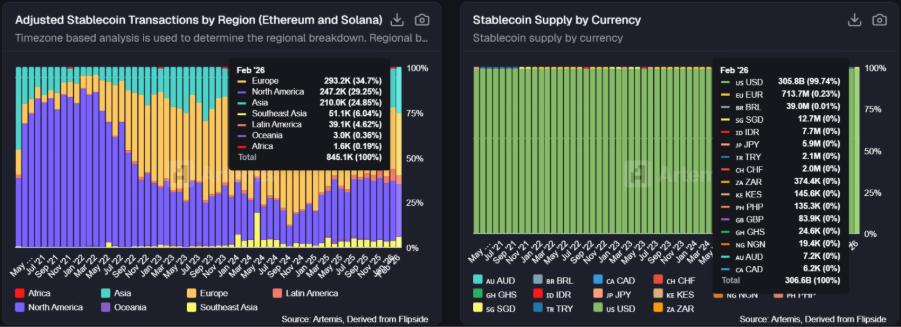
Europe’s measures have been similar, although perhaps not as strict, as those of China, who have banned stablecoins since 2021 and have been pioneers of CBDC with their digital yuan. With Asia being the third region with the highest volume of stablecoin transactions, countries such as Singapore, Japan, South Korea and Hong Kong have also accelerated their regulatory process, demanding strict conditions for stablecoins pegged to the dollar and trying to encourage the use of stablecoins pegged to their local currencies.
Russia, through the Kyrgyzstan company A7 but with the collaboration of the state bank Promsvyazbank, launched its stablecoin anchored to the ruble to evade sanctions, although it was banned in Europe. However, like Venezuela (who also had its stablecoin anchored to oil) and Iran, they do not have major ethical conflicts when using USDT. But also Bitcoin. Other countries, like Bolivia, come clean and adopt stablecoins at the state level because it solves the problems of their national currency.
These latest cases highlight that, when the need exists, even countries with ideological differences will turn to the tools that best help them. People and rulers prefer stablecoins because, thanks to the rails created by Bitcoin technology, they provide cross-border settlement speed and easy access to anyone, without the obstacles and fees of correspondent banks or Western Union. People choose it because it is still better than the legacy system.
So what can other countries do? They can copy Europe with MiCA and put obstacles in the way of stablecoins anchored to the dollar. They can go further like China and completely prohibit the use of stablecoins that are not pegged to their national currency, knowing that they can always be used in self-custody wallets. They can shout “sovereignty” until they are hoarse.
But history has already proven it: when people have a choice, they choose the money that is most efficient for them. Thiers law in action. Legal loopholes, P2P, remittances, international trade… everything will find a way, as it always has.
And here comes Bitcoin. Because stablecoins anchored to the dollar solve the problems of speed, access, reach and costs of the banking system, maintaining the preferred unit of account in the collective imagination. But they inherit all the vices of the Fed: chronic inflation, uncontrolled debt issuance, boom and bust cycles. They don’t fix anything structural. They only make the empire more efficient.
Bitcoin, on the other hand, is the only asset whose supply no one can manipulate. The only one that does not depend on trust in a private issuer or a central bank. The only one that, as it matures and its price stabilizes, becomes the neutral money that the world needs.
Central banks and politicians are trembling because they realized that they ignored the monetary revolution for 15 years. They believed they could control it with CBDC or bans. Now they see that the digital dollar is winning the battle, but not thanks to them, but to private companies that use the technology that they wanted to kill.
But they still have a chance. The defensive strategy—ban, regulate to the point of suffocation, write reports—has always failed in the face of inevitable innovations. The proactive strategy, then, makes more sense: adopt Bitcoin as a strategic reservesave in BTC in sovereign balance sheets, educate the population, create clear legal frameworks for its use as money. This is why it is often said that El Salvador lives in the future, and that is why the United States has decided to follow in its footsteps.
Bitcoin has not stopped growing in recent years. It is no longer the niche project that few technophiles used. Despite the growth of stablecoins, Bitcoin continues to maintain more than 50% market dominance, while all stablecoins barely reach 10%. In other words, Bitcoin is still five times larger than stablecoins.
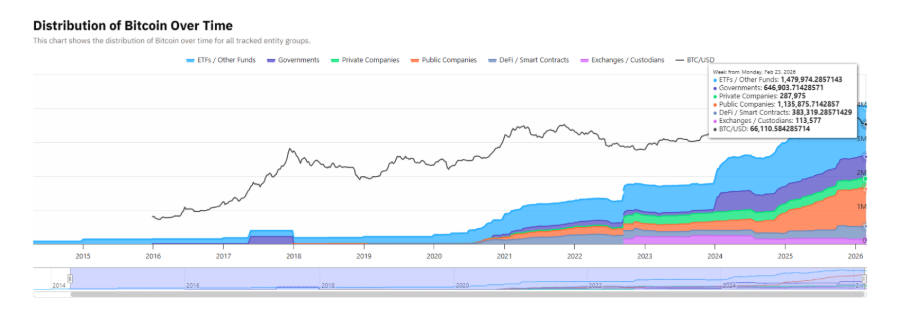
An increasing percentage of the supply is in the hands of governments, public and private companies, ETFs and other funds, evidencing the institutional appetite to obtain a share of their inelastic supply.
But its growth is not limited exclusively to its use as a reservation but also as a payment method. This is shown in data from the Lightning Network, which sets records for capacity per channel, and is currently projected to process over ten billion dollars worth of BTC annually. And as technology advances, it is likely that Lightning will also absorb that volume that moves in stablecoins.
Countries that adopt Bitcoin today will be one step ahead when bitcoinization accelerates and consolidates through Thiers’ Law. Because good money displaces bad money when people have a choice. And the dollar—even dressed as a private stablecoin—is still inflationary money. Not Bitcoin.
Tremble or act, the monetary revolution has already passed. It is the decision of each country whether to move towards the future or stay behind.