
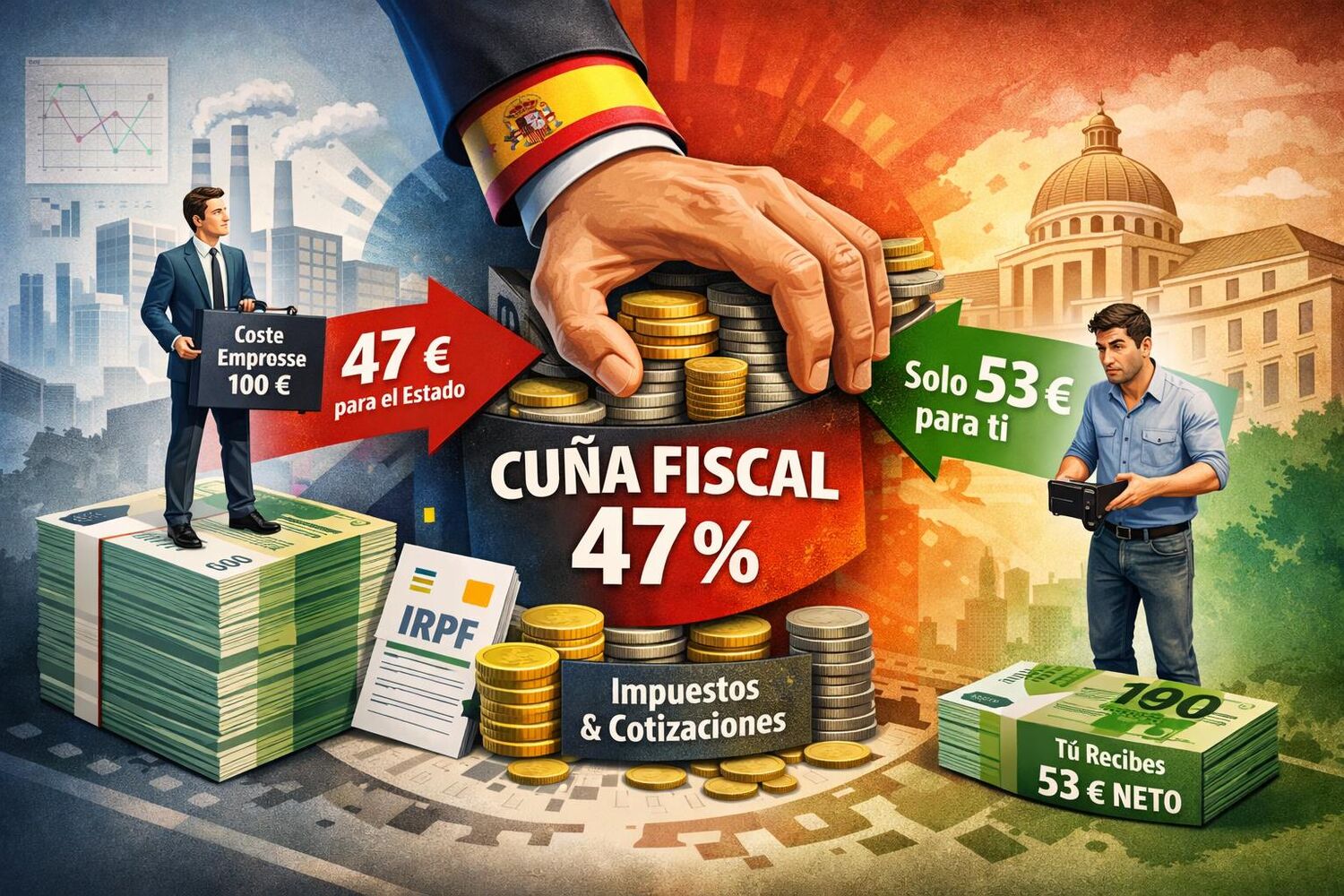
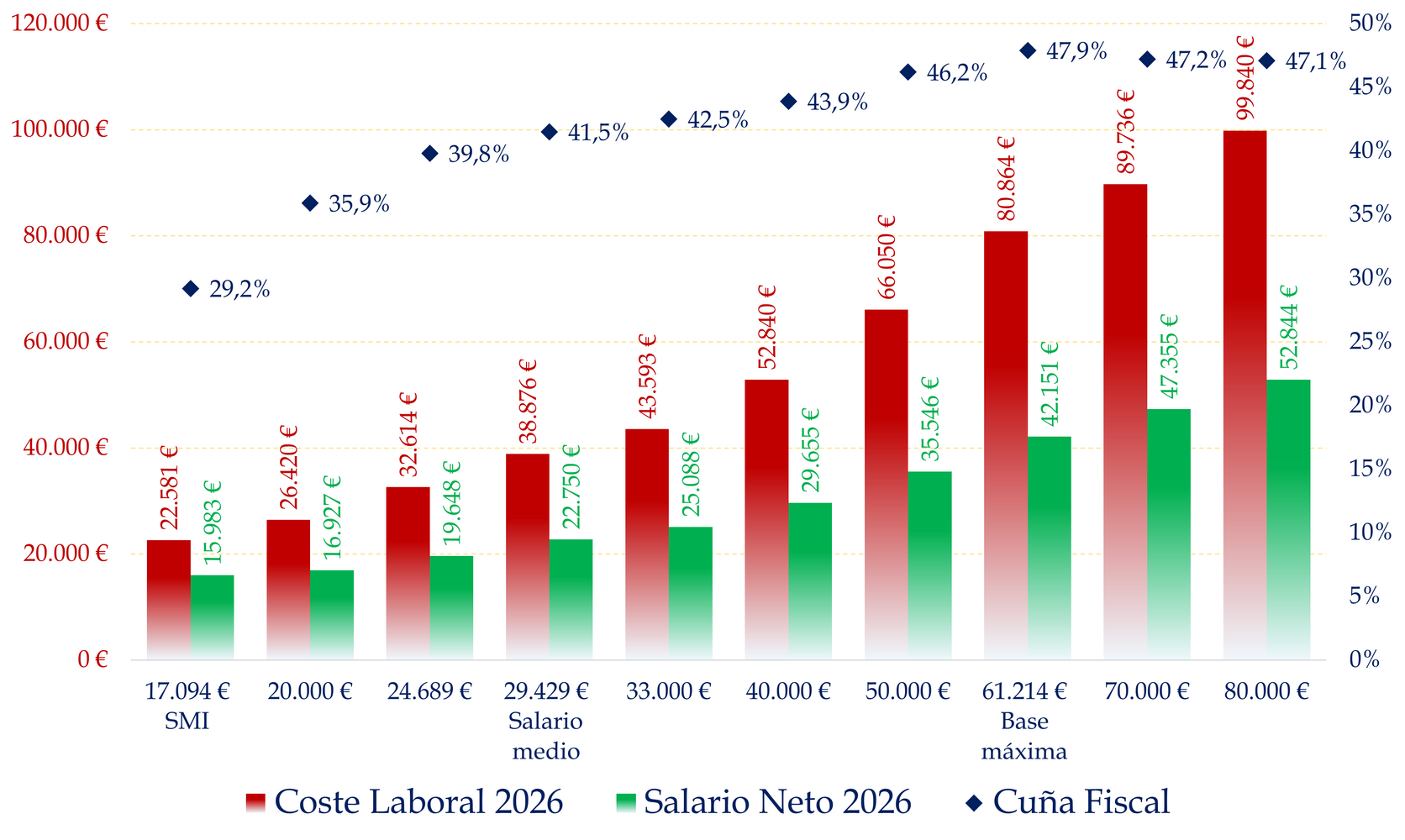
The tax wedge is the difference between what it costs the company hire someone and what that someone really takes homemore or less. In Spain, according to 2026 data, this gap has reached very dangerous figures: for the worker with an average salary, the state keeps more than 41 cents of every euro it generates. For incomes starting at 50,000 euros gross, the wedge exceeds 46%. He peak is reached around the maximum contribution base: 47.9%.
We are not just talking about personal income tax here. We also talk, and above all, about the Social Security contributions. That world almost invisible to the worker, who “theoretically” pays the company and which, precisely for this reason, is not noticed.
Let’s see the complete x-ray for 2026.
Source: Carlos Arenas Laorga
The most striking case is that of the worker with a gross salary of 80,000 euros or more. His company disburses almost 100,000 euros a year to have it on staff. That worker, on the other hand, earns only 52,844 net euros. That is, almost half of the money generated by your contract never reaches your checking account. It disappears along the way, absorbed by the system.
For every 100 euros that such a worker costs, the state keeps more than 47 before the salary reaches the pocket.
One of the great misunderstandings of the salary debate in Spain is to blame companies exclusively for low salaries. And yes, of course there are companies that squeeze where they can. But many of those who do not raise salaries are not because they are stingy, but because they cannot. In fact, the ideal of companies is attract talentnot expel it. Logically… That’s why anyone who says it’s the businessmen’s fault has not read or known about economics. That there will be some bad and stingy ones, surely, that will be the norm, absurd.
Let’s put a example. A company wants to raise the salary of an employee who is paid 33,000 euros gross. At the moment, That company already pays 43,593 euros in total for that worker. If you want the employee to receive 2,000 euros more net per year, you need to increase the labor cost by something significantly higher than that figure, because Each euro of gross increase also generates more quotes. Generosity, in this system, is expensive.
This has a direct consequence: discourages hiring, especially of profiles with lower qualifications or with part-time contractswho are the ones who need that first job the most. AND It also discourages salary increases. The design of fiscal intervention makes raising salaries a luxury that many SMEs cannot afford.
Economic theory has been explaining it for centuries: when you make work more expensive, you get less work. It’s as obvious as If you raise the price of any good, less is demanded. For someone to come along and say that raising contributions is good for workers is, at the very least, reckless.
In Spain, the company pays around 30% of the gross salary in contributions (for common contingencies, unemployment, training, Fogasa, and other items). The worker, for his part, contributes around an additional 6.35% of his payroll.
Add both parts. Add personal income tax. And thus we obtain the tax wedge that we saw in the graph. A cuña which, it is worth remembering, not seen on any full pay stub. The company sees your total labor cost. The worker sees his net income (he does see his contribution and personal income tax withholding).
The employer proposed that contributions are paid directly by the worker or, at least, see how that amount came in and then went out. The proposal was rejected between scandals. Of course, politicians know that if the worker saw all the loss on his payroll, the debate on labor taxation would be different. The opacity, in this case, is functional to the system. Maybe people would no longer call healthcare free, or would not say that the pension model is unbeatable.
And what do we do with this? Five ideas that work in other countries
Criticism without a proposal is easy. The difficult thing is to point out what can be changed and how. Here are some ideas that already work in economies around us and that would at least deserve to enter the Spanish debate:
1. Deflate personal income tax with accumulated inflation
Spain has not updated the income tax brackets with real inflation for years. The result is that many workers have started paying taxes at higher ratesnot because they earn more in real terms, but because inflation has raised their nominal salaries. This is, technically, a hidden tax increase. Germany and other countries correct it automatically. Not here. Since 2018, the Treasury has collected an extra 18 billion just for what is known as cold progressivity.
2. Total transparency in the payroll receipt
That the worker sees on his payroll not only what he earns, but also what the company pays for him. That the total labor cost is visible. It is a cosmetic change, because nothing changes, but with a huge pedagogical effect. Informed citizens demand accountability. Not ignorant citizens.
3. Simplification and stability of the fiscal framework
Estoniaa benchmark in tax design, does not tax reinvested business profits. Ireland has built decades of attracting foreign investment on the basis of a simple, predictable and competitive tax system. In SpainAccording to the World Bank, it takes more than 140 hours a year just to meet basic tax obligations. More than three weeks of work dedicated to paying the state, instead of producing.
4. Real audit of the quality of public spending
The argument for not lowering taxes is always the same: The state needs financing. OK. But that argument would be stronger if citizens perceived that every euro raised was well spent. In Nordic countries with high tax pressure, the taxpayer receives first-class services. In Spain, the general feeling—and the satisfaction data supports it—is that you pay a lot and receive little. That cannot be fixed by raising more taxes. It is fixed by spending better.
The conclusion comes out alone. The problem is not low salaries. It is high taxation.
Spain does not have a problem of greedy businessmen or unproductive workers (although both exist in some proportion, as in any country). Spain has a structural tax design problem that penalizes work, savings and effort especially harshly. A taxation that acts as a toll (also opaque) between what the market produces and what reaches the citizen’s pocket.
The tax wedge percentages are tremendous. You don’t have to be a radical liberal to see that this is a problem.
The first step to changing something is to understand how it works. If this article has made you look at your payroll with different eyes, or that the next time someone says that employers do not raise salaries, you think about the 38,876 euros that your company pays so that you earn 22,750, we will have made some progress.
Net wages will not rise sustainably until the tax wedge is reduced. Everything else is patches.