
-
The SDK is open source software for building AI agents with autonomous operations.
-
Brokers need gas tokens in addition to USD1, a limitation WLFI plans to resolve.
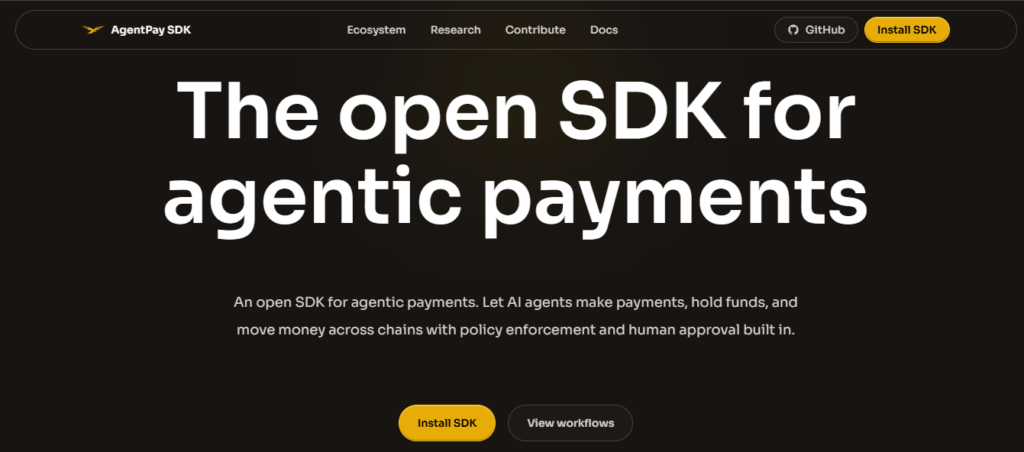
World Liberty Financial (WLFI), the decentralized finance company linked to United States President Donald Trump, launched AgentPay SDK on March 19. It is an open source software development kit designed for artificial intelligence (AI) agents to autonomously make payments using USD1, WLFI’s own stablecoin.
According to WLFI, AgentPay SDK promises to give agents the ability to pay services, hire resources or settle obligations within rules defined by the human operator.
According to the WLFI statement, the SDK operates through four layers that work together:
The command line interface (CLI)
It is about agentpay, the SDK operating tool which allows you to interact directly with the system from the terminal.
Through this environment payments are executed, balances are consulted, policy engine rules are configured and approval requests are managed, functioning as the link between agent instructions, condition validation and local signing before sending the transaction to the network.
It is intended for developers and operators who build or monitor AI agents, allowing them to explicitly control how and when those systems can move funds within defined limits.
Local custody
The SDK includes a component called vault-daemon which signs transactions directly on the user’s device, they explain from WLFI. Communication between the agent and that component occurs using Unix domain sockets, a technology that allows two programs on the same machine exchange data without using the internetso the private keys never leave the device or reach the WLFI servers.
The statement it does not specify where those keys are physically stored within the devicewhether in an encrypted file on disk, in memory, or on a dedicated hardware component.
The operations policy engine
Before the agent executes any payment, the system evaluates whether the transaction complies with the rules defined by the operator: limit per transaction, daily spending limit, networks enabled.
If the payment exceeds these thresholds, the SDK does not reject it but pauses it and generates a manual approval request for the user. According to WLFI, this establishes a distinction between routine transactions, which are carried out automatically, and higher-risk transactions, which await a human decision.
Integration packages (skill packs)
These packages are configuration files that the SDK automatically installs in the development tools that the user is using, such as Claude Code, Codex, Cursor, Windsurf, Cline, and Goose, among others. According to the statement, if the agent can read a configuration file, it can use the SDK to pay.
The role of USD1
AgentPay SDK is built around USD1, WLFI’s stablecoin indexed to the US dollar. WLFI presents USD1 as “the operational economic layer for autonomous AI systems”: a unit of account designed for machines to pay for services, application programming interfaces (APIs), or products without the friction of traditional banking systems.
At the time of SDK release, USD1 comes ready to use on Ethereum and the BNB Chain No additional configuration: contract addresses and network parameters are already included by default.
The BNB chain was chosen for its low transaction fees, according to the statement. At the time of writing, the average fees on the BNB networkThey are around USD 0.07while in Ethereum it is USD 0.01.

Current limitations
The SDK presents three relevant limitations that the statement itself partially recognizes:
- The first is gas dependency. To execute any transaction, the broker needs to have native tokens of the network (BNB on BNB Chain or ETH on Ethereum) to pay network fees. That means the operator must manage two different assets: USD1 for payments and the native token for gas. WLFI notes that it is working on implementing EIP-3009, a standard that would allow gasless transactions, but does not offer a date for that implementation.
- The second is the learning curve. Although the release describes the installation as “a single command line,” operating the SDK in production requires managing a local daemon, configuring spending policies, and managing wallets. That level of complexity makes it, for now, a tool for experienced developers, not end users.
- The third is the risk of agent manipulation. The SDK doesn’t specify this, but if an AI agent is tricked using a technique known as instruction injection (prompt injectionwhere a malicious actor inserts hidden commands into the content that the agent processes) could attempt to execute payments until the limits allowed by the policy engine are exhausted. The statement does not address that scenario or describe specific mitigation mechanisms.
Where WLFI is pointing
Beyond the launch, WLFI outlines a roadmap that includes the implementation of EIP-3009 to eliminate gas dependency, an open standard proposal (EIP) for all AI agents to operate under the same payment scheme, and future integration with DeFi protocols so that agents not only spend but also invest or manage capital. None of these developments have a confirmed date.
What WLFI launched is a first layer of infrastructure, not a finished ecosystem. Its real value will depend on how many developers adopt it, whether USD1 manages to establish itself as a settlement unit for AI agents, and whether current limitations, especially gas dependence and manipulation risk, are resolved before more established competitors occupy the space.
The launch of AgentPay SDK is part of a broader trend. Visa introduced Visa CLI, a tool for AI agents to make autonomous fiat payments using tokenized credentials, without human intervention and on traditional rails.
In parallel, ecosystem actors such as World (former Worldcoin) and exchanges such as Kraken, OKX and BingX develop infrastructures for agents, focused on identity, payments and autonomous tradingwhich shows a convergence towards systems where machines operate directly in the digital economy.