
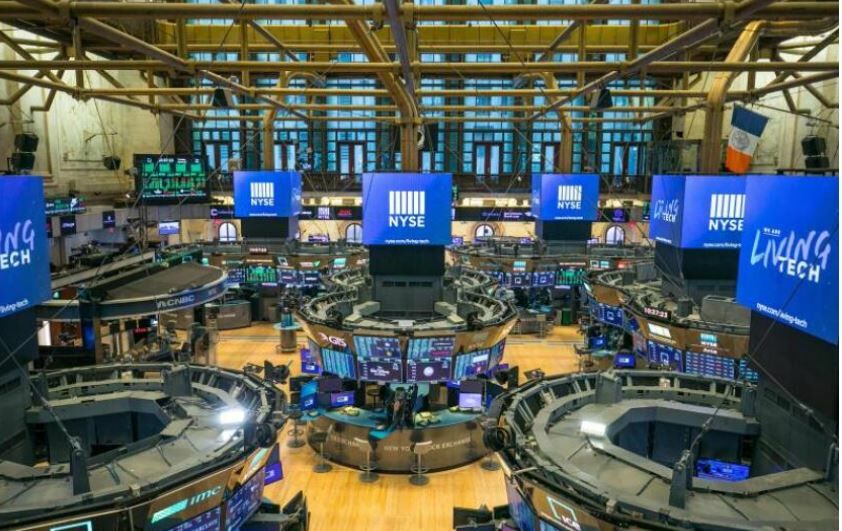
The DOW JONES index rose 0.86% at the opening to 45,555.63 points, with all values positive. The biggest increases are for Salesforce, which advances 1.79% and Goldman Sachs, which increases 1.4%. Apple and Cisco Systems are practically flat.
The S&P 500 rose 0.77% to 6,417.91 points, while the Nasdaq rose 0.73% to 21,100.31 points.
Wall Street is coming off a punishing day on Friday: the DOW JONES fell 793 points, or 1.73%, the S&P 500 fell 1.67% and the Nasdaq fell 2.15%. Dow Jones losses pushed it into correction territory (a drop of at least 10% from highs), joining the Nasdaq, which entered a correction the previous day. As the war in Iran drags on into its fifth week, investors hoping for a quick resolution to the conflict are increasingly concerned about its real consequences, including the US entering stagflation.
The values of the group of ‘Magnificent 7’not so long ago the great darlings of the market, saw evaporate up to $850 billion from the stock market last week, led by the defeat of Meta and Alphabet in a landmark lawsuit over the companies’ responsibilities in the fight against social media addiction.
Please note that this week will be shorter than usual, since On Friday Wall Street will be closed for Good Fridayalthough that day the important non-agricultural payrolls report for March will be released. Before this employment report, investors will learn about the Job Offers and Labor Turnover Survey (JOLTS) and the employment survey from the ADP payroll manager throughout the week. Another closely watched reference will be retail sales, which will be released on Wednesday.
But investors’ attention is focused above all on the war in Iran, which has entered its fifth week with no signs of an early end and in the face of contradictory messages. Today first thing in the morning the president of the United States, Donald Trumphe assured through a publication in Truth Social that “The US is holding serious talks with a NEW AND MORE REASONABLE REGIME to end our military operations in Iran”.
“Great progress has been made, but if for some reason an agreement is not reached soon, which is likely to happen, and if the Strait of Hormuz is not immediately opened to trade, We will conclude our pleasant stay in Iran by flying and completely annihilating all its power plants, oil wells and the island of Kharg (and possibly all the desalination plants!), which we have deliberately not touched yet.”
Yesterday Trump had assured that Iran had «ceded» to the US most of the 15 demands that it had presented to it to end the war. «They gave us the most points. How could they not?» he told reporters aboard Air Force One on Sunday. “We’re going to ask for a couple more things,” he said, although he declined to specify what concessions Iran had offered. Publicly, Iran has rejected the list of 15 ceasefire points that the US delivered through intermediaries in Pakistan, and has responded with five conditions of its own, including maintaining sovereignty over the Strait of Hormuz.
And if the confusion were not enough, the recent entry into the conflict of the Yemeni Houthi rebels also threatens to condition the passage of oil through the Red Sea at a time when the US is deploying more troops in the region.
The result is that oil prices continue to skyrocket. Today, US West Texas Intermediate oil futures rise 1.78% to $101.41 per barrel, while the international benchmark Brent is paid at $107.71, with an increase of 2.27%.
One of the market’s great fears is that the rise in energy will end up leading to a situation of stagflation of the American economy -that is, less growth and more inflation- that will greatly complicate the work of the Fed. If until now the market expected at least one rate cut this year, now the expectation is that rates may even rise.
In fixed income, always very sensitive to monetary policy expectations, the ten-year US bond today offers a yield of 4.356%, when before the conflict it moved below 4%.
On a business level, shares of aluminum manufacturer Alcoa soared 9.5% after learning that two aluminum manufacturers in Bahrain and the United Arab Emirates have been the target of Iranian attacks, raising concerns about possible interruptions in the supply of this metal. The Middle East represents approximately 9% of global aluminum production.
Regarding the quarterly results, it must be taken into account that this week the accounts of companies such as Nike will be presented. The sportswear giant, which is down 20% so far this year, is expected to put on the table revenue of $11.2 billion, in line with the same period last year, and earnings per share of 28 cents. Last year earnings were 54 cents per share.
McCormick and ConAgra Foods, among others, will also present accounts in the coming days.
3% increases for Leidos in the New York morning. A document submitted to the regulator (Form 13F) has revealed that UBS Group reduced its stake in the company, selling 58,303 shares and retaining 533,824 shares valued at approximately $96,301,860.
Sysco shares fall 7.4% after agreeing the purchase of Jetro Restaurant Depot for a total value of $29.1 billion. The transaction is expected to close in Sysco’s fiscal third quarter of 2027, and the wholesale food distributor says the transaction will have an immediate positive impact.
In analyst recommendations, good news for CrowdStrike which sees how Wolfe Research has upgraded the advice to ‘overweight’arguing that the cybersecurity company will benefit from the increase in cyber risks derived from artificial intelligence, rather than its business model being affected by this technology. While, Morgan Stanley includes it among its main recommendations. CrowdStrike accumulates a drop of more than 21% in forecasts for 2026 amid fears that AI will replace cybersecurity technology.