
-
Malicious use of quantum computing could theoretically breach digital security.
-
One expert warns that this advance could accelerate the arrival of “Q-day.”
A group of researchers published in the journal Springer Nature a study that marks a new turning point regarding quantum computing. In turn, the experiment, although they do not specify it, impacts Bitcoin’s resistance to that technology.
The work, published on September 23, describes how they managed to optimize the resources of Shor, a quantum algorithm that is presumed potentially capable of break Bitcoin cryptographic securitycryptocurrency networks and cybersecurity in general.
The use of Shor in «evil hands» could decrypt private keys generated by the elliptic curve cryptography (ECC) system. It is the same type of signature that Bitcoin uses under the ECDSA standard.
What the researchers found was dramatically reduce the amount of quantum resources needed to run that process in ECDLP (ECDSA’s security base), making the threat, which previously seemed distant, begin to feel more concrete.
Specifically, they managed to optimize the performance of the algorithm on three fronts:
- a 75% reduction in the number of logical operations (T-countin English),
- a 87% decrease in the depth of the circuit (T-depthin English),
- a 12% drop in the use of Cubitsthe quantum equivalent of traditional bits.
In simple terms, they got the “engine” of the algorithm to work with much less energy and componentsas if a vehicle that previously required a fuel truck could now travel the same distance with just a few liters.
Those improvements reduce hardware size and complexity necessary to attack an ECC-based cryptosystem, such as Bitcoin.
With the following infographic prepared by NoticiasVE it is possible to easily understand the link between quantum computing and Bitcoin:
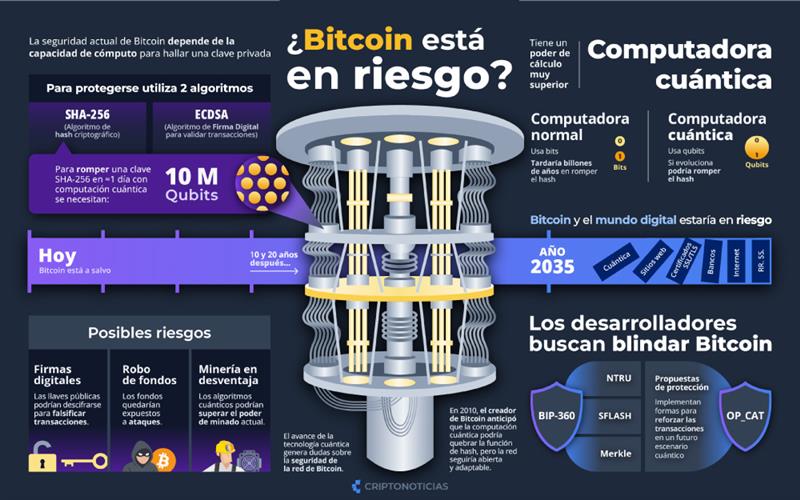
The guesses of a quantum computing expert
For Alex Pruden, CEO of Project 11, an initiative dedicated to studying the relationship between quantum computing and cryptocurrencies, Shor optimization is a significant leap:
“From a resource estimation point of view, this is a real breakthrough, because the T gates are the ones that dominate the costs in quantum cryptanalysis,” he explained on October 6 in his X account.
These gates are fundamental operations in quantum circuits, but their practical implementation is expensive, requiring complex error correction. Reducing their quantity, as this new approach achieved, implies making quantum algorithms much more efficient and bringing their real application closer to a tangible scenario.
And although experts estimate, according to the CEO of Project 11, that there are still «between five and fifteen years» before there are quantum computers capable of executing this type of attacks, an advance in hardware or error correction could shorten that horizon to just two or five yearshe opined.
«We must assume the worst case scenario and prepare for Q-Day now»Pruden concluded, referring to the hypothetical moment when quantum computers could break current cryptographic protections.
This study does not mean that Bitcoin is in imminent danger, but it does rekindle the urgency to advance research into post-quantum defense mechanisms.
The race between advances in quantum computing and the evolution of cryptography is accelerating, and the results of this work confirm that the margin of advantage could be narrowing.