
-
Stablecoins are no longer just liquidity on cryptocurrency exchanges.
-
«The rails are starting to move at their own pace,» says analyst.
Bitcoin (BTC) could be entering a new economic stage, one in which its price behavior no longer depends on the abundance or scarcity of global money.
For more than a decade, the digital asset’s price movements followed central banks’ liquidity cycles, rising when money was cheap and falling when it tightened.
But that bond is beginning to weaken. What was once a market driven almost entirely by speculation and international financial flows, is beginning to show signs of real economic use within the ecosystem.
The chief analyst at the firm Real Vision, Jamie Coutts, maintains that, for the first time, a part of the bitcoin and cryptocurrency economy «shows signs of independence from the liquidity cycle.»
He explains that until now, cryptocurrency activity had been driven by the expansion of global money, as use cases were mainly speculative.
However, it notes that, since mid-2025, the volume of stablecoin transfers has been decoupled from fees on decentralized networks and from global liquidity, something he defines as «a structural change.»
The following graph shared by Coutts reflects the evolution between global liquidity, commissions in decentralized networks and transfers with stablecoins from 2022 to October 2025.
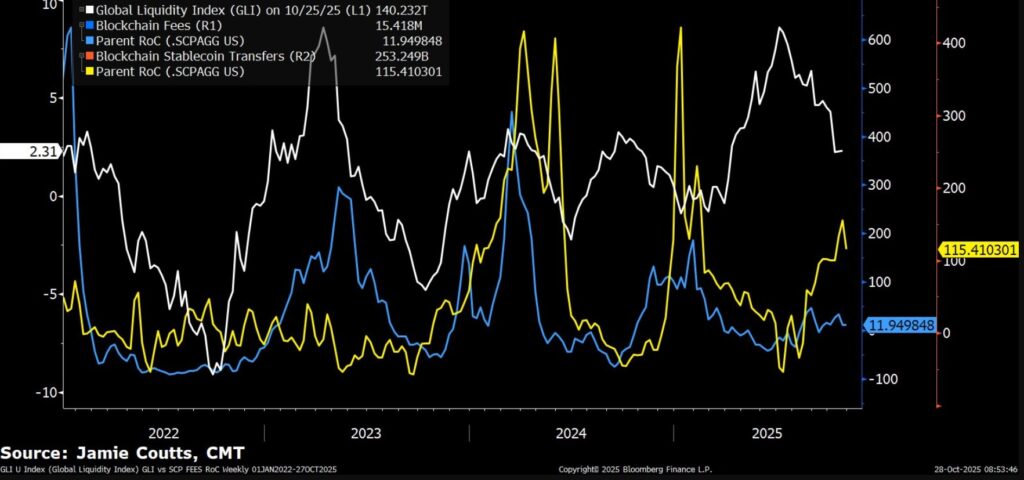
It shows that, while the global liquidity index (white line) and network fees (blue line) maintain a close correlation and decrease in parallel with international monetary cycles, transfers with stablecoins (yellow line) They begin to behave independently from mid-2024.
This divergence indicates, according to Coutts, a structural change in the economy: stablecoins no longer reflect only the speculative liquidity of exchanges, but They begin to be used on a sustained basis for payments, settlements and commercial activitiesmarking the beginning of a phase in which part of the cryptocurrency ecosystem operates with greater autonomy from the global liquidity cycle.
“The rails are starting to move at their own pace,” he says, adding that the combination between stablecoins and artificial intelligence (AI) will open new avenues of use for distributed networks, reducing the cyclical dependence of markets.
End of traditional bitcoin cycles
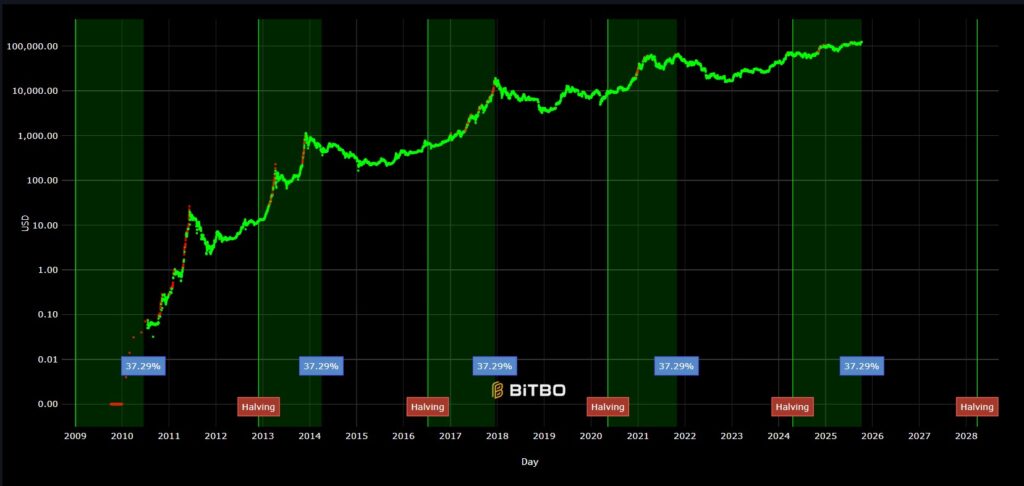
This change observed by Coutts comes while other analysts question the validity of the well-known four-year bitcoin cycle, linked to halving events.
Arthur Hayes, founder of the BitMEX exchange, maintains that this pattern is «dead.» He considers that the expansive monetary policies of the United States and China will prevent a new bearish phase, since “money will be cheaper and more abundant; Therefore, bitcoin will continue to rise in anticipation of this future.
For his part, professional analyst and trader, Willy Woo, believes that the price of bitcoin continues to be conditioned by global liquidity, rather than by the halving. In his opinion, a future severe recession will be the definitive test: it will determine whether bitcoin behaves as a risk asset or as a haven of value.
Precisely, the global money supply is at historical levels, which sustains the demand for digital assets as long as monetary expansion persists.
Specialists consulted by NoticiasVE affirm that the traditional bitcoin cycle has all the signs of getting longer, since the price of BTC does not stop falling. This is the case of Carmelo Alemán, a Spanish financial analyst, who states that currently «money continues to enter BTC» in massive ways.
He attributes this to the realized capitalization of bitcoin, a metric that measures the economically active value of BTC. It is currently at 1.1 trillion dollars, that is, at historical highs, as seen in the following graph:
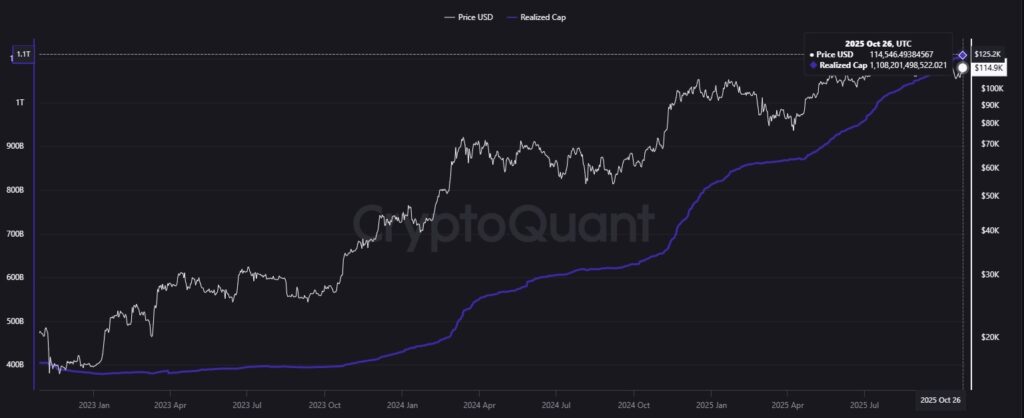
Beyond the capitalization made, Alemán predicts that monetary printing will trigger inflation next year, which will reduce the purchasing power of fiat money and benefit BTC. In his opinion, «large savings should be kept in assets that compensate for inflation, such as gold or bitcoin.»
Jan Domínguez, a Venezuelan accounting consultant specialized in bitcoin and cryptocurrencies, thinks something similar, who maintains a more conservative vision. and refuses to conclude the historical pattern.
«Until the opposite is proven, this behavior will be repeated,» he tells this news outlet. According to his analysis, if by 2026 the price of bitcoin has not corrected between 60% and 70%, then «it can definitely be considered that it was the end of post-halving cycles.»
Meanwhile, Colombian businessman and investor Mauricio Tovar, founder of Tropykus, also believes that cycles can extend, although not disappear.
«Markets are never up forever. Bitcoin has shown this behavior almost like clockwork. That may change, but as long as there is no evidence, I believe in the repetition of cycles,» he explains to this newspaper.
A new economy under construction
Between Coutts’ thesis on structural market independence and views linking bitcoin to global liquidity, a central question emerges: can the bitcoin ecosystem function without relying on cheap money?
If stablecoins continue to expand their use as a means of payment and trading tool, and not just as a speculative vehicle, The answer to that question could be yes.
It will only be in that scenario when bitcoin will begin to reflect its own economy, less influenced by central banks and more guided by the real usefulness of its disruptive technology.