
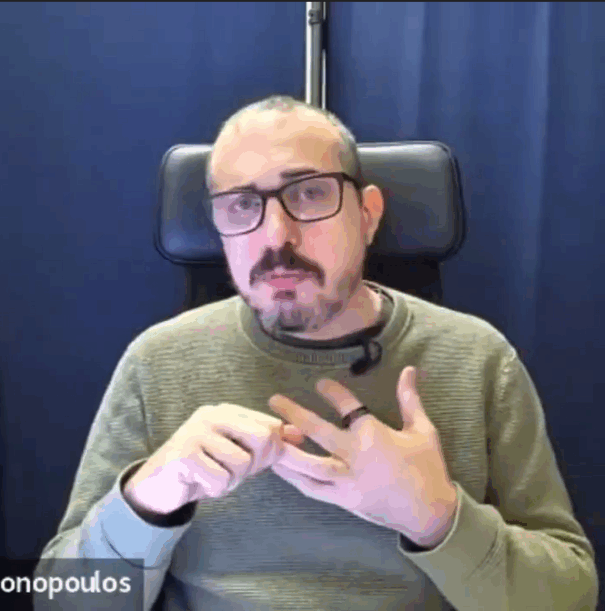
Andreas Antonopoulos, renowned educator and popularizer of Bitcoin, got into the controversy that exists over the use of the network to include non-monetary data. A debate that is dividing the identity of bitcoiners into two sides.
While some They consider these embeds as «spam»since they take up space without moving BTC, others maintain that Bitcoin is open and allows any use as long as commissions are paid.
This debate between users and developers about the impact of transactions that add arbitrary information It intensified since last April, as reported by NoticiasVE.
These data, which include images, texts, and files, among others, are inserted through the opcode OP_RETURN.
As part of the controversy, Antonopoulos published a video on his Patreon account on November 24. There he maintained that «any data can be encoded like any other data,» and that for that reason it’s hard to draw a clear line between what is legitimate and what is not. In his words:
One person’s spam is another person’s content. The power to decide what is allowed and what is not is dangerous because it leads to censorship.
Andreas Antonopoulos, bitcoiner educator.
The central point of his argument is censorship. If a group of developers defines what type of information can be included, the border would cease to be technical and would become political.
As he explained, if Bitcoin developers show that they can exclude content, «then they will be required to censor in all the jurisdictions where they live.»
The words of Antonopolis relieved the debate
Luke Dashjr, veteran protocol developer, main maintainer of Bitcoin Knots and opponent of non-monetary use of Bitcoin, dismissed Andreas’ analysisalthough without going into depth.
«In short, you don’t know what you’re talking about and you didn’t even bother to do your research,» Luke wrote when questioning Antonopoulos’ stance on using OP_RETURN.
In different threads on
For example, Sasha Hodder, founder of a law firm, clearly warns: “If developers can censor Bitcoin, they will end up being forced to censor it.”
Giacomo Zucco, president of PlanB Network, regrets the setback in the debate:
Damn, bringing the discussion back to «spam does not exist and filtering is censorship» is absolute retarded stupidity. We were moving towards how it is realistic to filter out spam. Negative net impact.
Giacomo Zucco, president of PlanB Network.
These positions show a spectrum that ranges from absolute rejection of any form of filtering for fear of centralized censorship, to frustration at not advancing practical technical solutions against abusive use of the network.
Why is it preferable to use OP_RETURN according to Antonopoulos?
To illustrate the extent of the problem, the educator listed several examples of information already circulating on the Internet: «Ordinals, shit pegsJPEG, NFT, garbage… Bible verses.
The list serves to show that non-monetary data can be trivial, artistic, arbitrary or even questionable. However, according to his vision, his presence cannot be selectively removed without introducing mechanisms that grant veto power.
Antonopoulos insisted that banning such uses would not solve the problem. He stated that, if the protocol makes it difficult to store data through a specific path, users will look for other, more invasive ways:
People will put content elsewhere in the protocol if we make OP_RETURN too difficult. I’d rather people put it in an OP_RETURN, where we can discard it and not load it forever.
Andreas Antonopoulos, bitcoiner educator.
When Andreas mentions that «we can discard it,» he is referring to a quality of using OP_RETURN, which allows that material to be contained in an area that the network can ignore without compromising security.
The data embedded through that opcode They are not permanently anchored to each copy of the network. That instruction marks the information as not essential to validate monetary transactions.
Therefore, nodes can “prune” it, that is, remove it from their storage without affecting the integrity of the payment history.
When Antonopoulos talks about “discarding it,” he means that this data can be optionally saved or directly omitted in nodes that want to operate with less space. something impossible if those same data were hidden within other parts of the protocol where they are indistinguishable from strictly monetary content.
OP_RETURN divides burden and Bitcoin
Despite Antonopoulos’ explanation, a user on X known as Zatoichi called his stance «incompetent.»
He argued that limiting or allowing certain types of data depending on the inclusion method, such as using OP_RETURN or the witness of transactions, does not imply exercising content moderation, but rather apply protocol rules.
He also pointed out that the witness (the data segment introduced with SegWit, which stores signatures and certain optional elements) is four times cheaper in terms of relative weight.
Finally, because of that lower cost, he argued that any new type of non-monetary data would tend to migrate there before OP_RETURNwhich would render Antonopoulos’s proposal ineffective.
Thus, the debate about «spam» splits the identity of bitcoiners, pushing them to take a position on which uses should be considered legitimate and which should not.