
Quantum computing is a technology that, in the hands of an evil actor, has the potential to break current digital security systems.
In this context, on January 7, 2025, the Banking Supervision Department of the Bank of Israel sent a letter to banks and financial entities, in which it required them to present, within one year, preparation plans against cyber threats derived from quantum.
According to the Calcalistech report, the message was direct: although a fully operational quantum computer does not yet exist, The financial system cannot wait for the encryption that supports it today to be broken.
Quantum processing capacity threatens to make current security algorithms obsolete, capable of solving in seconds what is impossible for computing today.
This vulnerability directly affects encryption systems that guarantee the confidentiality of financial, banking, state, health data and crypto asset networks such as Bitcoin, among others.
For Moshe Karako, Israeli cybersecurity advisor to governments and financial institutions, «a quantum computer makes it possible to open everything.»

The real danger, Karako explained, is psychological: money in a bank is worth trust. If a significant portion of the population tries to withdraw cash out of fear, the system could collapse even without an actual attack.
A break in the rules of cybersecurity
According to the aforementioned report, the Israeli regulator’s requirement marks a turning point.
Uzi Yaari, director of the digital division of the Elad firm, explained that quantum computing «is no longer just another threat in the cyber landscape,» but a technology that «changes all the rules of the game.»
According to his analysis, when quantum capabilities are relevant, the current defensive systems will no longer serve and it will be necessary to adopt completely different codes and encryption methods.
The problem, Yaari noted, doesn’t start with encryption itself, but with the infrastructure that supports it. Many banks operate on legacy systems, i.e. old platforms built with obsolete languages and processes accumulated over decades.
In this context, complying with a regulatory requirement is not enough. «There are two axes that must move at the same time,» he stated: responding to the regulator and, at the same time, modernize core systemseither correcting critical points or completely rewriting them.
In two years, the systems will not be protected. We can’t wait. We should have started yesterday.
Uzi Yaari, director of the digital division of the Elad firm.
Protecting today’s information against the quantum of the future
Moshe Karako also emphasized that the quantum threat It is not only technical, but systemic.
The advisor also warned about a less visible risk: the so-called “collect now, decipher later.” As he explained, large volumes of encrypted information (financial, medical or security) are already being stolen and stored.
Today they seem useless because they are protected, but they could become fully accessible when quantum computing matures. The damage then begins years before encryption is broken.
This problem is not limited to banks. It also affects communication systems that are considered secure today, such as messaging and encrypted telephony applications, including WhatsApp.
The encryption they use, for example, the cryptographic system called RSA, is part of the same chain of trust that supports electronic commerce, governments and global finance.
In that sense, as reported by NoticiasVE, the United States National Institute of Standards and Technology (NIST) has already established protection mechanisms against quantum computing.
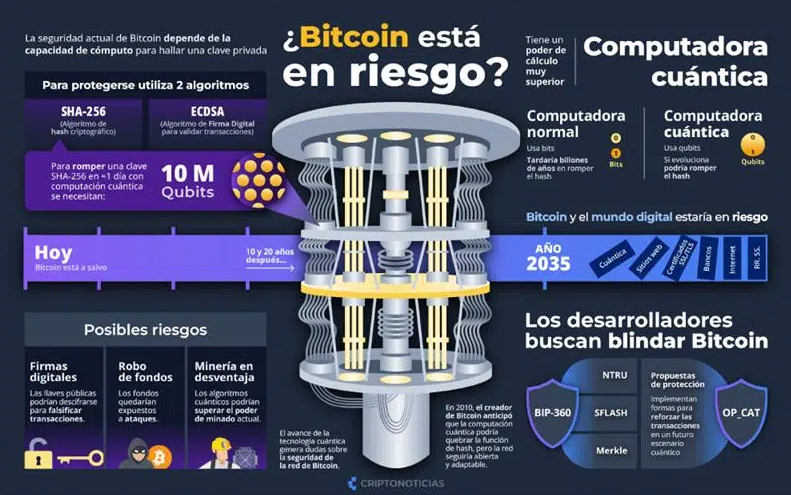
Adam Back, co-founder of Blockstream, even proposed the use of a NIST-approved quantum-resistant digital signature algorithm. to safeguard Bitcoin transactions.
For this reason, Karako stressed that the first step is not to «solve the quantum», but to understand what information exists, where it is encrypted and with what external providers.
Following the completion of the period ending January 7, 2026 and in response to Calcalistech, the Department of Banking Supervision noted that The entities are already sending their initial evaluations and that will be compared with emerging requirements and trends.