
Artificial intelligence has advanced by leaps and bounds, but it still cannot compete with the thought of a real student. It has made it clear a recent experiment in France, where Chatgpt was tested with an exercise in high school philosophy.
The result was disappointing, since The chatbot obtained 8 out of 20. The teacher in charge of correcting him was overwhelming and said that «A student would have done much better»he concluded.
This case disassembles part of the apocalyptic discourse that surrounds the generative AI in the educational field. Although it is repeated that it will eliminate thousands of jobs and transform education as we know it, the reality is that it still does not reason like humans.
While it may sound convincing in A technology that can write without spelling faults And with well -armed phrases, but when it comes to arguing with depth, analyzing abstract ideas or responding with criteria, a long stretch is still missing.
A test that evidenced artificial intelligence
The France 3 Hauts-De-France Editorial team decided to test whether a chatbot like Chatgpt would be able to write a philosophical essay with sufficient level to approve an access exam to the university.
It should be noted that the theme chosen was: «Is it always convincing truth?» They were given precise instructions for the text to seem written by a 17 -year -old student, following the three -part classical structure.
In the end, The AI delivered its answer in seconds And, at first glance, the result seemed correct, with well -formed phrases, an orderly format, as well as a tone that could pass through a student.
However, that impression soon faded, since with a more detained reading, The teacher could easily identify the weaknesses of the text. Beyond formal errors, there were deep failures in the understanding of the subject and in the focus used.
The first thing that caught the attention was that Openai’s chatbot did not respond directly to the question raised. Instead of developing the issue, is it always convincing truth? Chatgpt rewritten the prompt as Is it enough truth to convince?
For the teacher, this little change already showed that the system had not understood what was asked. And it is not an isolated failure, since these types of errors are frequent in language models. They work from statistical patterns, not real understanding.
Therefore, even if they sound convincing, many times they do not understand the deep sense of a slogan or are able to clarify an idea as a human would do. Philosophy, which requires precision in the approach and conceptual clarity, exposes those limitations.
Incoherent arguments and lack of depth
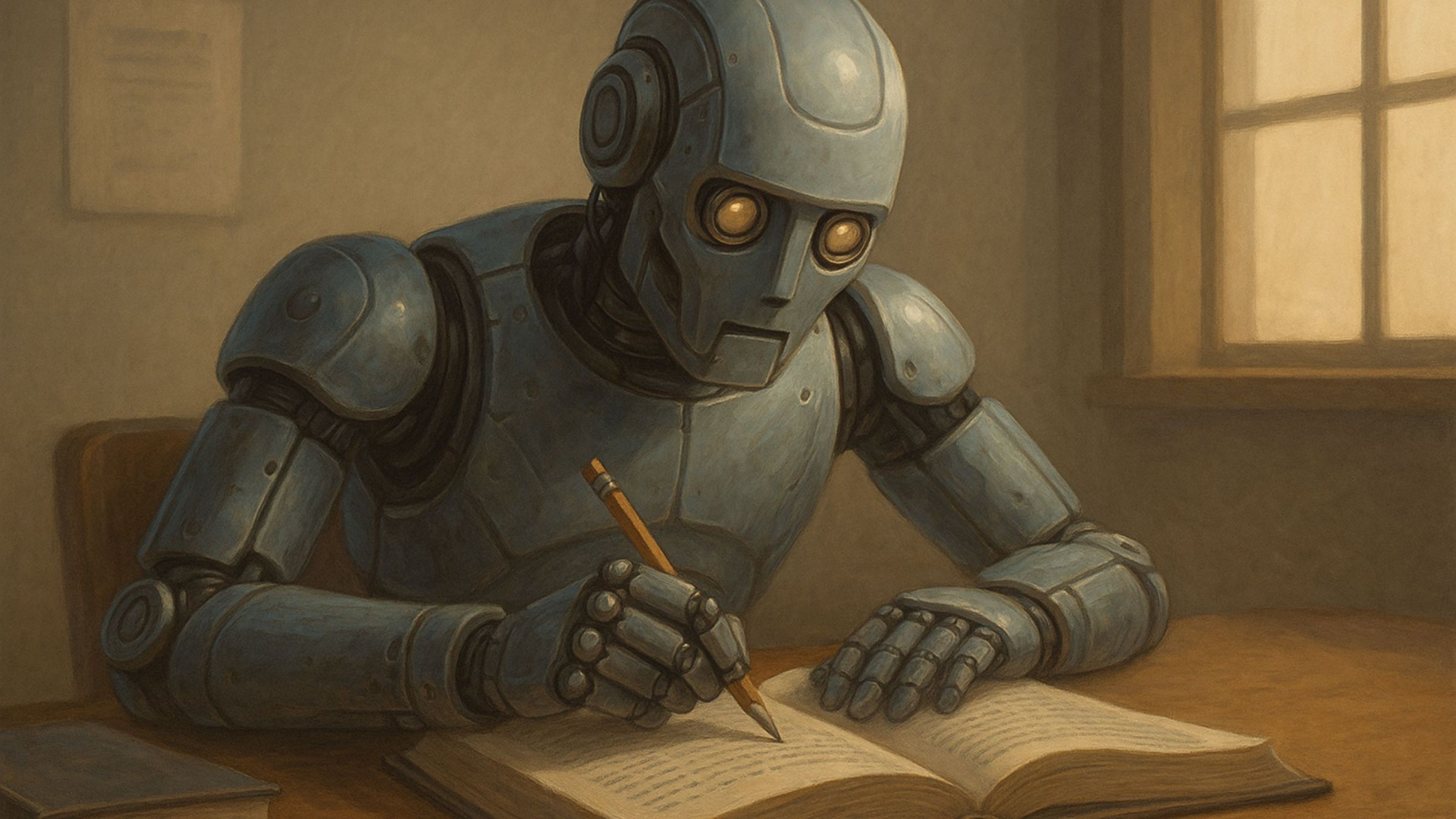
Generated with Ia
Beyond the initial error, The development of the text either convinced. The structure was there, yes, but the content was weak. According to the teacher, the arguments were vague, ideas were barely sustained and there were no relevant examples that allowed progress in reasoning.
Instead of a progressive and nuanced reflection, the trial stayed on the surface, repeating general formulas and statements.
This is an example that AI can write fluently, but not always meaning. In disciplines such as philosophy, where a logical construction of ideas is expected, the result falls short. Writing fast is not writing well, much less reasoning.

The final note was 8 out of 20 That, according to the teacher, it is below the level that would be expected from a real student. But the most curious thing is that when the AI was asked that self -assessment was described with a 19.5 out of 20.
It should be noted that this total lack of self -criticism is not only ironic, but perfectly illustrates one of the most obvious weaknesses of these intelligent systems, which can imitate the form, but do not understand the background.
They do not calibrate the impact of what they write or anticipate how it will be interpreted, so in the absence of real awareness and reflection, their criteria is limited. And that makes them unreliable in contexts where thought matters as much as the way of expressing it.
Know How we work in NoticiasVE.
Tags: Artificial intelligence