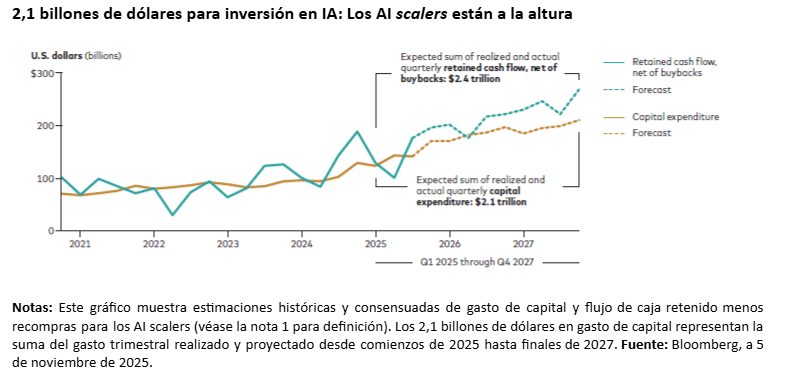
Hoy, The capital investment cycle for AI remains in its early stages, reflecting the trajectory of historic expansions. Contrary to popular narratives that present investment in AI until now as a phenomenon exclusive to the technology sector, this has been broad and has touched almost every corner of the economy. However, the path ahead will be different. The next phase will depend on the so-called “AI scalers”which seek to achieve a quantum leap in the capabilities of generative AI. These deep-pocketed AI scalers appear capable of meeting their historic investment commitments of 2.1 trillion dollars until 2027.
Nevertheless, Investments of this magnitude will increasingly require a wide variety of financing channels, including leases, public and private credit, and various types of equity issuances. This phase of the investment cycle, which will likely unfold over the next three to five years, will be a double-edged sword. On the one hand, it will push the economy to replace old tools with new ones, what economists call “capital deepening.” But it will also present an increasingly narrow investment landscape, in which investors will find it difficult to avoid risks linked to the success of this generation of AI investments.
A general purpose technology (GPT) needs capital deepening
Since the launch of ChatGPT in late 2022, investment in AI has contributed approximately $250 billion to the US GDP. While this nominal figure may seem high, historical comparisons offer perspective: as a percentage of GDP, the current AI capital investment cycle closely tracks the trajectory of past capital expansions.
From the railways of the 19th century, through industrial expansion after World War II, to the Internet and personal computers in the 1990s, the arrival of general purpose technology (GPT) has been accompanied by a process of capital deepening that requires significant investments in the new tools.
We hope that AI is no exception. Our analysis of reference periods suggests that these historical expansions peak after several years, typically in a window of four to six years. By this measure, the current AI cycle would still be in early stages, around 30–40% of historical peaks.
Previous expansions have also transformed the structure of companiesestablishing new standards and regulations and redefining competitive landscapes in many, and even most, sectors. For example, the expansion of telecommunications and the Internet led to the approval of the Telecommunications Act de 1996 y la Digital Millennium Copyright Act, laws that contributed to deregulate telecommunications markets, foster competition and provide new legal protections for the digital age.
Although the dBroader architectural developments are difficult to measure in real timewe consider that they are still forming in the case of AI, as evidenced by current debates on regulatory and governance standards, as well as the evolution of competition and sector dynamics.
The current investment cycle has broad economic support
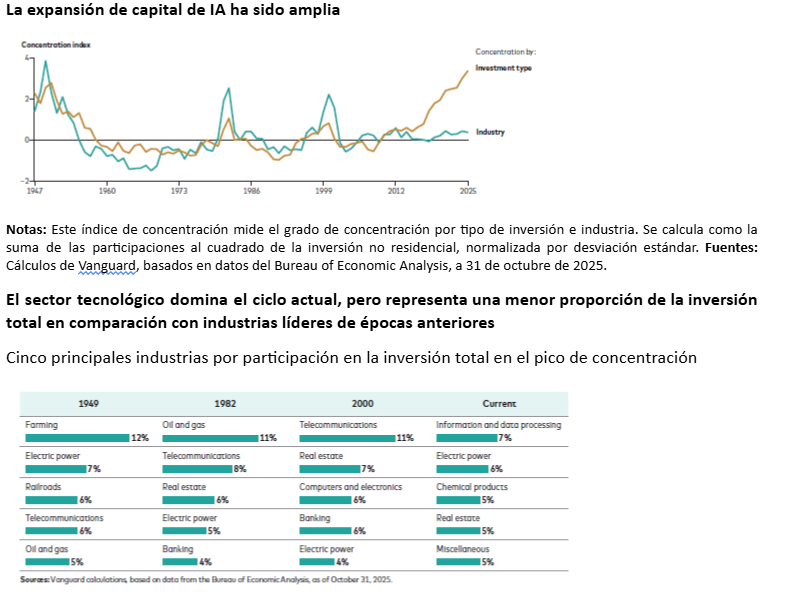
Despite the media attention on AI, investment so far has been broad, with participation from numerous sectors. This contrasts with the peaks of previous historical expansions, when investment was dominated by a small set of actors or sectors.
This distribution balanced sector indicates that there are still phases to go through. Although the technology sector is leading the process, its participation remains far below historical levels. In previous expansionsthe dominant sectors often represented double-digit percentages of the total invested as their contribution intensified. Today, The information and data processing sector represents only 7% of non-residential investment in the US economy.
From approximately 2017capital spending has primarily focused on intangible investments in software, computers and related equipment. Today, approximately 25 cents of every dollar invested goes into these intangible categories. As the capital deepening needed to support AI accelerates and matures, with tangible investments in data centers, energy production and semiconductor manufacturing, we expect investment to diversify beyond intangibles focused on software.
Although the next phase will depend on the AI scalers, it still has a way to go
The next phase of the expansion will increasingly rely on AI scalers in several ways– To provide computing power, data storage, and frontier models needed for large-scale applications.
The first dependence is the magnitude. Looking at past capital deepening cycles, AI scalers would be required to meet the $2.1 trillion investment commitments planned to date. The investment of AI scalers in data centers represents a decisive factor in the next phase of the AI investment cycle.
The second dimension is the type of investment. As the construction of AI data centers will likely make up the majority of AI-related capital investment, a smaller set of sectors of the economy are expected to be involved: AI chip manufacturers, specialized labor for construction and equipment, utilities (to generate electricity), and real estate close to existing power grids.
Overall, the implications for the economy and markets are clear: we are closer to the beginning than the end of this AI investment cycle.
The last relevant dependency, and possibly the most important, is the evolution of corporate fundamentals of AI scalers. As these companies look to surpass historic expansions, a natural question arises: Are they going overboard to finance such large investments?
Our baseline view is that AI scalers do have the resources necessary to finance these investments, thanks to the combination of large cash reserves, strong balance sheets and business models that provide deep competitive advantages and consistent revenue growth. In fact, market consensus suggests that AI scalers will continue to be profitable enough to more than cover the expected $2.1 trillion between 2025 and 2027.
Although these companies can finance the next phase of expansion, the historical magnitude of these investments will increasingly favor diversification of risk through different financing channels. In the second half of 2025 alone, we have seen an increase in popularity of leasing (often with credit guarantee), the use of private and public credit markets (both investment grade and high yield) and creative financing by suppliers, partially taking advantage of the favorable valuation of certain key companies in AI investment. Mindful of the market expectation to continue to deliver on revenue growth – a multi-year trend – AI scalers will become astute operators of their funding capabilities, likely utilizing most (if not all) available channels to maintain their growth trajectories.