
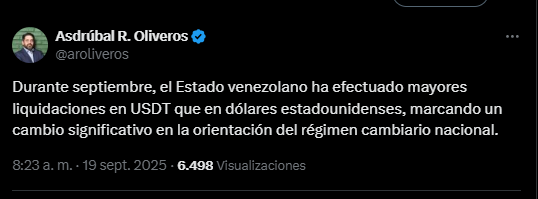
The Venezuelan State is taking a turn in its exchange strategy, making more liquidations in the stablecoin tether (USDT) than in US dollars. This was revealed by the economist and consultant Asdrúbal Oliveros, who highlighted the «transcendental change» that is happening in the Venezuelan exchange market.
This turn, driven by inflation and the devaluation of the bolivar, represents a drastic transformation that redefines the national financial landscape. ”The change, initiated two months ago, implies that The government assigns USDT directly to key companies Through two authorized platforms, instead of dollars through banks, as was the case at traditional auctions since 2019, ”Oliveros explained in a recent radio interview.
The economist pointed out that, although the traditional mechanism of dollars auctions through banking is maintained, the liquidations in this currency have decreased significantly. In contrast, «the government is receiving part of its payments in USDT and assigning those USDT to key companies.»
According to Oliveros, this direct USDT allocation is carried out weekly through two applications authorized by the Venezuelan State, which has encouraged numerous companies to adopt this stablecoin.
This preference for USDT marks a before and after in the economy, promoting companies and individuals to adapt rapidly. However, from the perspective of some, Doubts persist about the mass adoption of this digital assetsince it represents a technological barrier for certain sectors of the population, as recently reported cryptootics.
Shortage of traditional currencies promotes the adoption of USDT
The truth is that this change in the economy occurs in a country where the use of Bitcoin (BTC) and cryptocurrencies increases, acting as a shield against inflation, the constant depreciation of the bolivar and the scarcity of currencies of the traditional financial system.
For years, people and shops have resorted to digital assets for payments, savings and remittances, seeking stability and efficiency in a volatile economic environment. However, direct state intervention in USDT settlement introduces a new dynamic with immediate implications.
Aníbal Garrido, director of the BT & C Academy of the Andrés Bello Catholic University (UCAB), who participated together with Oliveros in the Radial Program, highlighted the advantages of USDT. He underlined the speed of transactions, which are completed «in a matter of seconds», overcoming the slowness of the Swift system and significantly reducing commissions.
«It is possible to transfer hundreds of billions of USDT or their equivalent in dollars for barely cents or a fraction of USDT,» said Garrido. For this reason, many Venezuelans prefer the use of stablcoins such as USDT, which offer an economic alternative to make transactions.
The current state allocation massifies its use at the corporate level, forcing companies to face a rapid learning curve on how to manage, register and fiscally declare these assets.
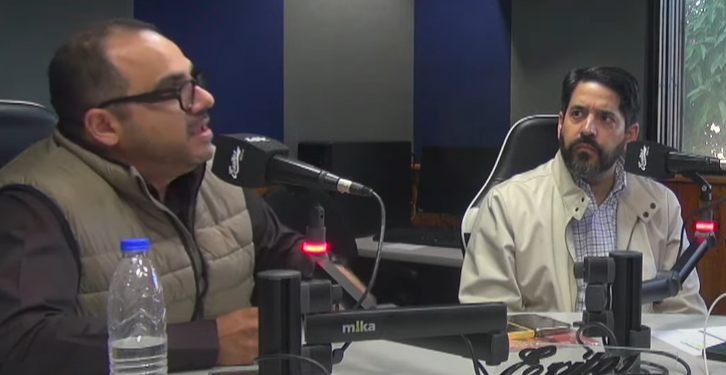
Garrido mentioned that there are peer-to-peer (P2P) payment platforms and two exchange houses in Venezuela, authorized by the State, which allow companies and natural people to change cryptoactive to bolivars in real time.
They stressed that banking and homeland platforms are the only officially authorized by the Venezuelan State to operate as cryptocurrency exchanges. However, it should also be taken into account that Crixto and Binance Pay allow payments with USDT to Bolivars in shops in the country, as Cryptonoticia reported in August.
Garrido stressed that «the use of cryptoactive is legal in Venezuelan territory,» backed by the BA Ven-Nif No. 12 (version No. 0) that is the «accounting treatment of the possession of own cryptoactive.»
This document, approved on February 15, 2020, establishes the accounting criteria for the recognition, measurement, presentation and revelation of digital assets (such as Bitcoin or USDT) in the financial statements of companies and natural persons in Venezuela.
For all this, this sudden change forces companies to train and educate themselves about the use of bitcoin and cryptoactive.
«The key, both for the business sector, the private sector, the public sector and for people, is that before starting to handle this type of money, they are informed, manage and educate it,» concluded Garrido, emphasizing the importance of education to take advantage of this emerging financial tool.