
Bitcoin (BTC) is going through a phase of technical and structural contraction which has altered its market behavior since the end of January 2026.
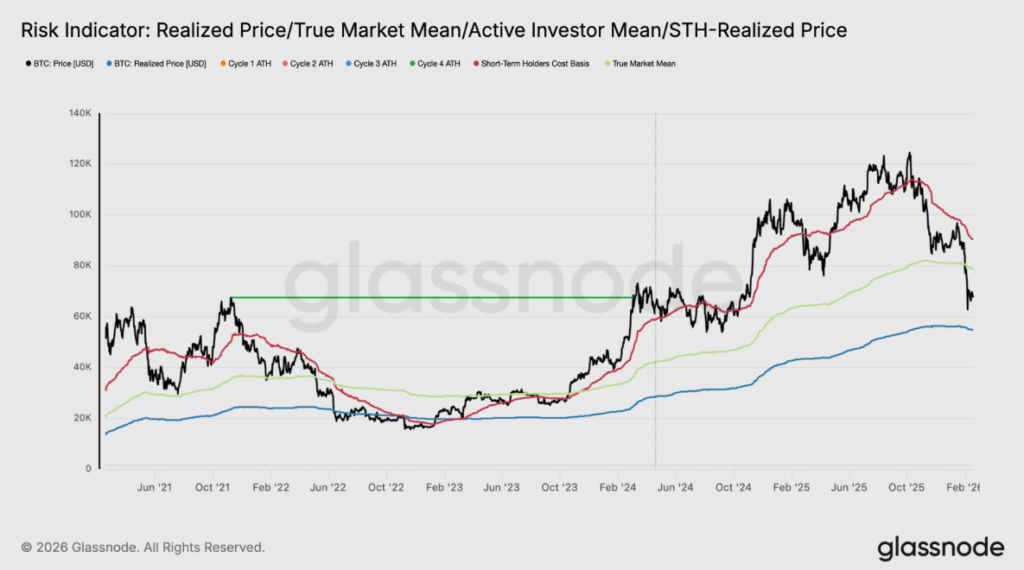
According to the most recent report from the analysis firm Glassnode, published on February 18, 2026, The digital asset has lost critical support by falling below the true market average (True Market Mean), currently located close to $79,000.
It is worth clarifying that the real market average is an on-chain analysis indicator that estimates the average acquisition cost of active investors, excluding capital paid to miners. This metric seeks to show a “fair price” or equilibrium point for those currently operating in the market; Therefore, when the price of bitcoin falls below this level, it is considered that the asset has lost its conviction support.
This move marks the beginning of a «defensive range» where selling pressure predominates and institutional liquidity, which months ago boosted the price, shows signs of exhaustion.
The current scenario places the coin between two pillars of on-chain valuation: the resistance of $79,000 and the realized price, which acts as the lower structural limit around $54,900. The average acquisition cost of all bitcoin in circulation is called the “realized price,” valuing each unit at the price it had the last time it moved through the network rather than its current market price.
According to Glassnode, CryptoVizArt analysts Chris Beamish and Antoine Colpaert, in the absence of a significant macroeconomic catalyst, it is highly likely that this price range “defines the medium-term outlook” for investors.
A market “under pressure and in range”
The loss of the true market average is not a minor event. In previous cycles, its breakdown has given way to prolonged periods of compression. Glassnode describes the current situation of bitcoin as “under pressure and in range”, highlighting that the price is in an absorption stage.
Despite the drop, the report reveals that there is a significant demand pool between $60,000 and $69,000. This zone, formed during the first half of 2024, is serving as a buffer.
On-chain data suggests that holders who acquired their coins in that period have maintained their position for more than a year, showing resilience that has avoided a larger impulsive drop. However, Glassnode analysts warn that defending this level suggests a transition toward consolidation, rather than an imminent rebound.
Weakness in the accumulation and outflow of institutional capital
One of the most critical points that the report that NoticiasVE is reviewing points out is the behavior change in large wallets.
The accumulation trend index (ATS), which weights the movements of entities with the greatest capital, shows a «fragile» balance. After the drop to $79,000, the market moved from an aggressive distribution to a neutral state (close to 0.43).
For bitcoin to resume an upward path, Glassnode states that “a sustained recovery would require renewed accumulation of large entities.”
For now, that conviction is not evident in the Bitcoin network data. Added to this is that overall liquidity remains limited. The ratio of realized profits and losses (90D) is stuck between 1 and 2, a level that historically characterizes stress phases where capital turnover slows down.
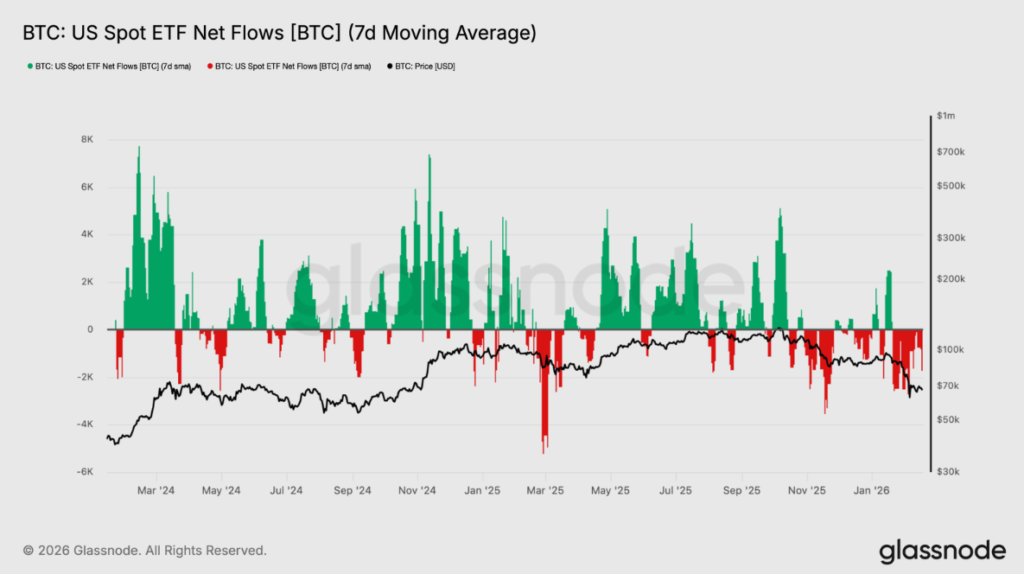
At the institutional level, the outlook is not more encouraging. Bitcoin ETFs (exchange-traded funds) in the United States, which were the driving force of the market during the rise to highs, have reversed their trend. The Glassnode report highlights:
ETF flows have turned into persistent outflows again, removing a key structural supply. Institutional demand no longer cushions the falls.
Glassnode, on-chain analytics company.
The following graph shows how capital outflows in bitcoin ETFs have increased:
Bitcoin derivatives: from panic to caution
Despite the bearish tone in the spot market (spot), the derivatives sector shows signs of stabilizationalthough not necessarily bullish. Implied volatility and risk premium have begun to normalize, suggesting that the “forced covering phase” following the initial sell-off is behind us.
The asymmetry (skew) of options, which measures demand for downside protection, fell from 20% to 11%. While this indicates that extreme fear has dissipated, traders still prefer to cover the downside rather than bet on explosive rises.
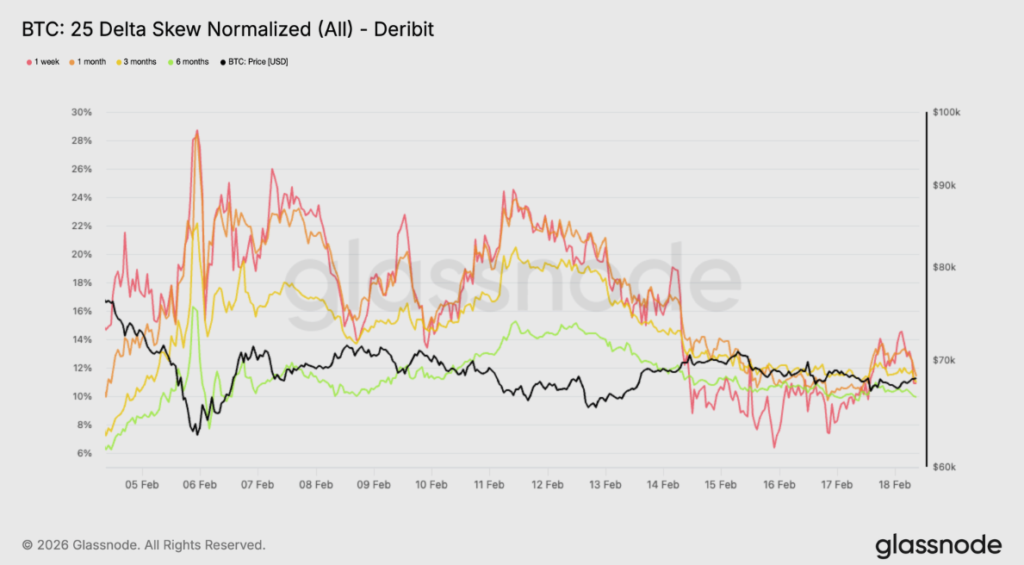
According to the Glassnode report, the market has moved from panic-driven reactive flows to “controlled consolidation.”
The market no longer foresees an imminent collapse scenario, but instead reflects expectations of consolidation, with volatility contained in a narrower range.
Glassnode, on-chain analytics company.
Bitcoin seems destined for a period of dormancy
The Glassnode report concludes that bitcoin is in a structurally defined corridor. Success in the coming weeks will depend on its ability to stay above the realized price of $54,900 and the ability of buyers to absorb the supply in the $60,000 area.
For Glassnode analysts, the conclusion is clear: The current structure is defensive in nature.
As long as spot CVD remains negative on platforms like Binance and Coinbase, the market bias will remain vulnerable. Only a stabilization in capital flows and an improvement in liquidity conditions will allow the resistance of the real market average to be broken.
This improvement in liquidity conditions could occur, for example, if there were clear signs of a reduction in interest rates in the United States by the Federal Reserve (FED). These signs have not yet been given despite the nomination of Kevin Warsh (an ally of President Donald Trump) to preside over the body.
Until those factors align, Glassnode assures that bitcoin seems destined for a period of technical lethargy where «absorption within a defined range between the main valuation pillars remains the dominant structural theme.»