
Bitcoin mining is going through a moment of profitability crisis and miners in Latin America were consulted about their strategies to address the current market situation. They all agree to maintain their positions in BTC.
A direct measure of this pressure on income is translated into hashprice: a metric that measures the daily profits generated by each unit of computing power (hashrate) contributed to the network.
The higher the price of BTC and the lower the mining difficulty, the higher the hashprice; at a lower price or greater difficulty, lower. This last scenario is currently occurring: BTC price in a downward trend and a final difficulty adjustment that pushed it up 15%, making it more complex to mine a Bitcoin block.
After hitting an all-time low of $27 per petahash per day (USD/PH/day) on February 24, the hashprice had rebounded to $32/PH/day on March 4, when BTC surpassed $74,000.
With the new drop in the value of BTC to the USD 69,000 area, the hashprice sank again on March 6. At the time of writing this note, that measurement stands at 29 USD/PH/day returning to historically low levels. This downward movement in the hashprice implies a decrease of almost 10%.
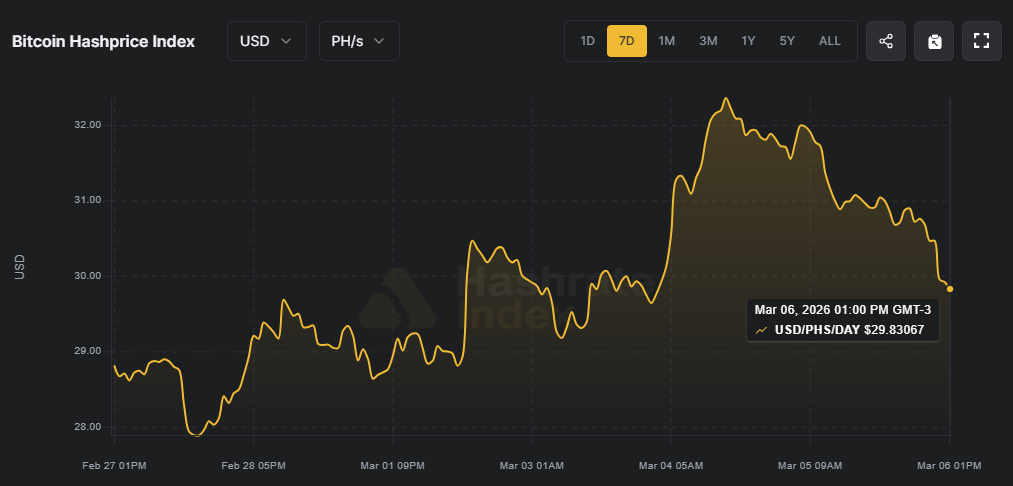
For miners, that 10% drop in hashprice directly translates into less income for the same computational effort.
In this context of profitability crisis, a report shared to NoticiasVE by the ViaBTC mining pool team consulted operators from its own structure and from other pools about their current strategies.
Junior Pérez, co-founder of 21 Bitcoin Academy: finance expenses with fiat
Junior Pérez, a Venezuelan living in Costa Rica and co-founder of 21 Bitcoin Academy, along with his partners, projected that BTC price could go through a negative trend.
Based on this analysis, they made a preventive decision: keep mining operations stable and generate income in fiat currency through other businesses to pay operating bills, without touching the accumulated BTC.
The logic behind the strategy is simple: spend fiat money and keep as much BTC as possible, under the conviction that BTC revalues better than the dollar in the long term.
The 21 Bitcoin Academy project is based in Costa Rica, where they manage a BTC mining farm with dozens of ASICs.
21 Bitcoin Academy, as reported by NoticiasVE, is a Latin American educational platform focused on Bitcoin, mining, self-custody and financial sovereignty.
Kike Miner, CEO of MinedMap: collateralized loans
Kike Miner, also Venezuelan, is the CEO of MinedMap, a company dedicated to Bitcoin mining, especially hosting and equipment operations located in Latin America, with an emphasis on Venezuela.
Kike shares the logic of preserving BTC, but adds a specific financial tool: collateralized loans.
The mechanism consists of depositing Bitcoin as collateral with a lender, in this case it mentions ViaBTC, among others, to obtain stablecoins or fiat money without having to sell the assets.
In this way, Kike Miner and his company cover operating expenses without parting with your BTC at a time of low prices.
The specific advantage of the mechanism used by Kike Miner is that the miner retain ownership of your BTC throughout the life of the loan.
If the price of Bitcoin rises in the meantime, recovering the collateral will cost you exactly the same as when you requested it (the loan amount plus the agreed interest), regardless of how much the asset has appreciated in that interval. However, collateralized loans are not risk-free. If the price of Bitcoin falls below a threshold defined by the lender (known as the liquidation level), the borrower may receive a margin call: a demand to deposit more BTC as additional collateral or to return part of the loan immediately.
«Bitcoin is always a good investment in the long term and miners are the first in line to take this business model into account,» said Kike.
In addition to the loans, the CEO of MinedMap recommends cutting unnecessary expensesevaluate the acquisition of new equipment according to available liquidity and take advantage of difficult readjustment moments to increase production.
Vakano, CEO of Horeb Energy: bullish and non-stop
Another of the Latin miners who shared their strategy was Arley Lozano, the CEO of the company Horeb Energy, also specialized in Bitcoin mining and energy solutions related to cryptocurrencies in Latin America, focused on Colombia.
Lozano, for his part, was more optimistic. According to him, he and his partners they continue mining without interruptionssupported by a long-term bullish view based on Bitcoin’s price history.
In addition, Lozano projects that BTC will reach a million dollarsalthough it did not offer a time frame or analytical basis for that figure.
Like Kike, he also uses BTC-secured loans to cover short-term expenses while he waits for the next bullish cycle.
What about the largest mining companies in the US?
The current miners’ crisis also affects the largest companies in the industry. In this context, many of these companies are redirecting resources towards the artificial intelligence (AI) sector.
They do so in search of more predictable income than that offered by Bitcoin mining, subject to price volatility and periodic network difficulty adjustments.
For example, MARA Holdings (MARA), one of the most relevant public Bitcoin mining companies in the US, recently confirmed that it will continue selling BTC to finance its business expansions, as reported by NoticiasVE.
Finally, Auradine, one of the largest US Bitcoin ASIC equipment manufacturers, refocused its business entirely on AI, shifting its exclusive focus on mining.