
The Bitcoin network recorded its largest negative adjustment to mining difficulty since July 2021, when China’s mining ban forced a significant portion of the global hashrate offline. This adjustment represents the tenth largest negative adjustment in the network’s history.
Bitcoin mining activity in the Asian country was dismantled after Beijing’s regulatory offensive, which caused a massive migration of mining operations to destinations such as North America, Europe or other areas of Central Asia, such as Kazakhstan, inducing downward adjustments in difficulty that exceeded 20% in several cases.
Since that event, there had not been a decline of comparable magnitude in a single adjustment cycle. Yesterday, February 7, 2026, the difficulty fell 11.16%going from 141.67 T (trillions or billion) to 125.86 T.
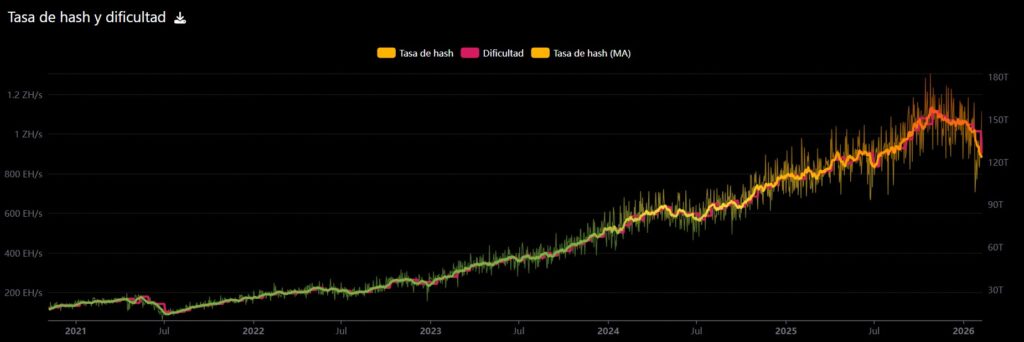
Let us remember, as we analyzed in NoticiasVE, that the adjustment of the difficulty level is an instrument that ensures the inelasticity of the currency supply, by limiting the increase in issuance when the price rises and more miners connect to extract profitability from the activity. In this way the emission rate is maintained. No other commodity and no metal has a similar property
Impact of the cold wave and economic pressure
Bitcoin mining is going through one of its most complicated moments in years. Since its all-time high of $126,000 in October 2025, the price of bitcoin has fallen nearly 50%, hitting lows below $63,000 last week, which — added to the severe cold wave in the United States that increased energy consumption — has put pressure on production costs and forced many miners to disconnect equipment, as reported by NoticiasVE.
As a result, the profitability of much of the fleet approached or even fell below the shutdown price, leading to a hashrate reduction of up to 20% and the largest negative difficulty adjustment since the 2021 Chinese ban. This indicator represents the level of the bitcoin price at which the income generated by a mining rig They exactly match their operating costs, mainly considering electrical consumption.
When the price operates below this threshold, the teams enter negative unrealized profitability, that is, the miners operate at a loss.
As a result, the hashrate fell from levels close to 1.1 zettahashes per second (ZH/s) to lows around 800 exahashes per second (EH/s) during the most critical days of the storm in January 2026. Subsequently, the hashrate has partially recovered to around 1.0–1.06 ZH/s, reflecting that many operators continue to keep their facilities active despite the pressures.
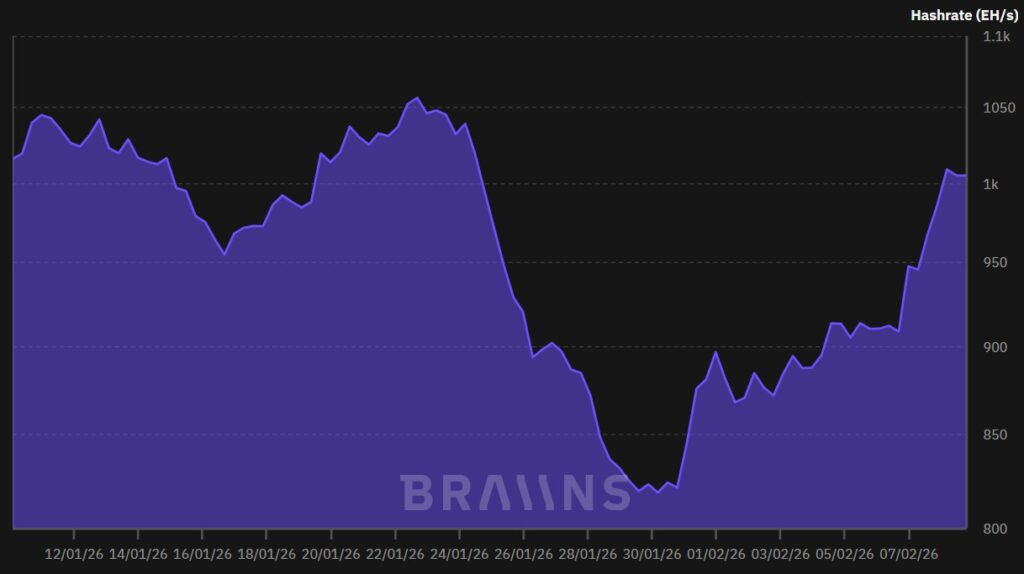
As a result of the gradual increase in hashrate, just after the adjustment of the difficulty level, it is estimated that within 2,016 blocks (or two weeks) the difficulty of mining Bitcoin will return to its previous level. What will prevent blocks from being mined faster than expected due to the increase in hashrate.
Partial recovery of Bitcoin hashrate
However, with the price of bitcoin at levels that continue to squeeze the mining economy, disconnecting unprofitable equipment has become an essential protective measure to preserve liquidity and avoid greater losses.
In fact, only four models of ASIC equipment continue to generate positive daily net income under current conditions, and only one of them operates with a comfortable margin. Among those still showing numbers in green stands out the Antminer U3S23H (or similar hydraulic variants of the S23 series), which records estimated net income of around USD 7–25 per day (depending on the exact price of BTC and energy costs).
This equipment delivers a massive hashrate of 1,160 TH/s (1.16 PH/s) with an electrical consumption of 11,020 watts, giving it outstanding efficiency (~9.5 J/TH) that allows it to remain profitable even in environments with electricity at USD 0.10 per kWh
Bitcoin Network Resilience
Miners have been shutting down unprofitable equipment to mitigate losses, which explains the hashrate drop and subsequent difficulty adjustment. However, Bitcoin mining does not affect the operation of the network: the protocol automatically adjusts the difficulty to maintain the pace of block production.
The Bitcoin protocol is designed precisely so that the network continues to function predictably and securely, regardless of variations in mining participation.