
-
What happens if someone embeds child pornography (PI) in Bitcoin, an immutable digital record?
-
A very wide op_return field will kill Bitcoin or is it just an FUD campaign?
The debate between Bitcoin Core and Bitcoin Knots continues. In this new episode, the confrontated sides raise the level of discussion to uncomfortable regions.
The «Anti-Spam» block, made up of developers and maximalists such as Luke Dashjr, Bitcoin Mechanic or Matt Kratter, speculate that Bitcoin Core version 30, which will be released in October, will bring serious network problems. Kratter in particular aggressively speculates that Core’s update is, or at least act, as A «state attack» of toxic garbage deployment in Bitcoin.
Following Bitcoin Mechanic, the first to propose the idea, Kratter alleges in a video summarizing the anti-SPAM block position that Core V30 will facilitate the use of Bitcoin as a repository of illegal content. In particular, like a warehouse that could house child pornography (PI) to evidence of criminal acts.
This result, apparently crazy, would be a consequence of a «waterfall effect», caused by developers who take with the Bitcoin protocol. Specifically, modifying its op_return limit, believes Kratter.
As Cryptonoticias reported, Bitcoin Core V30 will raise that limit to 100,000 bytes, which will allow the registration of a greater volume of arbitrary data (images, audio, text) in the blocks of the network.
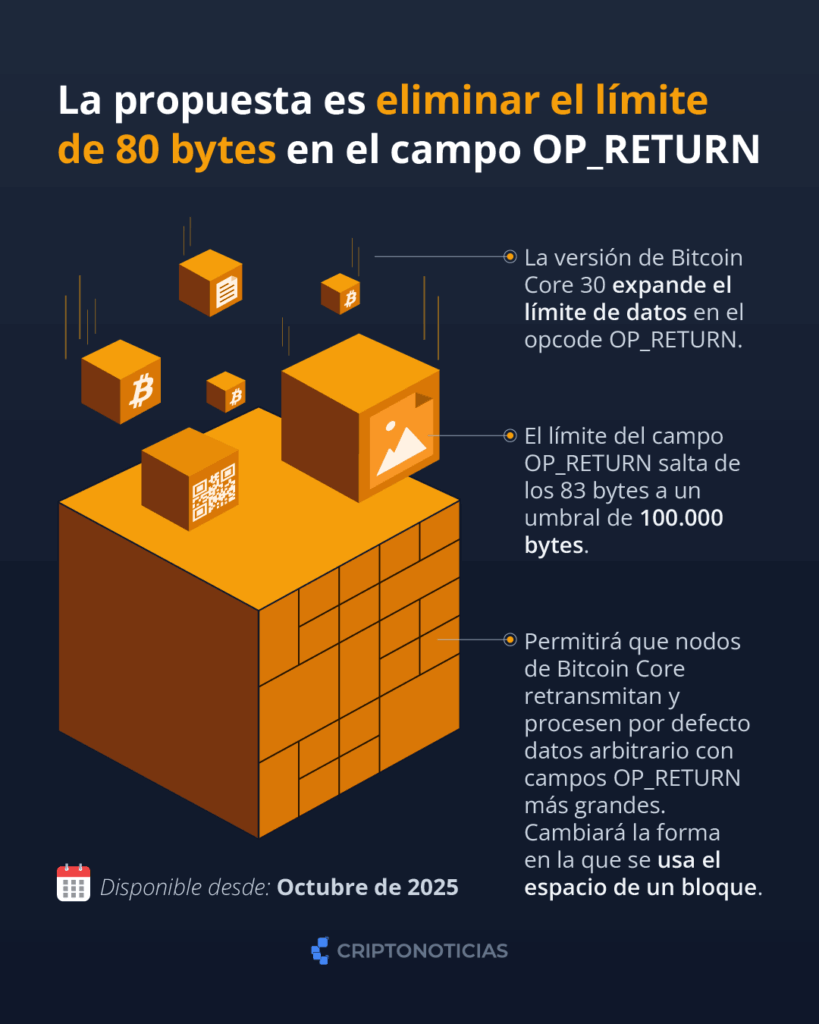
This modifies «the monetary essence» of Bitcoin, opening more space in the blocks for non -monetary uses. Potentially, Bitcoin could become a more complex database. Being a distributed and decentralized system, there is no way to reverse/denied a transaction (and its inscriptions) already included in a block.
The Bitcoin registration saved that it suffers some reorganization product of a mass attack (which is very unlikely), is immutable. None of the historical entries of that registry can be removed.
Thanks to this immutability, if someone enroll pornography in the op_return field of a transaction and is included and confirmed inside a block, there would be no way to eliminate that content. The nodes would be forced to transmit the transaction and their inscriptions, which could have legal consequences in some cases.
On the other hand, 100,000 bytes are many data. What will you do when these data contain confidential information, state secrets, highly classified information and other information whose possession is illegal?
Matthew Katter, Maximalist de Bitcoin.
So far, Kratter’s exhibition does not speculate or think. It speaks of plausible events, because there is no technical reason why you cannot register illegal content irreversibly in Bitcoin.
So what happens when the Bitcoiners begin to run the latest version of Bitcoin Core (V30) that opens the op_return and strength filters to each node to transmit this toxic garbage? Each node corridor becomes instantly guilty. (…).
Matthew Katter, Maximalist de Bitcoin.
The second part of its argument, speculative, tendentious and less important, alleges that the increase in the op_return field in the Bitcoin blocks is an attack against nodes by the State Police. The same one that is secretly orchestrating it to criminalize the network and its participants.
Each of the aforementioned bitcoiners defends the use of Bitcoin Knots, a client that uses an op_return filter by default of 40 bytes that would not be enough to register a single frame. Copilot, Microsoft’s AI, refers to In 40 bytes there are only 40 flat text characters or empty files with a minimal structure.
A typical image in an ultracompact format (such as JPEG) may require at least several hundred storage bytes. A video in Bitcoin is impossible.
This limit of 40 bytes is, therefore, restrictive and fulfills the mission to help «preserve» the monetary function of Bitcoin.
Figures that support Bitcoin Core and the relaxation of the Op_return filters issued their opinions about the ideations of the maximalists of Knots. None of them denies that Bitcoin could house illegal content with Bitcoin Core V30, and if they prefer to increase the op_return threshold instead of lowering it It is because they consider that the second represents a form of censorship.
That said, almost all the proponents of Core V30 consider that the illegal content is an FUD campaign by Knots.
For example, Jameson LOPP does not believe that a high op_return limit is able to kill Bitcoin, a possibility that Bitcoiners defeat such as Luke Dashjr and Bitcoin Mechanic. To support your denial, He quotes the case of Bitcoin SV, a spin-off de Bitcoin Cash Created by Craig Wright, also known as faketoshi.
When non -technical rhetoricians such as Bitcoin Mechanics elaborate narratives of fear, uncertainty and doubt (FUD), make naive mistakes such as forgetting to verify what other networks allow. If 100 kb of Op_return will kill BTC, how has BSV survived 5 years with 1 GB of op_return? Feel free to kill BSV to demonstrate your statement!
Jameson Race, Desarrollador de Bitcoin.
According to LOPP, then, a flexible limit will not kill Bitcoin.
For Francis Pouliot, the irreversibility of registering illegal content in Bitcoin does not imply a condemnation for the network. There are subsequent lines of defense that can draw miners and mining pools against this type of content. The developer considers that Bitcoin’s traceable nature It will allow Pools as Mara Banar users who transmit illegal content.
If I sent something really unpleasant as torrent links to Pi (or JPEG of Pi) or Mein Kampf (illegal in many countries), Mara could not deny plausibly that is publishing and distributing illegal content. It is right there in op_return so that everyone sees it. Consequently, they would probably not allow it. If they did, they would get into trouble. And it would be much easier for content senders to be trapped. If the non -standard nodes of nodes (that is, free relay) will begin to be abused by pedophiles, it is likely that their mining groups simply prohibited this type of peer of greater risk.
Francis Pouliot, developer of Bitcoin.
Consequently, Pouliot makes a prediction: mining pools will have no choice but to develop software to analyze the op_return field in transactions and evaluate what they will publish or not. These pools They could develop content moderation policiessince the illegality of the op_return content will be evident and will not have a plausible denial.
For Callebtc, an important Bitcoiner developer, the complaint about the possibility of registering Pi in Bitcoin is arbitrary. «Suddenly today they care about PI (rare), tomorrow perhaps for the financing of terrorism and next week for the lists of sanctions of the Ofac. They are losing the course. If you need a safe space, use PayPal, ”says Calle.
For him, Bitcoin must be an open economic market, and preserve this attribute It would be more important than making «pseudomoral» decisions.
Elian Huesca, a Mexican bitcoiner interviewed in the past by cryptootics, clarifies that the registration of material in the immutable stone of Bitcoin It is possible without the op_return limit updatebecause there is a plethora of ways to store non -monetary information in Bitcoin.
«The space in the blocks is agnostic and nature permissionless Bitcoin means that as long as any information is paid for that space, it can be stored, ”believes Huesca.
He considers that the debate between «monetarists» and «platformists» is political, not technical. Conciliator, he believes that after the found and controversial positions of both sides there would be a genuine interest in improving Bitcoin.
Both fields, monetarists and platformists want the best for Bitcoin according to their philosophical perspective of what Bitcoin should be to the future. The reality is that this is a political, non -technological debate.
Elian Huesca, Mexican Bitcoiner.
The Bitcoiner also believes that the discussion described in this text is illusory, false. The true discussion revolves around Bitcoin’s advance and its scalability in non -predictable scenarios, as in those of Bitcoin-Papel uses via the ETFs and the falls of transactions and commissions of miners, among others.