
BlackRock, the world’s largest asset manager, warned that the margin for future interest rate cuts in the United States is narrowing, in a context of persistent inflation and new pressures on energy prices.
The signal was given after the meeting held yesterday, March 19, 2026, by the Federal Open Market Committee (FOMC), in which The Federal Reserve (FED) kept the interest rate unchanged at 3.75% year-on-year, a decision that was already discounted by the market.
What generated the adjustment in expectations was the tone of the message from the president of the FED, Jerome Powell, as reported by NoticiasVE. The official acknowledged that the underlying inflation of the personal consumption expenditure (PCE) price index is at 3.0%. This is above the 2% target, and Powell stated that “on net, we are not making progress.” In addition, he warned that there will be no cuts if the economy does not show clear progress in the fight against inflation.
In that context, Nicholas Fawcett, an economist at BlackRock, noted that “the case for future rate cuts has weakened considerably.” As explained in a video published by the company, the combination of an economy that maintains a certain dynamism, persistent inflation and new shocks, such as the rise in energy prices amid tensions in the Middle East, reduces the probabilities of monetary flexibility in the short term. That’s why, He warned that “the window” to move towards that scenario “is closing.”
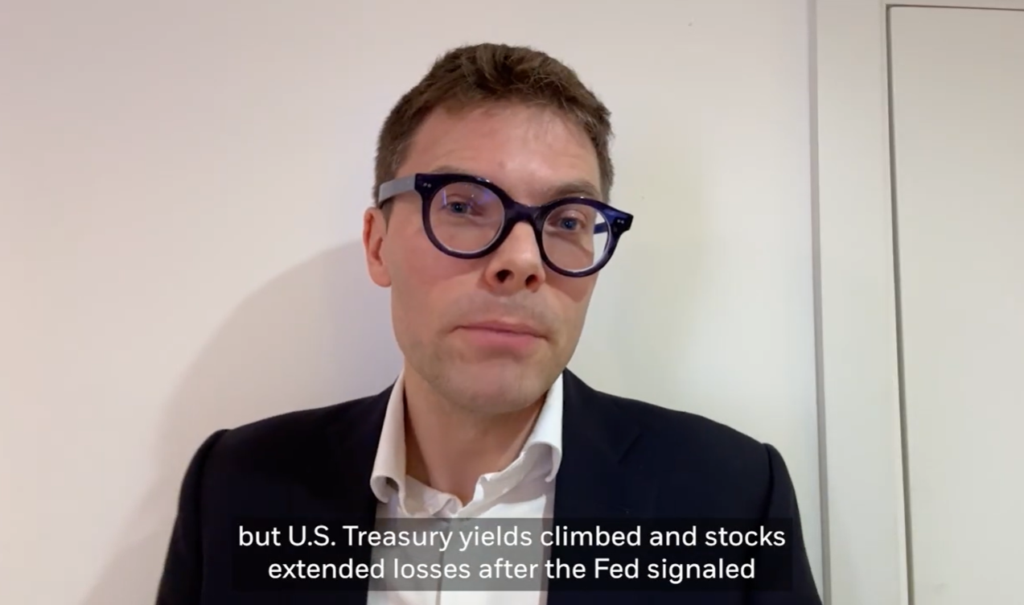
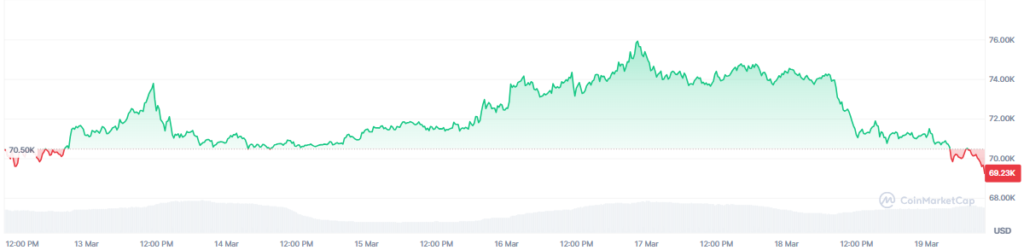
According to the firm’s analysis, financial markets have already begun to reflect this change in expectations. Following the FED’s decision, US Treasury bond yields rose and assets considered risky, such as stocks or bitcoin (BTC), turned red.
In the case of the digital currency, its price fell again below $70,000, as seen in the following graph:
The reason behind this market reaction is simple: higher rates imply more expensive credit, less liquidity and greater relative attractiveness of conservative instruments.
In this context, demand for more volatile assets is losing strength. Therefore, if the Federal Reserve suggests that cuts are still far away, The market interprets that the restrictive environment may extend longer than expected.
The report also notes that the FED’s new economic projections point to upward revisions in both growth and inflation, a factor that alone weakens the argument for more flexible policy. Added to this is that the labor market remains stable and shows no clear signs of deterioration.
For BlackRock, the energy factor will be decisive in the coming months. Not only because of the rise in crude oil itself, but because the conflict increased the risk in the Strait of Hormuz, a key passage for global energy trade through which nearly 20% of the world’s oil and liquefied natural gas circulate.
If this path continues to be interrupted or under threat, the rise in energy prices may translate into inflation and further weaken the argument in favor of monetary flexibility.
Another element of uncertainty is added to this scenario: the change in the leadership of the FED. Powell’s term as president ends on May 15, 2026, and Donald Trump has nominated Kevin Warsh as his successor. However, his confirmation is still delayed in the Senate, so the market is still He has no certainty about when he will take office or about the real margin he will have to change course.
Furthermore, we must not lose sight of the fact that there is uncertainty about when the Federal Reserve could begin a cycle of cuts. Inflation still remains above the target, rising energy prices add new pressures and The labor market does not show sufficient deterioration to force a rapid change in monetary policy.
For this reason, the market will closely follow the evolution of inflation, economic data and the impact of geopolitical factors. In that scenario, each signal from the Federal Reserve will be key to shaping expectations about monetary policy.