

If we talk about dividend kings one of the names that comes to mind is Chevron. The oil firm has had a solid compound annual growth rate of 7% over the past quarter century and an industry-leading 5% over the past decade. Expert analyzes have indicated that this growth could continue at least until 2030themselvesJoin Matt DiLallo on Yahoo Finance.
Chevron recently revealed its outlook through 2030. The oil giant foresees a annual growth greater than 10% both in his adjusted free cash flow as in their earnings per share until that year. These perspectives are based on the assumption that Brent oil (the world reference price) will be around $70 per barrel. While Brent is currently below that level (around $65), it has remained at or above $70 for much of this year.
That’s a solid growth rate for a company the size of Chevron. Of the 100 largest companies in the S&P 500, only 35 currently forecast greater than 10% annual growth in their earnings per share and free cash flow through 2027. Meanwhile, only nine of those companies have the financial strength of Chevron (a credit rating of AA- or higher). The oil company is the only company in that remaining group with a dividend yield greater than 4% (currently at 4.5%). This places the oil giant in a class apart thanks to its combination of growth, financial strength and profitability.
A look at the factors driving Chevron’s plan
He Chevron’s five-year plan is the result of hard work to transform the company into a free cash flow growth machine. Years of project execution and a series of strategic acquisitions, culminating in the acquisition of Hess This year, they have enabled the energy company to build a resilient, world-class portfolio with a diverse set of growth drivers that it expects to leverage over the next five years.
Most of your growth will come from your low-cost oil and gas operations in exploration and production. Chevron has a long list of expansion projects under construction or in development. The acquisition of Hess gave it a position in the prolific Bloque Stabroekoff the coast of Guyana. The joint development group led by Exxon Mobil (together with Chevron and the Chinese CNOOC) began its fourth development (Yellowtail) earlier this year. They have already approved three more projects (including the project Hammerhead of 6.8 billion dollars in September of this year), which will come into operation before 2029. They have another project in development (Longtail) which they plan to launch by 2030.
Guyana is not Chevron’s only growth engine. The company also has projects underway or in development in high seas in Africa, in the Mediterranean and in the Gulf of Mexico. Additionally, the company has a couple of refining and petrochemical projects under construction that should begin operations in 2027 (a petrochemical project in Qatar and a polymer project in the US).
Chevron is also developing several new energy platforms to complement its traditional fossil fuel businesses. You are building a green hydrogen project in the USA y an oilseed processing plant for biofuels. Additionally, it is developing a couple of carbon capture and storage centers, a lithium project and gas power solutions for AI data centers.
The company’s comprehensive approach helps reduce risk while strongly positioning it to meet its growth forecasts.
Ample potential to continue increasing its high-yield dividend
Chevron is an exceptional company that offers investors both solid growth and stable income. While oil prices can be volatile, the company has solid downside protection thanks to its diversification, a low breakeven point ($50 per barrel for its dividend and capital investment program), and a top-notch balance sheet. It also has significant growth potential thanks to its solid outlook, which should provide it with the necessary impetus to continue growing its dividend at a healthy pace. This combination of growth and income could give Chevron the ability to generate solid total returns over the next five years, making it a great stock to buy and hold at least through 2030.
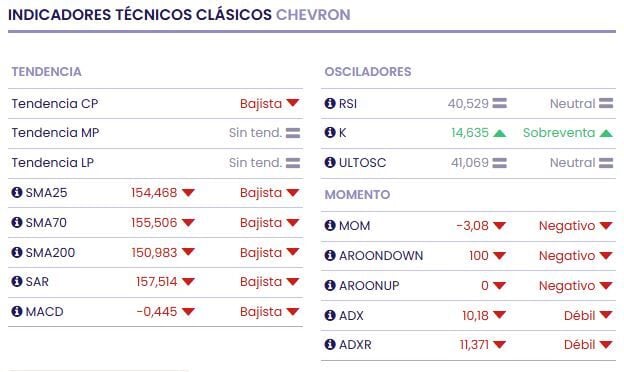
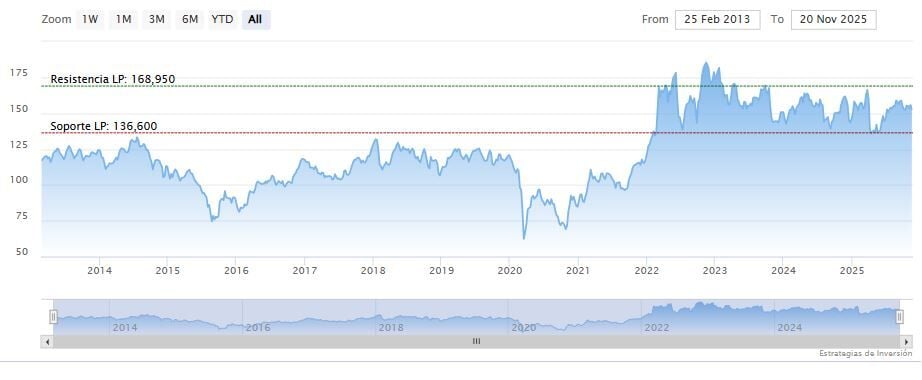
The 200-period moving average Chevron It is above the last candle, RSI is down at 40 points and the MACD lines are just below the zero level.
Medium-term support is at $148.89. Meanwhile, Ei indicators are mostly bearish.